
Homework Answers
Add Answer to:
When a shower is turned on in a closed bathroom, the splashing of the water on...
When a shower is turned on in a closed bathroom, the splashing of the water on...
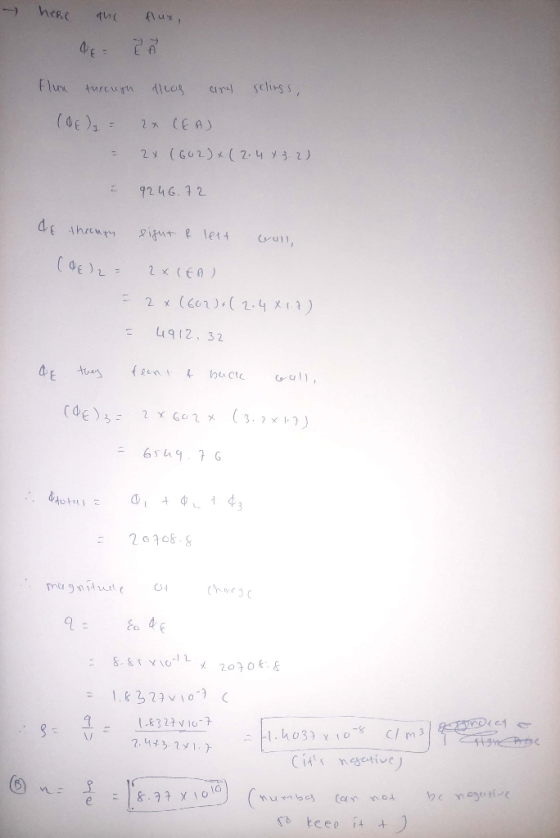
When a shower is turned on in a closed bathroom, the splashing of the water on the bare tub can fill the room's air with negatively charged ions and produce an electric field in the air as great as 1000 N/C. Consider a bathroom with dimensions 4.0 m ✕ 5.0 m ✕ 2.0 m. Along the ceiling, floor, and four walls, approximate the electric field in the air as being directed perpendicular to the surface and as having a uniform...
Question 1 The figure shows a closed Gaussian surface in the shape of a cube of...
 Question 1 The figure shows a closed Gaussian surface in the shape of a cube of edge length 2.80 m. It lies in a region where the electric field is given by E = (1.58x + 4.62 4.197.86 k N/C, with x in meters. What is the net charge contained by the cube? Number Units the tolerance is +/-590
The figure shows a closed Gaussian surface in the shape of a cube of edge length...
 The figure shows a closed Gaussian surface in the shape of a cube of edge length 2.1 m, with one corner at x1 = 4.8 m,y1 = 4.7 m. The cube lies in a region where the electric field vector is given by Ě = -3.2 ì -4.0 y2 +2.4 Â N/C, with y in meters. What is the net charge contained by the cube? *1 -- Number Number 1 Units Units
The figure shows a closed Gaussian surface in the shape of a cube of edge length...
 The figure shows a closed Gaussian surface in the shape of a cube of edge length 2.0 m, with one corner at X1 = 4.6 m,y1 = 4.3 m. The cube lies in a region where the electric field vector is given by E- 341-3.0 yj +2.8 N/C, with y in meters. What is the net charge contained by the cube? Number Units the tolerance is +/-590
What is the difference in between conductor and insulators? Write with necessany figures and examples of...
 What is the difference in between conductor and insulators? Write with necessany figures and examples of electrostatic charging by Induction? What is conservation of Charge? 1. Problem-1: Find the charge (Q) of a system having 1000 electrons? Explain the electric field produced due to a positive and negative point charges separately with necessary figures? 2. Problem-2: Calculate the electricfield (E) at a field point of 0.2 μm from a point charge q 10 pC? 3. What is electric dipole moment?...
What is the difference in between conductor and insulators? Write with necessany figures and examples of...
 What is the difference in between conductor and insulators? Write with necessany figures and examples of electrostatic charging by Induction? What is conservation of Charge? 1. Problem-1: Find the charge (Q) of a system having 1000 electrons? Explain the electric field produced due to a positive and negative point charges separately with necessary figures? 2. Problem-2: Calculate the electricfield (E) at a field point of 0.2 μm from a point charge q 10 pC? 3. What is electric dipole moment?...
Consider a cylindrical capacitor like that shown in Fig. 24.6. Let d = rb − ra...
 Consider a cylindrical capacitor like that shown in Fig. 24.6. Let d = rb − ra be the spacing between the inner and outer conductors. (a) Let the radii of the two conductors be only slightly different, so that d << ra. Show that the result derived in Example 24.4 (Section 24.1) for the capacitance of a cylindrical capacitor then reduces to Eq. (24.2), the equation for the capacitance of a parallel-plate capacitor, with A being the surface area of...
 Question 1 The figure shows a closed Gaussian surface in the shape of a cube of edge length 2.80 m. It lies in a region where the electric field is given by E = (1.58x + 4.62 4.197.86 k N/C, with x in meters. What is the net charge contained by the cube? Number Units the tolerance is +/-590
 The figure shows a closed Gaussian surface in the shape of a cube of edge length 2.1 m, with one corner at x1 = 4.8 m,y1 = 4.7 m. The cube lies in a region where the electric field vector is given by Ě = -3.2 ì -4.0 y2 +2.4 Â N/C, with y in meters. What is the net charge contained by the cube? *1 -- Number Number 1 Units Units
 The figure shows a closed Gaussian surface in the shape of a cube of edge length 2.0 m, with one corner at X1 = 4.6 m,y1 = 4.3 m. The cube lies in a region where the electric field vector is given by E- 341-3.0 yj +2.8 N/C, with y in meters. What is the net charge contained by the cube? Number Units the tolerance is +/-590
 What is the difference in between conductor and insulators? Write with necessany figures and examples of electrostatic charging by Induction? What is conservation of Charge? 1. Problem-1: Find the charge (Q) of a system having 1000 electrons? Explain the electric field produced due to a positive and negative point charges separately with necessary figures? 2. Problem-2: Calculate the electricfield (E) at a field point of 0.2 μm from a point charge q 10 pC? 3. What is electric dipole moment?...
 What is the difference in between conductor and insulators? Write with necessany figures and examples of electrostatic charging by Induction? What is conservation of Charge? 1. Problem-1: Find the charge (Q) of a system having 1000 electrons? Explain the electric field produced due to a positive and negative point charges separately with necessary figures? 2. Problem-2: Calculate the electricfield (E) at a field point of 0.2 μm from a point charge q 10 pC? 3. What is electric dipole moment?...
 Consider a cylindrical capacitor like that shown in Fig. 24.6. Let d = rb − ra be the spacing between the inner and outer conductors. (a) Let the radii of the two conductors be only slightly different, so that d << ra. Show that the result derived in Example 24.4 (Section 24.1) for the capacitance of a cylindrical capacitor then reduces to Eq. (24.2), the equation for the capacitance of a parallel-plate capacitor, with A being the surface area of...
Most questions answered within 3 hours.
-
Where is the error in this code sequence?
String s1 = "Hello";
String s2 = "ello";...
asked 10 months ago -
Financial data for Joel de Paris, Inc., for last year
follow:
Joel de Paris, Inc.
Balance...
asked 10 months ago -
Consider this reaction:
Al2(SO4)3 (aq)+ BaCl3
(aq) Al2Cl6 (aq)- +
3BaSO4(s) . What is the...
asked 10 months ago -
Suppose that Savneet is considering increasing her
recent random sample from 20 car rentals to 40...
asked 10 months ago -
Trucks arrive at an unloading terminal at an average rate of 120
per hour.
Trucks arrive...
asked 10 months ago -
Why are methanol and ethanol completely soluble in water while
octanol is not very little soluble....
asked 10 months ago -
A facilities manager at a university reads in a research report
that the mean amount of...
asked 10 months ago -
When the CuSO4 is rehydrated by adding water to the anhydrous
compound, is this an endothermic...
asked 10 months ago -
A ray of sunlight is passing from diamond into crown glass; the
angle of incidence is...
asked 10 months ago -
A block of mass 0.249 kg is placed on top of a light, vertical
spring of...
asked 10 months ago -
how do the kidneys compensate in the presences of acidosis
a) trigger hyperventilate
b) reserve acid...
asked 10 months ago -
Question 501 pts
The rental rate of capital to the firm increases. Which of the
following...
asked 10 months ago