match each type of market to possible incentive or disincentive for advertising in it
Homework Answers
Introduction
Advertising as a tool, is constantly used by companies to bring in more customers to its outlets and allow for more profits to run in the company. However, many companies do not realize the kind of market type they operate in and are prone at making errors while making the decision on how much money is required to be spent on advertising and the pros and cons of it in the current market structure in which they operated.
Case Specifics:-
The different types of market structures and their possible incentives and disincentives for advertising in it are as follows:-
1) Perfect Competition:-
A perfect competition is a market structure, in which there are numerous buyers and sellers in the market for the same product. The competition is so much, that a single producer cannot alter the pricing of the goods because of the alternatives available in such a market structure to the consumers.
Advertising in such a market structure would be prone to the following incentives and disincentives respectively.
Incentives:-
The incentives for advertising in a perfect competition are that it can create brand value to consumers which is up and beyond the nature of the product. Thus, in perfectly competitive market structures also, it can be possible to earn higher profits than competition by promoting the brand and retaining the consumer respectively.
Disincentives:-
The cost of creating a brand name in a perfectly competitive environment is extremely high. Small companies cannot thus spend money on advertising their brand especially when competition is so high and increased costs can lead to losses for an enterprise. Thus, the disincentive is that small companies find themselves spending too much to create a brand value and loose the plot because of increased costs respectively.
(2) Monopolies:-
A monopoly is a market structure when there is only one single producer of the good or service which is sold to the public. As such, the quality, quantity and pricing of the product is something, which is directly in the control of that single company respectively.
Further, in a monopoly, the effects of advertising are as explained in detail:-
Incentives:-
Even in monopolies market demand may need some awareness creation so that the product sells in a better manner to the consumer. For this to create awareness in the market and to increase the overall demand to the maximum possible limits it can be encouraging for monopolies to spend money on advertising.
For example a public utility like gas pipelines which is controlled by the government constantly advertises for the need to eliminate wood as a source of energy. This increases the demand, creates awareness and helps the government in controlling ill effects of wood burning such as pollution and health related issues.
Further, maintaining a monopoly is also important. Through active advertising, monopolies can maintain themselves and eliminate the risk of small producers emerging and spoiling the markets.
Disincentives:-
In conditions where monopolies operate at full demand, the process of advertising is unwanted for and can be considered as a wasteful expenditure.
(3) Oligopolies:-
An oligopoly is a structure in which the number of producers producing a commodity is relatively low. Such market structures exists when the barriers to enter trade can be qualified by a small number of companies only. For example The Telecommunications Sector in the United States in which handful of producers such as AT&T and Verizon are the only suppliers of the services being offered.
The incentives and disincentives of advertising in this market structure is as follows:-
Incentives:-
The incentives for oligopolies to engage in advertising is that it helps them retaining customers to its own brand. Oligopolies tend to advertise like traditional competitive firms and ensure that customers can find it more value for money to stick to one brand. Thus it is used as a tool to cut demand of the competition and ensure long term profits for a firm
Disincentives:-
The biggest disincentive in advertising in oligopolies is that it can be used by all companies alike. Competition is relatively lesser and other companies soon follow suit and engage in equal expenditure on advertising which in turn increases the cost of operations respectively.
(4) Monopolistic Competition:-
A monopolistic competition is similar to perfect competition where numerous producers and buyers exist in the market type, however, the product offering Is different from competition thus giving an advantage of monopoly also in case the seller is unique in nature.
The biggest example of this is the artistic industry or the music industry, in which the number of buyers and sellers may be high, but the uniqueness which each artist has differentiates the offering and creates a unique market structure respectively.
The pros and cons of advertising in a monopolistic competition are as described:-
Incentives:-
A monopolistic competition is characterized by unique nature of the products or services being offered. These values when described to the consumers in a better manner can result in increased demand and can create brand value which may result in repurchase and loyalty among customers respectively.
Disincentives:-
If consumers perceive the uniqueness of the product being offered by your competition in this market structure as more valuable they will continue to purchase it no matter the level of advertising. This happens because of the differences in the nature of the product or service being sold respectively.
Please feel free to ask your doubts in the comments section if any.
Add Answer to:
match each type of market to possible incentive or disincentive for
advertising in it
Match the most likely market type to each of the following markets Restaurants Clothing stores Aircraft...
 Match the most likely market type to each of the following markets Restaurants Clothing stores Aircraft manufacturers Local electric company :Monopolistic competitionMonopoly: OligopolyPure competition
Match the description of the industry to the type of market in which it belongs.
 Match the description of the industry to the type of market in which it belongs.
The use of advertising makes it possible for the market to produce some public goods. O...
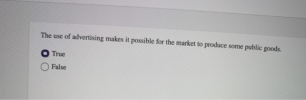 The use of advertising makes it possible for the market to produce some public goods. O True False
34. Game Theory suggests that oligopolists selling differentiated products have an incentive to decrease their advertising,...
34. Game Theory suggests that oligopolists selling differentiated products have an incentive to decrease their advertising, but only if their rivals also agree to scale back their advertising have and incentive to decrease their advertising if the rival firms increase their advertising have an incentive to increase their advertising no matter what rival firms do about advertising should always maximize their advertising program in order to assure that they gain customers Flag this Question Question 352.5 pts 35. All of...
types of bonds match each description with the most appropriate type of bond
 Match each description with the most appropriate type of
bond.
Match each description with the most appropriate type of bond.
Match each description with the most appropriate type of
bond.
Match each description with the most appropriate type of bond.
Match each type of RNA com descon RNA 2 RNA Match each of the options above...
 Match each type of RNA com descon RNA 2 RNA Match each of the options above to the below Combines with proteins to commarbosome Carnesino acids to me and binds to cons codons specify the order of amino acids in station
Match each description with the appropriate type of cell division. Match each description with the appropriate...
 Match each description with the appropriate type of cell division. Match each description with the appropriate type of cell division. The new cells produced are genetically identical to each other and to the original coll During the first nuclear division, sister kinelochores fuse and are attached to the same pole Chromosomes The chromosome Independent condense before they number is reduced from Crossing over occurs assortment of maternal attach to the spindle 2 sets to 1 set and paternal chromosomes Nuclear...
For each of the following, draw possible diagrams that match the given measurements.
For each of the following, draw possible diagrams that match the given measurements. Then, calculate the length of side c. If the calculation cannot be made, explain why. a) In ΔABC, a = 13 cm, b = 21 cm, and ∠A = 29° b) In ΔABC, a = 24 m, b = 21 m, and ∠A = 75°.
QUESTION 4 Match the strongest type of attractive forces each molecule is capable of in the...
 QUESTION 4 Match the strongest type of attractive forces each molecule is capable of in the pure liquid form. Acetone < Water A. Dipole-Dipole B. Hydrogen Bonding C. Dispersion Forces vHexane Water
Match the types of corporate advertising with the characteristics of each strategy Characteristics May be sponsored...
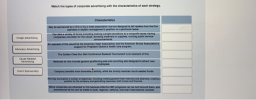 Match the types of corporate advertising with the characteristics of each strategy Characteristics May be sponsored by a firm or by a trade association and are designed to tell readers how the fiem operates or explain management's position on a particular lesue. Can take a variety of forms insiuding making outright donations to a nonprofit cause, having companies volumteer tor the cause, donating manerials or supplies, running public service announcements Image Advertising An example of this would be the American...
 Match the most likely market type to each of the following markets Restaurants Clothing stores Aircraft manufacturers Local electric company :Monopolistic competitionMonopoly: OligopolyPure competition
 Match the description of the industry to the type of market in which it belongs.
 The use of advertising makes it possible for the market to produce some public goods. O True False
 Match each description with the most appropriate type of
bond.
Match each description with the most appropriate type of bond.
Match each description with the most appropriate type of
bond.
Match each description with the most appropriate type of bond.
 Match each type of RNA com descon RNA 2 RNA Match each of the options above to the below Combines with proteins to commarbosome Carnesino acids to me and binds to cons codons specify the order of amino acids in station
 Match each description with the appropriate type of cell division. Match each description with the appropriate type of cell division. The new cells produced are genetically identical to each other and to the original coll During the first nuclear division, sister kinelochores fuse and are attached to the same pole Chromosomes The chromosome Independent condense before they number is reduced from Crossing over occurs assortment of maternal attach to the spindle 2 sets to 1 set and paternal chromosomes Nuclear...
 QUESTION 4 Match the strongest type of attractive forces each molecule is capable of in the pure liquid form. Acetone < Water A. Dipole-Dipole B. Hydrogen Bonding C. Dispersion Forces vHexane Water
 Match the types of corporate advertising with the characteristics of each strategy Characteristics May be sponsored by a firm or by a trade association and are designed to tell readers how the fiem operates or explain management's position on a particular lesue. Can take a variety of forms insiuding making outright donations to a nonprofit cause, having companies volumteer tor the cause, donating manerials or supplies, running public service announcements Image Advertising An example of this would be the American...
Most questions answered within 3 hours.
-
Where is the error in this code sequence?
String s1 = "Hello";
String s2 = "ello";...
asked 11 months ago -
Financial data for Joel de Paris, Inc., for last year
follow:
Joel de Paris, Inc.
Balance...
asked 11 months ago -
Consider this reaction:
Al2(SO4)3 (aq)+ BaCl3
(aq) Al2Cl6 (aq)- +
3BaSO4(s) . What is the...
asked 11 months ago -
Suppose that Savneet is considering increasing her
recent random sample from 20 car rentals to 40...
asked 11 months ago -
Trucks arrive at an unloading terminal at an average rate of 120
per hour.
Trucks arrive...
asked 11 months ago -
Why are methanol and ethanol completely soluble in water while
octanol is not very little soluble....
asked 11 months ago -
A facilities manager at a university reads in a research report
that the mean amount of...
asked 11 months ago -
When the CuSO4 is rehydrated by adding water to the anhydrous
compound, is this an endothermic...
asked 11 months ago -
A ray of sunlight is passing from diamond into crown glass; the
angle of incidence is...
asked 11 months ago -
A block of mass 0.249 kg is placed on top of a light, vertical
spring of...
asked 11 months ago -
how do the kidneys compensate in the presences of acidosis
a) trigger hyperventilate
b) reserve acid...
asked 11 months ago -
Question 501 pts
The rental rate of capital to the firm increases. Which of the
following...
asked 11 months ago