
Homework Answers
Add Answer to:
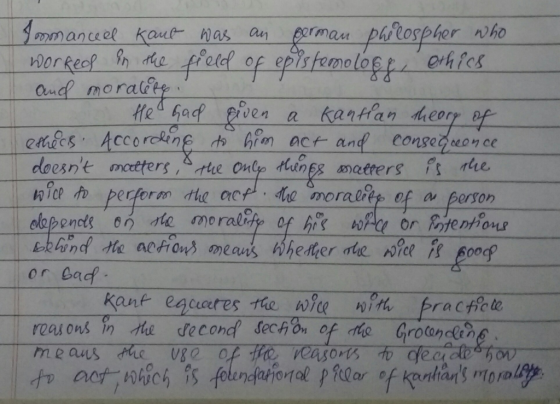
Choose one) Kant equates the will with which of the following in the second section of...
Kant asserts that we view the world through our own perception and that morality is objective...
Kant asserts that we view the world through our own perception and that morality is objective and based on reason. The types of knowledge we can have is a priori, knowledge independent of experience, and a posteriori, knowledge we can only have after certain experiences. A priori knowledge can provide knowledge of the noumenal world, while a posteriori knowledge gives us knowledge of the phenomenal world. According to Kant, we can make theoretical or practical judgements. Theoretical judgements are concerned...
Which one one of the following philosophers was a virtue ethicist? a.) kant b.) hobbes c.)...
Which one one of the following philosophers was a virtue ethicist? a.) kant b.) hobbes c.) Aristotle d.)plato
Mill and Kant questions- ethics multiple choice 2) 6) Question 2 (1 point) In the second...
 Mill and Kant questions- ethics
multiple choice
2)
6)
Question 2 (1 point) In the second paragraph of the following text, Millargues for half of the main conclusion he is arguing for in the entire text. What is the main explicit premise Mill uses in the second paragraph to prove half of his main conclusion? Mill (1863, pp. 24-26) writes: The utilitarian doctrine is that happiness is desirable as an end, and is the only thing that is so; anything...
Mill and Kant questions- ethics
multiple choice
2)
6)
Question 2 (1 point) In the second paragraph of the following text, Millargues for half of the main conclusion he is arguing for in the entire text. What is the main explicit premise Mill uses in the second paragraph to prove half of his main conclusion? Mill (1863, pp. 24-26) writes: The utilitarian doctrine is that happiness is desirable as an end, and is the only thing that is so; anything...
Kant suggested that which of the following is the true test of good will?
Kant suggested that which of the following is the true test of good will? the person's intention of the will the person continues to act out of duty the person's relationship to the will the person has moral virtue
The following statement falls in line with which philosopher?: Kant (K) or Mill (M) Stephanie witnesses...
The following statement falls in line with which philosopher?: Kant (K) or Mill (M) Stephanie witnesses an act of workplace bullying and reports it to HR so that she and others at work can work in a comfortable and safe work environment that will foster a greater level of productivity for the company. The following statement falls in line with which philosopher?: Kant (K) or Mill (M) Tom, the boss of a company, allows his employees to freely express their...
1. Which one of the following is NOT a version of the categorical imperative discussed by...
 1. Which one of the following is NOT a version of the categorical imperative discussed by Kant? A) Always act so that you treat a person not only as an end but also as means. B) Always act so that the rule governing your act can be willed to be universal moral law. C) Persons as rational ends in themselves are the makers of universal moral law. D) Each of the following is a version of the categorical imperative discussed...
Summarize/Paraphrase There are two ways in which such defiance of practical reason call work. One can...
Summarize/Paraphrase There are two ways in which such defiance of practical reason call work. One can either defy the normative power of practical reason directly or one can defy it indirectly by defying the information provided by theoretical reason on which the disliked directives of practical reason are based. The form of reasoning constitutive of the direct defiance of practical reason is: “I want to do x but I know that doing x will not allow me to achieve y...
24. Which of the following is TRUE? A) Kant is a suspected psychological egoist B) Aristotle...
24. Which of the following is TRUE? A) Kant is a suspected psychological egoist B) Aristotle focuses on action rather than character. C) Nagel rejects Kant’s ethics but not Mill’s. D) Act utilitarianism was proposed to resolve problems with utilitarianism. E) Two of the above
Section I Look over the image in the top section and choose which piece from the...
 Section I
Look over the image in the top section and choose which piece
from the bottom should be placed in the question mark (?) that
would be next in the sequence.
Which option is correct?
Section l Look over the image in the top section and choose which piece from the bottom should be placed in the question mark (?) that would be next in the sequence 2 Select the missing piece [?] below
Section I
Look over the image in the top section and choose which piece
from the bottom should be placed in the question mark (?) that
would be next in the sequence.
Which option is correct?
Section l Look over the image in the top section and choose which piece from the bottom should be placed in the question mark (?) that would be next in the sequence 2 Select the missing piece [?] below
The first base and second base amounts are used to determine whether Marks: 1 Choose one...
 The first base and second base amounts are used to determine whether Marks: 1 Choose one answer a None of social security benefits are taxable b. Up to 50% of social security benefits are taxable c. Up to 85% of social security benefits are taxable All of these O d 68 In 2018, Tim takes one class at a local university to earn credits toward a degree in accounting He is now a sophomore in college. Which credit is he...
 Mill and Kant questions- ethics
multiple choice
2)
6)
Question 2 (1 point) In the second paragraph of the following text, Millargues for half of the main conclusion he is arguing for in the entire text. What is the main explicit premise Mill uses in the second paragraph to prove half of his main conclusion? Mill (1863, pp. 24-26) writes: The utilitarian doctrine is that happiness is desirable as an end, and is the only thing that is so; anything...
Mill and Kant questions- ethics
multiple choice
2)
6)
Question 2 (1 point) In the second paragraph of the following text, Millargues for half of the main conclusion he is arguing for in the entire text. What is the main explicit premise Mill uses in the second paragraph to prove half of his main conclusion? Mill (1863, pp. 24-26) writes: The utilitarian doctrine is that happiness is desirable as an end, and is the only thing that is so; anything...
 1. Which one of the following is NOT a version of the categorical imperative discussed by Kant? A) Always act so that you treat a person not only as an end but also as means. B) Always act so that the rule governing your act can be willed to be universal moral law. C) Persons as rational ends in themselves are the makers of universal moral law. D) Each of the following is a version of the categorical imperative discussed...
 Section I
Look over the image in the top section and choose which piece
from the bottom should be placed in the question mark (?) that
would be next in the sequence.
Which option is correct?
Section l Look over the image in the top section and choose which piece from the bottom should be placed in the question mark (?) that would be next in the sequence 2 Select the missing piece [?] below
Section I
Look over the image in the top section and choose which piece
from the bottom should be placed in the question mark (?) that
would be next in the sequence.
Which option is correct?
Section l Look over the image in the top section and choose which piece from the bottom should be placed in the question mark (?) that would be next in the sequence 2 Select the missing piece [?] below
 The first base and second base amounts are used to determine whether Marks: 1 Choose one answer a None of social security benefits are taxable b. Up to 50% of social security benefits are taxable c. Up to 85% of social security benefits are taxable All of these O d 68 In 2018, Tim takes one class at a local university to earn credits toward a degree in accounting He is now a sophomore in college. Which credit is he...
Most questions answered within 3 hours.
-
Where is the error in this code sequence?
String s1 = "Hello";
String s2 = "ello";...
asked 10 months ago -
Financial data for Joel de Paris, Inc., for last year
follow:
Joel de Paris, Inc.
Balance...
asked 10 months ago -
Consider this reaction:
Al2(SO4)3 (aq)+ BaCl3
(aq) Al2Cl6 (aq)- +
3BaSO4(s) . What is the...
asked 10 months ago -
Suppose that Savneet is considering increasing her
recent random sample from 20 car rentals to 40...
asked 10 months ago -
Trucks arrive at an unloading terminal at an average rate of 120
per hour.
Trucks arrive...
asked 10 months ago -
Why are methanol and ethanol completely soluble in water while
octanol is not very little soluble....
asked 10 months ago -
A facilities manager at a university reads in a research report
that the mean amount of...
asked 10 months ago -
When the CuSO4 is rehydrated by adding water to the anhydrous
compound, is this an endothermic...
asked 10 months ago -
A ray of sunlight is passing from diamond into crown glass; the
angle of incidence is...
asked 10 months ago -
A block of mass 0.249 kg is placed on top of a light, vertical
spring of...
asked 10 months ago -
how do the kidneys compensate in the presences of acidosis
a) trigger hyperventilate
b) reserve acid...
asked 10 months ago -
Question 501 pts
The rental rate of capital to the firm increases. Which of the
following...
asked 10 months ago