![3. An object 3cm high is placed 40cm in front of a thin +10.00D lens. Find the [30] position and size of the image. (Note: a](http://img.homeworklib.com/questions/42b880b0-8ced-11eb-b07e-2d99e3b4cb32.png?x-oss-process=image/resize,w_560)
Homework Answers
Add Answer to:
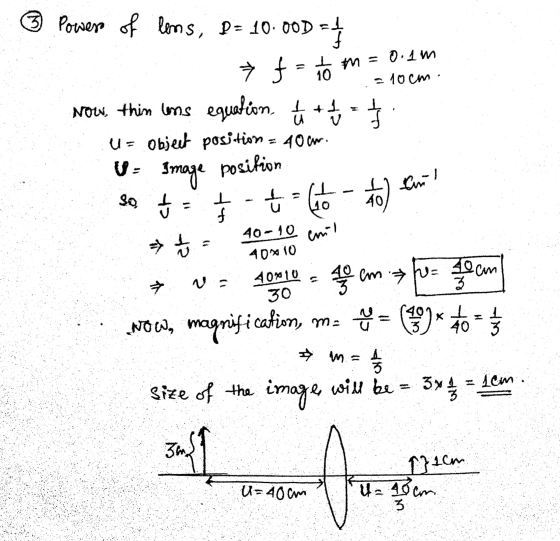
3. An object 3cm high is placed 40cm in front of a thin +10.00D lens. Find...
The object is placed front of a positive thin lens and forms a real image, with...
The object is placed front of a positive thin lens and forms a real image, with the size of image is 1/2 size of object and along the same upright direction. If the object is moved closer to the lens by 100 mm, the image is the same size and direction as the object, find the focal length of thin lens.
(a) An object that is 2.73 cm high is placed 25.3 cm in front of a...
 (a) An object that is 2.73 cm high is placed 25.3 cm in front of a thin lens that has a power equal to 10 D. Draw a ray diagram to find the position and the size of the image and check your results using the thin-lens equation. cm cm (b) Repeat Part (a) if the object is placed 21.4 cm in front of the lens cm cm (c) Repeat Part (a) for an object placed 19.8 cm in front...
Problem 4 (10 points) A thin converging lens has a focal length 6.0 cm. An object...
 Problem 4 (10 points) A thin converging lens has a focal length 6.0 cm. An object of height 2.0 cm is located 3cm in front of the lens as shown below 1) Draw a ray diagram to show the image position and size. 2) Calculate the image position and size using lens equations. -6em, 4em h-2cm f-6cm f-6cm s 3cm
An object is placed in front of two thin coaxial lenses 1(convex) and 2 (concave). The...
An object is placed in front of two thin coaxial lenses 1(convex) and 2 (concave). The focal points for lens 1(convex) and 3cm from the lens: those for lens 2 (concave)are 6cm from the lens. The lenses have separation L=8.5 cm, and the pencil is 9 cm to the left of lens 1. a) Where does the system of two lenses produce an image of the object? b) The object has height h=2mm. What is the height of image 2?...
An object is placed 100 cm in front of a lens of focal length 20 cm....
An object is placed 100 cm in front of a lens of focal length 20 cm. A second lens is placed 35 cm beyond the first, this second lens having a focal length of 8.0 cm. If the size of the object is 6.0 cm, what is the size of the final image? Draw ray diagram and apply thin lens formula
A thin lens produces a magnification of -5.5 when an object 8 cm high is placed...
A thin lens produces a magnification of -5.5 when an object 8 cm high is placed 15 from the lens. Find the size of the image formed. (If the image is inverted, represent this by a negative value.) What will be the image distance from the lens? Calculate the focal length of this lens.
An object is placed 100cm in front of a lens of focal length 50cm. A lens...
An object is placed 100cm in front of a lens of focal length 50cm. A lens of focal length -20cm is placed 90cm beyond the first lens. a) Where is the final image located? b) Is this a real or virtual image? c) What is the magnification of the lens combination? d) Is the final image inverted or upright? e) Is the final image bigger or smaller than the object?
5. (8pts) An object 2cm high is placed 5cm in front of a convex mirror with...
 5. (8pts) An object 2cm high is placed 5cm in front of a convex mirror with a focal lengti of 3cm. (1) Calculate the image position, image height and the magnification. (2) Describe the image (upright/inverted, real/virtual, bigger/smaller).(3) Draw ray diagram to locate the image (note: your drawing image should agree with your (2) answers). Please use ruler.
An object is placed in front of a converging lens in such a position that the...
An object is placed in front of a converging lens in such a position that the lens (f = 14.0 cm) creates a real image located 22.0 cm from the lens. Then, with the object remaining in place, the lens is replaced with another converging lens (f = 15.0 cm). A new, real image is formed. What is the image distance of this new image?
An object is placed in front of a converging lens in such a position that the...
An object is placed in front of a converging lens in such a position that the lens (f = 15.0 cm) creates a real image located 28.0 cm from the lens. Then, with the object remaining in place, the lens is replaced with another converging lens (f = 19.0 cm). A new, real image is formed. What is the image distance of this new image?
 (a) An object that is 2.73 cm high is placed 25.3 cm in front of a thin lens that has a power equal to 10 D. Draw a ray diagram to find the position and the size of the image and check your results using the thin-lens equation. cm cm (b) Repeat Part (a) if the object is placed 21.4 cm in front of the lens cm cm (c) Repeat Part (a) for an object placed 19.8 cm in front...
 Problem 4 (10 points) A thin converging lens has a focal length 6.0 cm. An object of height 2.0 cm is located 3cm in front of the lens as shown below 1) Draw a ray diagram to show the image position and size. 2) Calculate the image position and size using lens equations. -6em, 4em h-2cm f-6cm f-6cm s 3cm
 5. (8pts) An object 2cm high is placed 5cm in front of a convex mirror with a focal lengti of 3cm. (1) Calculate the image position, image height and the magnification. (2) Describe the image (upright/inverted, real/virtual, bigger/smaller).(3) Draw ray diagram to locate the image (note: your drawing image should agree with your (2) answers). Please use ruler.
Most questions answered within 3 hours.
-
Where is the error in this code sequence?
String s1 = "Hello";
String s2 = "ello";...
asked 11 months ago -
Financial data for Joel de Paris, Inc., for last year
follow:
Joel de Paris, Inc.
Balance...
asked 11 months ago -
Consider this reaction:
Al2(SO4)3 (aq)+ BaCl3
(aq) Al2Cl6 (aq)- +
3BaSO4(s) . What is the...
asked 11 months ago -
Suppose that Savneet is considering increasing her
recent random sample from 20 car rentals to 40...
asked 11 months ago -
Trucks arrive at an unloading terminal at an average rate of 120
per hour.
Trucks arrive...
asked 11 months ago -
Why are methanol and ethanol completely soluble in water while
octanol is not very little soluble....
asked 11 months ago -
A facilities manager at a university reads in a research report
that the mean amount of...
asked 11 months ago -
When the CuSO4 is rehydrated by adding water to the anhydrous
compound, is this an endothermic...
asked 11 months ago -
A ray of sunlight is passing from diamond into crown glass; the
angle of incidence is...
asked 11 months ago -
A block of mass 0.249 kg is placed on top of a light, vertical
spring of...
asked 11 months ago -
how do the kidneys compensate in the presences of acidosis
a) trigger hyperventilate
b) reserve acid...
asked 11 months ago -
Question 501 pts
The rental rate of capital to the firm increases. Which of the
following...
asked 11 months ago