![2. Two fair six-sided dice are tossed independently. Let M = the maximum of the two tosses (so M (1,5) = 5, M (3,3) = 3, etc). (a) I4 ptsl Find the probability mass function of M. (b) 14 pts] Find the cumulative distribution function of M and graph it. (c) 12 pts] Find the expected value of M (d) 12 pts] Find the variance of M. (e) 12 pts] Find the standard deviation of M.](http://img.homeworklib.com/questions/fcf149c0-8d05-11eb-bcdd-f1b8d372d693.png?x-oss-process=image/resize,w_560)
Homework Answers
Solution:
we are given that : two fair six sided dice are tossed independently.
M = Maximum of the two tosses.
Thus we get:
| First Die | Second Die | M = Maximum of two dice |
| 1 | 1 | 1 |
| 1 | 2 | 2 |
| 1 | 3 | 3 |
| 1 | 4 | 4 |
| 1 | 5 | 5 |
| 1 | 6 | 6 |
| 2 | 1 | 2 |
| 2 | 2 | 2 |
| 2 | 3 | 3 |
| 2 | 4 | 4 |
| 2 | 5 | 5 |
| 2 | 6 | 6 |
| 3 | 1 | 3 |
| 3 | 2 | 3 |
| 3 | 3 | 3 |
| 3 | 4 | 4 |
| 3 | 5 | 5 |
| 3 | 6 | 6 |
| 4 | 1 | 4 |
| 4 | 2 | 4 |
| 4 | 3 | 4 |
| 4 | 4 | 4 |
| 4 | 5 | 5 |
| 4 | 6 | 6 |
| 5 | 1 | 5 |
| 5 | 2 | 5 |
| 5 | 3 | 5 |
| 5 | 4 | 5 |
| 5 | 5 | 5 |
| 5 | 6 | 6 |
| 6 | 1 | 6 |
| 6 | 2 | 6 |
| 6 | 3 | 6 |
| 6 | 4 | 6 |
| 6 | 5 | 6 |
| 6 | 6 | 6 |
Part a) Probability mass function of M.
We need to find frequencies of each possible values of M and then divide each frequency by N = 36
| M | f = frequency | P(M) |
| 1 | 1 | 0.0278 |
| 2 | 3 | 0.0833 |
| 3 | 5 | 0.1389 |
| 4 | 7 | 0.1944 |
| 5 | 9 | 0.2500 |
| 6 | 11 | 0.3056 |
| N = 36 |
Part b) Cumulative distribution function of M and Graph it.
To get cumulative distribution function , we need to find F(M) column
That is find cumulative sum of probabilities of each value of M.
Thus we get :
| M | P(M) | Calculations of F(M) | F(M) |
| 1 | 0.0278 | 0.0278 | 0.0278 |
| 2 | 0.0833 | 0.0278+0.0833=0.1111 | 0.1111 |
| 3 | 0.1389 | 0.1111+0.1389=0.2500 | 0.2500 |
| 4 | 0.1944 | 0.2500+0.1944=0.4444 | 0.4444 |
| 5 | 0.2500 | 0.4444+0.2500=0.6944 | 0.6944 |
| 6 | 0.3056 | 0.6944+0.3056=1.0000 | 1.0000 |
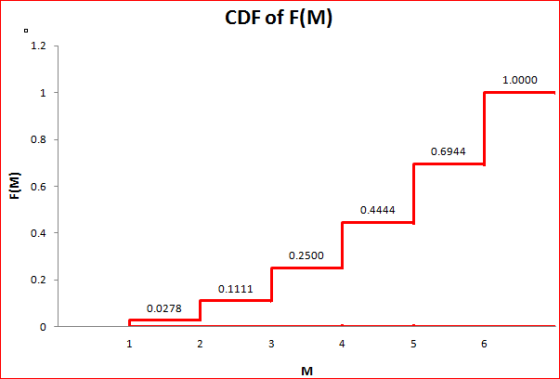
Part c) Expected value of M

| M | P(M) | M * P(M) |
| 1 | 0.0278 | 0.0278 |
| 2 | 0.0833 | 0.1667 |
| 3 | 0.1389 | 0.4167 |
| 4 | 0.1944 | 0.7778 |
| 5 | 0.2500 | 1.2500 |
| 6 | 0.3056 | 1.8333 |
 |
Thus

Part d) Variance of M

Where

| M | P(M) | M * P(M) | M^2 * P(M) |
| 1 | 0.0278 | 0.0278 | 0.0278 |
| 2 | 0.0833 | 0.1667 | 0.3333 |
| 3 | 0.1389 | 0.4167 | 1.2500 |
| 4 | 0.1944 | 0.7778 | 3.1111 |
| 5 | 0.2500 | 1.2500 | 6.2500 |
| 6 | 0.3056 | 1.8333 | 11.0000 |
|
 |
Thus




Part e) Standard deviation of M



Add Answer to:
2. Two fair six-sided dice are tossed independently. Let M = the maximum of the two...
Please help 3. 1/14 points | Previous Answers DevoreStat9 3.E.018. Notes O Ask Your T Two...
 Please help
3. 1/14 points | Previous Answers DevoreStat9 3.E.018. Notes O Ask Your T Two fair six-sided dice are tossed independently. Let M - the maximum of the two tosses (so M(1,5) - 5, M(3,3) 3, etc.). (a) What is the pmf of M? [Hint: First determine p(1), then p(2), and so on.] (Enter your answers as fractions.) p(m) (b) Determine the cdf of M. (Enter your answers as fractions.) 1 sm< 2 Graph the cdf of M. F(m)...
Please help
3. 1/14 points | Previous Answers DevoreStat9 3.E.018. Notes O Ask Your T Two fair six-sided dice are tossed independently. Let M - the maximum of the two tosses (so M(1,5) - 5, M(3,3) 3, etc.). (a) What is the pmf of M? [Hint: First determine p(1), then p(2), and so on.] (Enter your answers as fractions.) p(m) (b) Determine the cdf of M. (Enter your answers as fractions.) 1 sm< 2 Graph the cdf of M. F(m)...
Answer it as soon as possible please. Two fair six-sided dice are rolled. Let X be...
 Answer it as soon as possible please.
Two fair six-sided dice are rolled. Let X be the maximum of the two tosses (for example, if you roll a 2 and a 5, X = 5). Construct a pdf for X, and use it to calculate the following probabilities: p(z) F(x) 1, P(X=3) 3. Construct a cdf for X and use it to calculate P(X s 4).
Answer it as soon as possible please.
Two fair six-sided dice are rolled. Let X be the maximum of the two tosses (for example, if you roll a 2 and a 5, X = 5). Construct a pdf for X, and use it to calculate the following probabilities: p(z) F(x) 1, P(X=3) 3. Construct a cdf for X and use it to calculate P(X s 4).
5. Find the expected value of the sum obtained when n fair six-sided dice are tossed.
5. Find the expected value of the sum obtained when n fair six-sided dice are tossed.
1. Suppose a fair six-sided die is tossed, with N being the resulting number on the...
 1. Suppose a fair six-sided die is tossed, with N being the resulting number on the uppermost face. Given N, a fair coin is tossed independently until N heads are recorded. Let X be the total number of tails recorded. a. What is the pmf of N? (5 pts) b. Given N = 3, what is the distribution of X? (10 pts) c. What is Pr(X = 1)? (10 pts) d. What is E(X)? (10 pts)
Two fair dice are tossed independently, and the pair, (X, Y), denote the number of spots...
 Two fair dice are tossed independently, and the pair, (X, Y), denote the number of spots on the first and on the second dice. Consider two random variables: U = X + Y and W = X-Y! 1. Find the distribution of U. 2. Find the distribution of W. 3. Find the conditional distribution of W, given that U 6
2. Suppose you have a four-sided dice, a six-sided dice and a 12-sided dice, each dice...
 2. Suppose you have a four-sided dice, a six-sided dice and a 12-sided dice, each dice is fair. You roll the three dice once and let Z be the number of 4's showing. Find E(Z) using the indicator method.
Two fair 6-sided dice are tossed. Let X denote the number appearing on the first die...
 Two fair 6-sided dice are tossed. Let X denote the number appearing on the first die and let y denote the number appearing on the second die. Show that X, Y are independent by showing that P(X = x, Y = y) = P(X = x) x P(Y = y) for all (x,y) pairs.
If two standard six sided dice are tossed and if the dice equal the sum of...
If two standard six sided dice are tossed and if the dice equal the sum of 2 you win 1000 dollars but if it lands on anything else you lose 100 dollars what are the probabilities that u win 1000 and how many trails would you need or expect to win on average and is it worth the risk and why
Roll two fair six-sided dice, and let X, Y denote the first and the second numbers....
 Roll two fair six-sided dice, and let X, Y denote the first and the second numbers.If Z=max {X, Y}, find- E(Z)- V(Z)If Z=|X-Y|, find- E(Z)- V(Z)
A standard six sided dice is tossed repeatedly. Let N be the total number of observed...
A standard six sided dice is tossed repeatedly. Let N be the total number of observed 1s and 2s. For independent individual outcomes, calculate p(N=infinity) (Hint continuity) Full solution with justification.
 Please help
3. 1/14 points | Previous Answers DevoreStat9 3.E.018. Notes O Ask Your T Two fair six-sided dice are tossed independently. Let M - the maximum of the two tosses (so M(1,5) - 5, M(3,3) 3, etc.). (a) What is the pmf of M? [Hint: First determine p(1), then p(2), and so on.] (Enter your answers as fractions.) p(m) (b) Determine the cdf of M. (Enter your answers as fractions.) 1 sm< 2 Graph the cdf of M. F(m)...
Please help
3. 1/14 points | Previous Answers DevoreStat9 3.E.018. Notes O Ask Your T Two fair six-sided dice are tossed independently. Let M - the maximum of the two tosses (so M(1,5) - 5, M(3,3) 3, etc.). (a) What is the pmf of M? [Hint: First determine p(1), then p(2), and so on.] (Enter your answers as fractions.) p(m) (b) Determine the cdf of M. (Enter your answers as fractions.) 1 sm< 2 Graph the cdf of M. F(m)...
 Answer it as soon as possible please.
Two fair six-sided dice are rolled. Let X be the maximum of the two tosses (for example, if you roll a 2 and a 5, X = 5). Construct a pdf for X, and use it to calculate the following probabilities: p(z) F(x) 1, P(X=3) 3. Construct a cdf for X and use it to calculate P(X s 4).
Answer it as soon as possible please.
Two fair six-sided dice are rolled. Let X be the maximum of the two tosses (for example, if you roll a 2 and a 5, X = 5). Construct a pdf for X, and use it to calculate the following probabilities: p(z) F(x) 1, P(X=3) 3. Construct a cdf for X and use it to calculate P(X s 4).
 1. Suppose a fair six-sided die is tossed, with N being the resulting number on the uppermost face. Given N, a fair coin is tossed independently until N heads are recorded. Let X be the total number of tails recorded. a. What is the pmf of N? (5 pts) b. Given N = 3, what is the distribution of X? (10 pts) c. What is Pr(X = 1)? (10 pts) d. What is E(X)? (10 pts)
 Two fair dice are tossed independently, and the pair, (X, Y), denote the number of spots on the first and on the second dice. Consider two random variables: U = X + Y and W = X-Y! 1. Find the distribution of U. 2. Find the distribution of W. 3. Find the conditional distribution of W, given that U 6
 2. Suppose you have a four-sided dice, a six-sided dice and a 12-sided dice, each dice is fair. You roll the three dice once and let Z be the number of 4's showing. Find E(Z) using the indicator method.
 Two fair 6-sided dice are tossed. Let X denote the number appearing on the first die and let y denote the number appearing on the second die. Show that X, Y are independent by showing that P(X = x, Y = y) = P(X = x) x P(Y = y) for all (x,y) pairs.
 Roll two fair six-sided dice, and let X, Y denote the first and the second numbers.If Z=max {X, Y}, find- E(Z)- V(Z)If Z=|X-Y|, find- E(Z)- V(Z)
Most questions answered within 3 hours.
-
Where is the error in this code sequence?
String s1 = "Hello";
String s2 = "ello";...
asked 10 months ago -
Financial data for Joel de Paris, Inc., for last year
follow:
Joel de Paris, Inc.
Balance...
asked 10 months ago -
Consider this reaction:
Al2(SO4)3 (aq)+ BaCl3
(aq) Al2Cl6 (aq)- +
3BaSO4(s) . What is the...
asked 10 months ago -
Suppose that Savneet is considering increasing her
recent random sample from 20 car rentals to 40...
asked 10 months ago -
Trucks arrive at an unloading terminal at an average rate of 120
per hour.
Trucks arrive...
asked 10 months ago -
Why are methanol and ethanol completely soluble in water while
octanol is not very little soluble....
asked 10 months ago -
A facilities manager at a university reads in a research report
that the mean amount of...
asked 10 months ago -
When the CuSO4 is rehydrated by adding water to the anhydrous
compound, is this an endothermic...
asked 10 months ago -
A ray of sunlight is passing from diamond into crown glass; the
angle of incidence is...
asked 10 months ago -
A block of mass 0.249 kg is placed on top of a light, vertical
spring of...
asked 10 months ago -
how do the kidneys compensate in the presences of acidosis
a) trigger hyperventilate
b) reserve acid...
asked 10 months ago -
Question 501 pts
The rental rate of capital to the firm increases. Which of the
following...
asked 10 months ago