Suppose that two carts, with a compressed spring between them (but not attached to either cart),...
Suppose that two carts, with a compressed spring between them (but not attached to either cart), are free to roll on a level table. The carts have very different masses and are initially stationary. Consider frictional losses to be negligible. The spring is released and the carts move apart. Are the final kinetic energies of the two carts equal, or is one greater than the other (if so, specify which is greater)? Explain your reasoning using fundamental physics principles, laws, and definitions. Include appropriate diagrams and drawings.
Homework Answers

Add Answer to:
Suppose that two carts, with a compressed spring between them
(but not attached to either cart),...
The same two carts are initially at rest touching each other. A compressed spring between them...
The same two carts are initially at rest touching each other. A compressed spring between them is released and the 1500 g cart takes off toward the right with a speed of 25 cm/s. How fast and in what direction does the 500 g cart move? Ignore the mass and motion of the spring.
8. Suppose that two carts, one twice as massive as the other, fly apart when the...
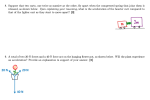 8. Suppose that two carts, one twice as massive as the other, fly apart when the compressed spring that joins them is released, as shown below. Upon explaining your reasoning, what is the acceleration of the heavier cart compared to that of the lighter cart as they start to move apart? [2] mwand 2m o o 9. A total of two 20-N forces and a 40-N force act on the hanging flower pot, as shown below. Will the plant experience...
Particle A and particle B are held together with a compressed spring between them. When they...
Particle A and particle B are held together with a compressed spring between them. When they are released, the spring pushes them apart, and they then fly off in opposite directions, free of the spring. The mass of A is 3.00 times the mass of B, and the energy stored in the spring was 90 J. Assume that the spring has negligible mass and that all its stored energy is transferred to the particles. Once that transfer is complete, what...
Particle A and particle B are held together with a compressed spring between them. When they...
Particle A and particle B are held together with a compressed spring between them. When they are released, the spring pushes them apart, and they then fly off in opposite directions, free of the spring. The mass of A is 4.00 times the mass of B, and the energy stored in the spring was 41 J. Assume that the spring has negligible mass and that all its stored energy is transferred to the particles. Once that transfer is complete, what...
A spring of negligible mass is compressed between two masses on a frictionless table with sloping...
A spring of negligible mass is compressed between two masses on a frictionless table with sloping ramps at each end. The masses are released simultaneously. The masses have the same volume, but the density of M1 is greater than that of M2. Select the appropriate symbol for each statement: G (Greater than), L (Less than), or E (Equal to). (If the first two are 'greater than,' and the last four 'less than,' then enter GGLLLL). A) The duration of the...
Two blocks on a frictionless table are held at rest with a compressed spring between them....
Two blocks on a frictionless table are held at rest with a compressed spring between them. When the blocks are released, the spring pushes them apart and they move in opposite directions. The spring has a spring constant of 215N / m and was compressed by 0.20 m. If one of the blocks moves at 1.50 m/s and the other moves away at 3.00 m/s , what is the mass of the heavier block in kg? (Hint: mechanical energy in...
Problem two: Cari won.no Track A frictionless cart of mass M is attached to a spring...
 Problem two: Cari won.no Track A frictionless cart of mass M is attached to a spring with spring constant k. When the cart is displaced 6 centimeters from its rest Rest position position and released, il oscillates with a period of 2 seconds. Four students are discussing what would happen to the period of oscillation if the original cart with mass M was displaced 12 cm o O from its rest position instead of 6 cm and again released: Ava:...
10. Write a one-page summary of the attached paper? INTRODUCTION Many problems can develop in activated...
10. Write a one-page summary of the attached paper? INTRODUCTION Many problems can develop in activated sludge operation that adversely affect effluent quality with origins in the engineering, hydraulic and microbiological components of the process. The real "heart" of the activated sludge system is the development and maintenance of a mixed microbial culture (activated sludge) that treats wastewater and which can be managed. One definition of a wastewater treatment plant operator is a "bug farmer", one who controls the aeration...
 8. Suppose that two carts, one twice as massive as the other, fly apart when the compressed spring that joins them is released, as shown below. Upon explaining your reasoning, what is the acceleration of the heavier cart compared to that of the lighter cart as they start to move apart? [2] mwand 2m o o 9. A total of two 20-N forces and a 40-N force act on the hanging flower pot, as shown below. Will the plant experience...
 Problem two: Cari won.no Track A frictionless cart of mass M is attached to a spring with spring constant k. When the cart is displaced 6 centimeters from its rest Rest position position and released, il oscillates with a period of 2 seconds. Four students are discussing what would happen to the period of oscillation if the original cart with mass M was displaced 12 cm o O from its rest position instead of 6 cm and again released: Ava:...
Most questions answered within 3 hours.
-
Where is the error in this code sequence?
String s1 = "Hello";
String s2 = "ello";...
asked 10 months ago -
Financial data for Joel de Paris, Inc., for last year
follow:
Joel de Paris, Inc.
Balance...
asked 10 months ago -
Consider this reaction:
Al2(SO4)3 (aq)+ BaCl3
(aq) Al2Cl6 (aq)- +
3BaSO4(s) . What is the...
asked 10 months ago -
Suppose that Savneet is considering increasing her
recent random sample from 20 car rentals to 40...
asked 10 months ago -
Trucks arrive at an unloading terminal at an average rate of 120
per hour.
Trucks arrive...
asked 10 months ago -
Why are methanol and ethanol completely soluble in water while
octanol is not very little soluble....
asked 10 months ago -
A facilities manager at a university reads in a research report
that the mean amount of...
asked 10 months ago -
When the CuSO4 is rehydrated by adding water to the anhydrous
compound, is this an endothermic...
asked 10 months ago -
A ray of sunlight is passing from diamond into crown glass; the
angle of incidence is...
asked 10 months ago -
A block of mass 0.249 kg is placed on top of a light, vertical
spring of...
asked 10 months ago -
how do the kidneys compensate in the presences of acidosis
a) trigger hyperventilate
b) reserve acid...
asked 10 months ago -
Question 501 pts
The rental rate of capital to the firm increases. Which of the
following...
asked 10 months ago