
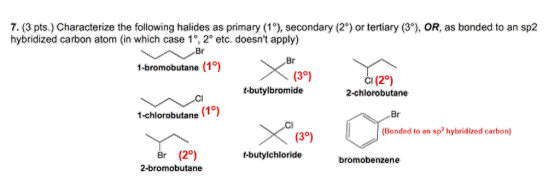
Characterize the following halides as primary (1°), secondary (2°) or tertiary (3°), OR, as bonded to an sp2 hybridized carbon atom (in which case 1°, 2° etc. doesn't apply)
Homework Answers
Add Answer to:
Characterize the following halides as primary (1°), secondary
(2°) or tertiary (3°), OR, as bonded to...
11. (2 pts.) What did you learn about the relative reactivities of primary versus secondary halides....
 11. (2 pts.) What did you learn about the
relative reactivities of primary versus secondary halides. You need
to discuss the results of experiments 1, 2, 3 and 4 in Table 3.
12. (2 pts.) What did you learn about the
relative reactivities of primary versus tertiary halides. You need
to discuss the results of experiments 1, 2, 5 and 6 in Table 3.
13. (2 pts.) What did you learn about the
leaving group being on an sp3 hybridized...
11. (2 pts.) What did you learn about the
relative reactivities of primary versus secondary halides. You need
to discuss the results of experiments 1, 2, 3 and 4 in Table 3.
12. (2 pts.) What did you learn about the
relative reactivities of primary versus tertiary halides. You need
to discuss the results of experiments 1, 2, 5 and 6 in Table 3.
13. (2 pts.) What did you learn about the
leaving group being on an sp3 hybridized...
1. Compare the reactivity of primary alkyl halides in part 1 (SN2) of this experiment to...
1. Compare the reactivity of primary alkyl halides in part 1 (SN2) of this experiment to the reactivity of primary alkyl halides today. What conclusions, if any, can you make about the reactivity of these molecules under these different conditions? Use specific data to make your point. 2. Compare the reactivity of secondary alkyl halides in part 1 (SN2) of this experiment to the reactivity of secondary alkyl halides today. What conclusions, if any, can you make about the reactivity...
ChemActivity 10: Oxidation and Reduction 145 Model 7: Primary (1°), Secondary (2°), and Tertiary (3°) Carbons...
 ChemActivity 10: Oxidation and Reduction 145 Model 7: Primary (1°), Secondary (2°), and Tertiary (3°) Carbons The words methyl (0'), primary (1), secondary (2"), and tertiary (3) were used to describe the number of (nonhydrogen) R groups attached to a carbocation carbon (see CA 8). This same naming strategy is used to describe any carbon with one attached "heteroatom," Z (hetero other). H R Z any atom other than C or H (hetroatom) R- -z -Z н- alkyl (not H)...
ChemActivity 10: Oxidation and Reduction 145 Model 7: Primary (1°), Secondary (2°), and Tertiary (3°) Carbons...
 ChemActivity 10: Oxidation and Reduction 145 Model 7: Primary (1°), Secondary (2°), and Tertiary (3°) Carbons The words methyl (0'), primary (1), secondary (2"), and tertiary (3) were used to describe the number of (nonhydrogen) R groups attached to a carbocation carbon (see CA 8). This same naming strategy is used to describe any carbon with one attached "heteroatom," Z (hetero other). H R Z any atom other than C or H (hetroatom) R- -z -Z н- alkyl (not H)...
3. Draw and classify the following alkyl halides as methyl-, primary (1°), secondary (11°), or tertiary...
 3. Draw and classify the following alkyl halides as methyl-, primary (1°), secondary (11°), or tertiary (111°) halide: 10pts -2-chloro-3,3-dimethylhexane; -4-sec-butyl-2-chlorononane; -1-bromo-4-isopropylcyclohexane; -2-chloro-3,3-dimethylhexane; -4-sec-butyl-2-chlorononane; -1-bromo-4-isopropylcyclohexane;
2) Predict the order of reactivity (1=least, 4=most) of primary, secondary, tertiary, and aryl halides toward...
 2) Predict the order of reactivity (1=least, 4=most) of
primary, secondary, tertiary, and aryl halides toward nucleophilic
displacement by an SN1 reaction mechanism. Explain
3) Give a detailed summary of the chemistry in both reactions
SN2 and SN1 in details please for both reactions. include any
general statements about the experiments.
LAB)o Organic Chemistry I Lab CHEM 3512 Nueleophilic Substitution Reactions: Sl vs S2 To review Sul, S2, El and E2 reactions and mechanisms and compare and contrast the effect...
2) Predict the order of reactivity (1=least, 4=most) of
primary, secondary, tertiary, and aryl halides toward nucleophilic
displacement by an SN1 reaction mechanism. Explain
3) Give a detailed summary of the chemistry in both reactions
SN2 and SN1 in details please for both reactions. include any
general statements about the experiments.
LAB)o Organic Chemistry I Lab CHEM 3512 Nueleophilic Substitution Reactions: Sl vs S2 To review Sul, S2, El and E2 reactions and mechanisms and compare and contrast the effect...
17. Classify the following alkyl halides as primary, secondary, tertiary, or none, as appropriate. 17. Clasifique...
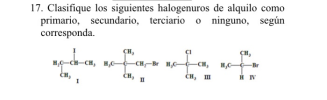 17. Classify the following alkyl halides as primary,
secondary, tertiary, or none, as appropriate.
17. Clasifique los siguientes halogenuros de alquilo como primario, secundario, terciario o ninguno, según corresponda. no-din-an, H, CH–CH, H,C- CH CH, -CH -BrH, -CH CH, HI H,-¢-Br HIV сн. 1
17. Classify the following alkyl halides as primary,
secondary, tertiary, or none, as appropriate.
17. Clasifique los siguientes halogenuros de alquilo como primario, secundario, terciario o ninguno, según corresponda. no-din-an, H, CH–CH, H,C- CH CH, -CH -BrH, -CH CH, HI H,-¢-Br HIV сн. 1
2. Classify the following alkyl halides as primary, secondary, or tertiary. Which one of these options...
 2. Classify the following alkyl halides as primary, secondary, or tertiary. Which one of these options would be best suited for a unimolecular nucleophilic substitution reaction? مو لہ کی لہ لا 3. Describe the following reactions in written form, making sure to use the following terms where appropriate: nucleophile, lone pair, loss of leaving group, electron-deficient, and electrophile. . و ». . که ملیہ -- « -
1. arrange Alkyl chlorides in theoretical order of reactivity in SN1 reaction 2. arrange Alkyl chlorides in theoretica...
 1. arrange Alkyl chlorides in theoretical order of reactivity
in SN1 reaction
2. arrange Alkyl chlorides in theoretical order of reactivity
in SN2 reaction
a HC 1-Chlorobutane AgNO3+ Ethanol (SN1) Nal + Acetone SN2 CH3 H3C 2-Chlorobutane Br CH3 H3C 2-Bromobutane CH3 H2C- a CH3 t-butylchloride Benzylchloride Br Bromobenzene
1. arrange Alkyl chlorides in theoretical order of reactivity
in SN1 reaction
2. arrange Alkyl chlorides in theoretical order of reactivity
in SN2 reaction
a HC 1-Chlorobutane AgNO3+ Ethanol (SN1) Nal + Acetone SN2 CH3 H3C 2-Chlorobutane Br CH3 H3C 2-Bromobutane CH3 H2C- a CH3 t-butylchloride Benzylchloride Br Bromobenzene
1. arrange Alkyl bromides in theoretical order of reactivity in SN1 reaction 2. arrange Alkyl bromides in theoretical o...
 1.
arrange Alkyl bromides in theoretical order of reactivity in SN1
reaction
2. arrange Alkyl bromides in theoretical order of reactivity
in SN2 reaction
AgNO3+ Ethanol Yal H₂C (SN 1) 1-Chlorobutane Nal + Acetone SN2 CH3 H3C 2-Chlorobutane Br CH3 H3C 2-Bromobutane CH3 H2C- a CH3 t-butylchloride Benzylchloride Br Bromobenzene
1.
arrange Alkyl bromides in theoretical order of reactivity in SN1
reaction
2. arrange Alkyl bromides in theoretical order of reactivity
in SN2 reaction
AgNO3+ Ethanol Yal H₂C (SN 1) 1-Chlorobutane Nal + Acetone SN2 CH3 H3C 2-Chlorobutane Br CH3 H3C 2-Bromobutane CH3 H2C- a CH3 t-butylchloride Benzylchloride Br Bromobenzene
 11. (2 pts.) What did you learn about the
relative reactivities of primary versus secondary halides. You need
to discuss the results of experiments 1, 2, 3 and 4 in Table 3.
12. (2 pts.) What did you learn about the
relative reactivities of primary versus tertiary halides. You need
to discuss the results of experiments 1, 2, 5 and 6 in Table 3.
13. (2 pts.) What did you learn about the
leaving group being on an sp3 hybridized...
11. (2 pts.) What did you learn about the
relative reactivities of primary versus secondary halides. You need
to discuss the results of experiments 1, 2, 3 and 4 in Table 3.
12. (2 pts.) What did you learn about the
relative reactivities of primary versus tertiary halides. You need
to discuss the results of experiments 1, 2, 5 and 6 in Table 3.
13. (2 pts.) What did you learn about the
leaving group being on an sp3 hybridized...
 ChemActivity 10: Oxidation and Reduction 145 Model 7: Primary (1°), Secondary (2°), and Tertiary (3°) Carbons The words methyl (0'), primary (1), secondary (2"), and tertiary (3) were used to describe the number of (nonhydrogen) R groups attached to a carbocation carbon (see CA 8). This same naming strategy is used to describe any carbon with one attached "heteroatom," Z (hetero other). H R Z any atom other than C or H (hetroatom) R- -z -Z н- alkyl (not H)...
 ChemActivity 10: Oxidation and Reduction 145 Model 7: Primary (1°), Secondary (2°), and Tertiary (3°) Carbons The words methyl (0'), primary (1), secondary (2"), and tertiary (3) were used to describe the number of (nonhydrogen) R groups attached to a carbocation carbon (see CA 8). This same naming strategy is used to describe any carbon with one attached "heteroatom," Z (hetero other). H R Z any atom other than C or H (hetroatom) R- -z -Z н- alkyl (not H)...
 3. Draw and classify the following alkyl halides as methyl-, primary (1°), secondary (11°), or tertiary (111°) halide: 10pts -2-chloro-3,3-dimethylhexane; -4-sec-butyl-2-chlorononane; -1-bromo-4-isopropylcyclohexane; -2-chloro-3,3-dimethylhexane; -4-sec-butyl-2-chlorononane; -1-bromo-4-isopropylcyclohexane;
 2) Predict the order of reactivity (1=least, 4=most) of
primary, secondary, tertiary, and aryl halides toward nucleophilic
displacement by an SN1 reaction mechanism. Explain
3) Give a detailed summary of the chemistry in both reactions
SN2 and SN1 in details please for both reactions. include any
general statements about the experiments.
LAB)o Organic Chemistry I Lab CHEM 3512 Nueleophilic Substitution Reactions: Sl vs S2 To review Sul, S2, El and E2 reactions and mechanisms and compare and contrast the effect...
2) Predict the order of reactivity (1=least, 4=most) of
primary, secondary, tertiary, and aryl halides toward nucleophilic
displacement by an SN1 reaction mechanism. Explain
3) Give a detailed summary of the chemistry in both reactions
SN2 and SN1 in details please for both reactions. include any
general statements about the experiments.
LAB)o Organic Chemistry I Lab CHEM 3512 Nueleophilic Substitution Reactions: Sl vs S2 To review Sul, S2, El and E2 reactions and mechanisms and compare and contrast the effect...
 17. Classify the following alkyl halides as primary,
secondary, tertiary, or none, as appropriate.
17. Clasifique los siguientes halogenuros de alquilo como primario, secundario, terciario o ninguno, según corresponda. no-din-an, H, CH–CH, H,C- CH CH, -CH -BrH, -CH CH, HI H,-¢-Br HIV сн. 1
17. Classify the following alkyl halides as primary,
secondary, tertiary, or none, as appropriate.
17. Clasifique los siguientes halogenuros de alquilo como primario, secundario, terciario o ninguno, según corresponda. no-din-an, H, CH–CH, H,C- CH CH, -CH -BrH, -CH CH, HI H,-¢-Br HIV сн. 1
 2. Classify the following alkyl halides as primary, secondary, or tertiary. Which one of these options would be best suited for a unimolecular nucleophilic substitution reaction? مو لہ کی لہ لا 3. Describe the following reactions in written form, making sure to use the following terms where appropriate: nucleophile, lone pair, loss of leaving group, electron-deficient, and electrophile. . و ». . که ملیہ -- « -
 1. arrange Alkyl chlorides in theoretical order of reactivity
in SN1 reaction
2. arrange Alkyl chlorides in theoretical order of reactivity
in SN2 reaction
a HC 1-Chlorobutane AgNO3+ Ethanol (SN1) Nal + Acetone SN2 CH3 H3C 2-Chlorobutane Br CH3 H3C 2-Bromobutane CH3 H2C- a CH3 t-butylchloride Benzylchloride Br Bromobenzene
1. arrange Alkyl chlorides in theoretical order of reactivity
in SN1 reaction
2. arrange Alkyl chlorides in theoretical order of reactivity
in SN2 reaction
a HC 1-Chlorobutane AgNO3+ Ethanol (SN1) Nal + Acetone SN2 CH3 H3C 2-Chlorobutane Br CH3 H3C 2-Bromobutane CH3 H2C- a CH3 t-butylchloride Benzylchloride Br Bromobenzene
 1.
arrange Alkyl bromides in theoretical order of reactivity in SN1
reaction
2. arrange Alkyl bromides in theoretical order of reactivity
in SN2 reaction
AgNO3+ Ethanol Yal H₂C (SN 1) 1-Chlorobutane Nal + Acetone SN2 CH3 H3C 2-Chlorobutane Br CH3 H3C 2-Bromobutane CH3 H2C- a CH3 t-butylchloride Benzylchloride Br Bromobenzene
1.
arrange Alkyl bromides in theoretical order of reactivity in SN1
reaction
2. arrange Alkyl bromides in theoretical order of reactivity
in SN2 reaction
AgNO3+ Ethanol Yal H₂C (SN 1) 1-Chlorobutane Nal + Acetone SN2 CH3 H3C 2-Chlorobutane Br CH3 H3C 2-Bromobutane CH3 H2C- a CH3 t-butylchloride Benzylchloride Br Bromobenzene
Most questions answered within 3 hours.
-
Where is the error in this code sequence?
String s1 = "Hello";
String s2 = "ello";...
asked 10 months ago -
Financial data for Joel de Paris, Inc., for last year
follow:
Joel de Paris, Inc.
Balance...
asked 10 months ago -
Consider this reaction:
Al2(SO4)3 (aq)+ BaCl3
(aq) Al2Cl6 (aq)- +
3BaSO4(s) . What is the...
asked 10 months ago -
Suppose that Savneet is considering increasing her
recent random sample from 20 car rentals to 40...
asked 10 months ago -
Trucks arrive at an unloading terminal at an average rate of 120
per hour.
Trucks arrive...
asked 10 months ago -
Why are methanol and ethanol completely soluble in water while
octanol is not very little soluble....
asked 10 months ago -
A facilities manager at a university reads in a research report
that the mean amount of...
asked 10 months ago -
When the CuSO4 is rehydrated by adding water to the anhydrous
compound, is this an endothermic...
asked 10 months ago -
A ray of sunlight is passing from diamond into crown glass; the
angle of incidence is...
asked 10 months ago -
A block of mass 0.249 kg is placed on top of a light, vertical
spring of...
asked 10 months ago -
how do the kidneys compensate in the presences of acidosis
a) trigger hyperventilate
b) reserve acid...
asked 10 months ago -
Question 501 pts
The rental rate of capital to the firm increases. Which of the
following...
asked 10 months ago