A crane of mass m1 = 3 225 kg supports a load of mass m2 =...
A crane of mass m1 = 3 225 kg supports a load of mass m2 = 12 100 kg as shown in the figure below. The crane is pivoted with a frictionless pin at A and rests against a smooth support at B.
(a) Find the reaction forces at point A.
horizontal component: Magnitude/Direction
vertical component: Magnitude/Direction
(b) Find the reaction forces at point B.
horizontal component: Magnitude/Direction
vertical component: Magnitude/Direction
Homework Answers

4. A load with a mass of 10000 kg is hung on the end of the...
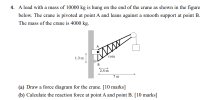 4. A load with a mass of 10000 kg is hung on the end of the crane as shown in the figure below. The crane is pivoted at point A and leans against a smooth support at point B The mass of the crane is 4000 kg. A com 1.3 m В 2.4 m 7 m (a) Draw a force diagram for the crane. [10 marks] (b) Calculate the reaction force at point A and point B. [10 marks]
A mass m2 = 15.0 kg is connected by a light cord to a mass m1...
A mass m2 = 15.0 kg is connected by a light cord to a mass m1 = 15.0 kg, which slides on a smooth horizontal surface. The pulley, of mass M = 1.00 kg, rotates about a frictionless axle and has a radius R = 0.200 m and a moment of inertia I = 0.0900 kg-m2 . The cord does not slip on the pulley. a) What is the magnitude of the acceleration of m1? b) What is the tension...
An object with mass m1 = 4.70 kg, rests on a frictionless horizontal table and is...
 An object with mass m1 = 4.70 kg, rests on a frictionless horizontal table and is connected to a cable that passes over a pulley and is then fastened to a hanging object with mass m2 = 11.7 kg, shown in the figure. as (a) Find the magnitude of the acceleration of each object m/s2 a1= m/s2 a2 (b) Find the tension in the cable N
An object with mass m1 = 4.70 kg, rests on a frictionless horizontal table and is...
An object with mass m1 = 4.70 kg, rests on a frictionless horizontal table and is connected to a cable that passes over a pulley and is then fastened to a hanging object with mass m2 = 12.0 kg, as shown in the figure. (a) Find the magnitude of the acceleration of each object. a1 = 12 m/s2 a2 = m/s2 (b) Find the tension in the cable.
A mass m1 = 5.6 kg rests on a frictionless table. It is connected by a massless and frictionless pulley to a second mass m2 = 3.8 kg that hangs freely.
A mass m1 = 5.6 kg rests on a frictionless table. It is connected by a massless and frictionless pulley to a second mass m2 = 3.8 kg that hangs freely.1) What is the magnitude of the acceleration of block 1?2) What is the tension in the string?3)Now the table is tilted at an angle of ? = 69.0° with respect to the vertical. Find the magnitude of the new acceleration of block 1.4) At what “critical” angle will the...
Mass m1 = 5.80 kg is connected to mass m2 = 3.50 kg by a light...
Mass m1 = 5.80 kg is connected to mass m2 = 3.50 kg by a light string that passes over a frictionless pulley. The pulley has a moment of inertia of 0.490 kg · m2 and a radius of 0.280 m. Mass m2 sits on a frictionless horizontal surface. The string does not slip while in motion on the pulley. Find the tension force T1 on mass m1 in N
A mass m1 = 6.6 kg rests on a frictionless table. It is connected by a...
A mass m1 = 6.6 kg rests on a frictionless table. It is connected by a massless and frictionless pulley to a second mass m2 = 3.7 kg that hangs freely. 1) What is the magnitude of the acceleration of block 1? 2) What is the tension in the string? 23.4 N Now the table is tilted at an angle of θ = 76° with respect to the vertical. Find the magnitude of the new acceleration of block 1. 2...
2. The shelf supports the electric motor which has a mass of 15 kg and mass...
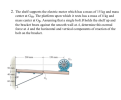 2. The shelf supports the electric motor which has a mass of 15 kg and mass center at Gm. The platform upon which it rests has a mass of 4 kg and mass center at Gp. Assuming that a single bolt B holds the shelf up and the bracket bears against the smooth wall at A, determine this normal force at A and the horizontal and vertical components of reaction of the bolt on the bracket. 200 mm 150 mm...
Consider a frictionless track as shown in the figure below. A block of mass m1 = 5.65 kg is released from A
 Consider a frictionless track as shown in the figure below. A
block of mass m1 = 5.65
kg is released from A. It makes a
head-on elastic collision at B with a block of
mass m2 = 20.0
kg that is initially at rest. Calculate the maximum
height to which m1 rises after the
collision.Two masses are shown on a frictionless wooden track. The left
part of the track curves downward from left to right, starting from
an almost-vertical slope and then decreasing in...
Consider a frictionless track as shown in the figure below. A
block of mass m1 = 5.65
kg is released from A. It makes a
head-on elastic collision at B with a block of
mass m2 = 20.0
kg that is initially at rest. Calculate the maximum
height to which m1 rises after the
collision.Two masses are shown on a frictionless wooden track. The left
part of the track curves downward from left to right, starting from
an almost-vertical slope and then decreasing in...
A small crane supports a mass of 10 kg as shown above. The crane boom is...
 A small crane supports a mass of 10 kg as shown above. The crane boom is 3 m long, has a uniformly distributed mass of 5 kg, and is hinged to the ground at its base, and it is attached to the ground behind it with a rope of tension T. What is the tension T (in Newtons) such that this crane is in static equilibrium? What is the magnitude of the force that the ground exerts on the crane...
 4. A load with a mass of 10000 kg is hung on the end of the crane as shown in the figure below. The crane is pivoted at point A and leans against a smooth support at point B The mass of the crane is 4000 kg. A com 1.3 m В 2.4 m 7 m (a) Draw a force diagram for the crane. [10 marks] (b) Calculate the reaction force at point A and point B. [10 marks]
 An object with mass m1 = 4.70 kg, rests on a frictionless horizontal table and is connected to a cable that passes over a pulley and is then fastened to a hanging object with mass m2 = 11.7 kg, shown in the figure. as (a) Find the magnitude of the acceleration of each object m/s2 a1= m/s2 a2 (b) Find the tension in the cable N
 2. The shelf supports the electric motor which has a mass of 15 kg and mass center at Gm. The platform upon which it rests has a mass of 4 kg and mass center at Gp. Assuming that a single bolt B holds the shelf up and the bracket bears against the smooth wall at A, determine this normal force at A and the horizontal and vertical components of reaction of the bolt on the bracket. 200 mm 150 mm...
 Consider a frictionless track as shown in the figure below. A
block of mass m1 = 5.65
kg is released from A. It makes a
head-on elastic collision at B with a block of
mass m2 = 20.0
kg that is initially at rest. Calculate the maximum
height to which m1 rises after the
collision.Two masses are shown on a frictionless wooden track. The left
part of the track curves downward from left to right, starting from
an almost-vertical slope and then decreasing in...
Consider a frictionless track as shown in the figure below. A
block of mass m1 = 5.65
kg is released from A. It makes a
head-on elastic collision at B with a block of
mass m2 = 20.0
kg that is initially at rest. Calculate the maximum
height to which m1 rises after the
collision.Two masses are shown on a frictionless wooden track. The left
part of the track curves downward from left to right, starting from
an almost-vertical slope and then decreasing in...
 A small crane supports a mass of 10 kg as shown above. The crane boom is 3 m long, has a uniformly distributed mass of 5 kg, and is hinged to the ground at its base, and it is attached to the ground behind it with a rope of tension T. What is the tension T (in Newtons) such that this crane is in static equilibrium? What is the magnitude of the force that the ground exerts on the crane...
Most questions answered within 3 hours.
-
Where is the error in this code sequence?
String s1 = "Hello";
String s2 = "ello";...
asked 11 months ago -
Financial data for Joel de Paris, Inc., for last year
follow:
Joel de Paris, Inc.
Balance...
asked 11 months ago -
Consider this reaction:
Al2(SO4)3 (aq)+ BaCl3
(aq) Al2Cl6 (aq)- +
3BaSO4(s) . What is the...
asked 11 months ago -
Suppose that Savneet is considering increasing her
recent random sample from 20 car rentals to 40...
asked 11 months ago -
Trucks arrive at an unloading terminal at an average rate of 120
per hour.
Trucks arrive...
asked 11 months ago -
Why are methanol and ethanol completely soluble in water while
octanol is not very little soluble....
asked 11 months ago -
A facilities manager at a university reads in a research report
that the mean amount of...
asked 11 months ago -
When the CuSO4 is rehydrated by adding water to the anhydrous
compound, is this an endothermic...
asked 11 months ago -
A ray of sunlight is passing from diamond into crown glass; the
angle of incidence is...
asked 11 months ago -
A block of mass 0.249 kg is placed on top of a light, vertical
spring of...
asked 11 months ago -
how do the kidneys compensate in the presences of acidosis
a) trigger hyperventilate
b) reserve acid...
asked 11 months ago -
Question 501 pts
The rental rate of capital to the firm increases. Which of the
following...
asked 11 months ago