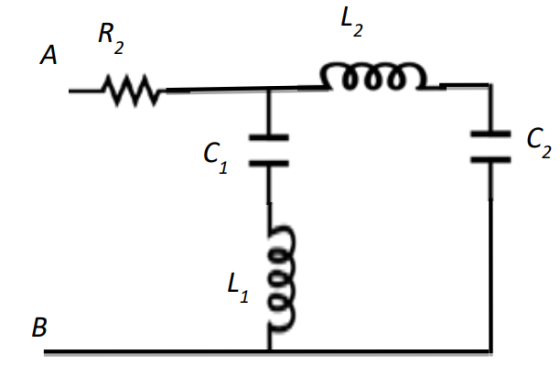
What is the equivalent impedance of this circuit between nodes A and B? Note: Do not simplify but simply recognize which elements are in series and parallel and compare to answers.

Homework Answers
Request Answer!
We need at least 10 more requests to produce the answer.
0 / 10 have requested this problem solution
The more requests, the faster the answer.
Add Answer to:
What is the equivalent impedance of this circuit between nodes A
and B? Note: Do not...
2012 Calculate the final equivalent resistance between terminals A and B? Ensure that you draw out...
 2012 Calculate the final equivalent resistance between terminals A and B? Ensure that you draw out each step. You should follow the process: a. Identify the parallel resistors using their labels and the parallel symbol notation (e.g. Rx = R1 || Rs), then work out the equivalent values for the parallel resistance(s), using your designated labels (e.g. Rx = 492). b. Redraw the circuit with the parallel resistors replaced by their equivalent resistance(s). Hint: replacing parallel resistors does not remove...
1. For the circuit below: (a) Identify and label all distinct nodes. (b) Identify all combinations...
 1. For the circuit below: (a) Identify and label all distinct nodes. (b) Identify all combinations of 2 or more circuit elements that are connected in series. (c) Identify pairs of circuit elements that are connected in parallel. 312 222 2 20 V 1322 62
Problem 4.2-6 The circuit in (b) is equivalent to the circuit in (a). Circuit (b) is...
 Problem 4.2-6 The circuit in (b) is equivalent to the circuit in (a). Circuit (b) is obtained from Circuit (a) by replacing series and parallel combinations of resistors by equivalent resistors. 71 22 48 22 30 22 71 2 702 45.092 7012 22 2 30 mA (1 130 mA Ô 812 § 9012 Ž 30 mA 130mA Ô 42.631 S Voltages V1, V2 and V3 are the node voltages at nodes 1,2 and 3 of the equivalent circuit. Determine the...
Q1) Find the equivalent impedance of the circuit below in the S-domain. UC2F 30.5 H is(t)...
 Q1) Find the equivalent impedance of the circuit below in the S-domain. UC2F 30.5 H is(t) Q2) The circuit of shown below, Given that R-422, L=2H and i (0-) = 1 A. The current source in the circuit is given as is(t) = 3e 'u(t) A. a) Considering the initial conditions, redraw the circuit in the s-domain. b) Identify which circuit analysis approach could be used to solve this problem. c) Formulate the problem by writing the equations that describe...
3. Please reduce this circuit with impedances (i.e., what is Vou(s)/Vin(s)?). All the resistors have the...
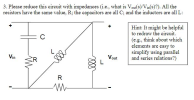 3. Please reduce this circuit with impedances (i.e., what is Vou(s)/Vin(s)?). All the resistors have the same value, R; the capacitors are all C; and the inductors are all L Hint: It might be helpful to redraw the circuit. C (e.g., think about which elements are easy to simplify using parallel and series relations?) Vin Vout L R
(50 points) a o 2 Determine the series equivalent circuit at f- 1 kHz. R1 =...
 (50 points) a o 2 Determine the series equivalent circuit at f- 1 kHz. R1 = 3.3k, R2 = 1.2M2, C = 100nF, L = 380mH The equivalent circuit is a? circuit. k2. help In the equivalent circuit, the resistor is of (numbers) Following this, in addition to the resistor, the remaining element in the equivalent circuit is of Note: If it is a R only circuit, input '0' and 'NA'
2. LRC series circuit. [10 pts.] Consider an LRC series circuit driven by an ac voltage source Vi...
 2. LRC series circuit. [10 pts.] Consider an LRC series circuit driven by an ac voltage source Vin Vo cos(wt). (a) Derive an expression for the real ac current in the circuit in terms of L, R, C, and a. (b) Determine the resonant frequency f, and angular frequency w, by direct differentiation of the current amplitude from part (a). Compare your result to LC (c) Determine the Q factor of this circuit in terms of L, R, and C....
Determine resonant frequency, amplitude, impedance, and phase angle. (b) Suppose the circuit parameters in a series...
 Determine resonant frequency, amplitude, impedance,
and phase angle.
(b) Suppose the circuit parameters in a series RLC circuit are: L = 1.0 uH, C = 10.0 nF, R= 10092, and the source voltage is 220 V. Determine the resonant frequency of the circuit and the amplitude of the current at resonance. If the frequency of the input voltage source is 50 Hz, calculate the impedance and the phase angle. f = 1 / 2 x 5c = 1/2 X 511...
Determine resonant frequency, amplitude, impedance,
and phase angle.
(b) Suppose the circuit parameters in a series RLC circuit are: L = 1.0 uH, C = 10.0 nF, R= 10092, and the source voltage is 220 V. Determine the resonant frequency of the circuit and the amplitude of the current at resonance. If the frequency of the input voltage source is 50 Hz, calculate the impedance and the phase angle. f = 1 / 2 x 5c = 1/2 X 511...
Part A: What is the impedance of the circuit? Part B: What is the current amplitude?...
 Part A: What is the impedance of the circuit?
Part B: What is the current amplitude?
Part C: What is the phase angle of the source voltage with
respect to the current?
Part D: Does the source voltage lag or lead the current?
Part E: What is the voltage amplitude across the resistor?
Part F: What is the voltage amplitude across the inductor?
Part G: What is the voltage amplitudes across the capacitor?
Constants You have a resistor of resistance...
Part A: What is the impedance of the circuit?
Part B: What is the current amplitude?
Part C: What is the phase angle of the source voltage with
respect to the current?
Part D: Does the source voltage lag or lead the current?
Part E: What is the voltage amplitude across the resistor?
Part F: What is the voltage amplitude across the inductor?
Part G: What is the voltage amplitudes across the capacitor?
Constants You have a resistor of resistance...
R3 R3 w Find the equivalent resistance between A and B when R1 =952, R2 =84...
 R3 R3 w Find the equivalent resistance between A and B when R1 =952, R2 =84 12 and R3 =242. (Note you can enter the units as ohm. Give your answer correct to 3 significant figures.) Number Units Consider the circuit below. . + M + 10 + IS + 1 a. Recall that in a circuit a node is any wire connecting the terminals of two or more circuit elements. How many nodes are contained in this circuit? Numbei...
 2012 Calculate the final equivalent resistance between terminals A and B? Ensure that you draw out each step. You should follow the process: a. Identify the parallel resistors using their labels and the parallel symbol notation (e.g. Rx = R1 || Rs), then work out the equivalent values for the parallel resistance(s), using your designated labels (e.g. Rx = 492). b. Redraw the circuit with the parallel resistors replaced by their equivalent resistance(s). Hint: replacing parallel resistors does not remove...
 1. For the circuit below: (a) Identify and label all distinct nodes. (b) Identify all combinations of 2 or more circuit elements that are connected in series. (c) Identify pairs of circuit elements that are connected in parallel. 312 222 2 20 V 1322 62
 Problem 4.2-6 The circuit in (b) is equivalent to the circuit in (a). Circuit (b) is obtained from Circuit (a) by replacing series and parallel combinations of resistors by equivalent resistors. 71 22 48 22 30 22 71 2 702 45.092 7012 22 2 30 mA (1 130 mA Ô 812 § 9012 Ž 30 mA 130mA Ô 42.631 S Voltages V1, V2 and V3 are the node voltages at nodes 1,2 and 3 of the equivalent circuit. Determine the...
 Q1) Find the equivalent impedance of the circuit below in the S-domain. UC2F 30.5 H is(t) Q2) The circuit of shown below, Given that R-422, L=2H and i (0-) = 1 A. The current source in the circuit is given as is(t) = 3e 'u(t) A. a) Considering the initial conditions, redraw the circuit in the s-domain. b) Identify which circuit analysis approach could be used to solve this problem. c) Formulate the problem by writing the equations that describe...
 3. Please reduce this circuit with impedances (i.e., what is Vou(s)/Vin(s)?). All the resistors have the same value, R; the capacitors are all C; and the inductors are all L Hint: It might be helpful to redraw the circuit. C (e.g., think about which elements are easy to simplify using parallel and series relations?) Vin Vout L R
 (50 points) a o 2 Determine the series equivalent circuit at f- 1 kHz. R1 = 3.3k, R2 = 1.2M2, C = 100nF, L = 380mH The equivalent circuit is a? circuit. k2. help In the equivalent circuit, the resistor is of (numbers) Following this, in addition to the resistor, the remaining element in the equivalent circuit is of Note: If it is a R only circuit, input '0' and 'NA'
 2. LRC series circuit. [10 pts.] Consider an LRC series circuit driven by an ac voltage source Vin Vo cos(wt). (a) Derive an expression for the real ac current in the circuit in terms of L, R, C, and a. (b) Determine the resonant frequency f, and angular frequency w, by direct differentiation of the current amplitude from part (a). Compare your result to LC (c) Determine the Q factor of this circuit in terms of L, R, and C....
 Determine resonant frequency, amplitude, impedance,
and phase angle.
(b) Suppose the circuit parameters in a series RLC circuit are: L = 1.0 uH, C = 10.0 nF, R= 10092, and the source voltage is 220 V. Determine the resonant frequency of the circuit and the amplitude of the current at resonance. If the frequency of the input voltage source is 50 Hz, calculate the impedance and the phase angle. f = 1 / 2 x 5c = 1/2 X 511...
Determine resonant frequency, amplitude, impedance,
and phase angle.
(b) Suppose the circuit parameters in a series RLC circuit are: L = 1.0 uH, C = 10.0 nF, R= 10092, and the source voltage is 220 V. Determine the resonant frequency of the circuit and the amplitude of the current at resonance. If the frequency of the input voltage source is 50 Hz, calculate the impedance and the phase angle. f = 1 / 2 x 5c = 1/2 X 511...
 Part A: What is the impedance of the circuit?
Part B: What is the current amplitude?
Part C: What is the phase angle of the source voltage with
respect to the current?
Part D: Does the source voltage lag or lead the current?
Part E: What is the voltage amplitude across the resistor?
Part F: What is the voltage amplitude across the inductor?
Part G: What is the voltage amplitudes across the capacitor?
Constants You have a resistor of resistance...
Part A: What is the impedance of the circuit?
Part B: What is the current amplitude?
Part C: What is the phase angle of the source voltage with
respect to the current?
Part D: Does the source voltage lag or lead the current?
Part E: What is the voltage amplitude across the resistor?
Part F: What is the voltage amplitude across the inductor?
Part G: What is the voltage amplitudes across the capacitor?
Constants You have a resistor of resistance...
 R3 R3 w Find the equivalent resistance between A and B when R1 =952, R2 =84 12 and R3 =242. (Note you can enter the units as ohm. Give your answer correct to 3 significant figures.) Number Units Consider the circuit below. . + M + 10 + IS + 1 a. Recall that in a circuit a node is any wire connecting the terminals of two or more circuit elements. How many nodes are contained in this circuit? Numbei...
Most questions answered within 3 hours.
-
Where is the error in this code sequence?
String s1 = "Hello";
String s2 = "ello";...
asked 11 months ago -
Financial data for Joel de Paris, Inc., for last year
follow:
Joel de Paris, Inc.
Balance...
asked 11 months ago -
Consider this reaction:
Al2(SO4)3 (aq)+ BaCl3
(aq) Al2Cl6 (aq)- +
3BaSO4(s) . What is the...
asked 11 months ago -
Suppose that Savneet is considering increasing her
recent random sample from 20 car rentals to 40...
asked 11 months ago -
Trucks arrive at an unloading terminal at an average rate of 120
per hour.
Trucks arrive...
asked 11 months ago -
Why are methanol and ethanol completely soluble in water while
octanol is not very little soluble....
asked 11 months ago -
A facilities manager at a university reads in a research report
that the mean amount of...
asked 11 months ago -
When the CuSO4 is rehydrated by adding water to the anhydrous
compound, is this an endothermic...
asked 11 months ago -
A ray of sunlight is passing from diamond into crown glass; the
angle of incidence is...
asked 11 months ago -
A block of mass 0.249 kg is placed on top of a light, vertical
spring of...
asked 11 months ago -
how do the kidneys compensate in the presences of acidosis
a) trigger hyperventilate
b) reserve acid...
asked 11 months ago -
Question 501 pts
The rental rate of capital to the firm increases. Which of the
following...
asked 11 months ago