![Let X and Y be two random variables with ECr)- and EY2 a. Show that the constant c that minimizes E(Y-c)2 is c = μ. oo. -fx))X] is <00. b. Deduce that the random variable f(X) that minimizes E[Y f(X) = E[YlX1. c. Deduce that the random variable f (X) that minimizes E(Y-(x))2 is also f(X) = E[Y|X]](http://img.homeworklib.com/questions/58006a50-8e65-11eb-9570-09227e0101b5.png?x-oss-process=image/resize,w_560)
Homework Answers


Add Answer to:
Note:
I want the answers step by step with explanations and
details
Thank you
Let X...
C2.3 Let X and Y be random variables with finite variance, so that EX2o0 (i) Show...
 C2.3 Let X and Y be random variables with finite variance, so that EX2o0 (i) Show that E(X) - (EX) E(X - EX)2, and hence that the variance of (ii) By considering (|XI Y)2, or otherwise, show that XY has finite expecta- (iii) Let q(t) = E(X + tY)2. Show that q(t)2 0, and by considering the roots of and EY2 < oo. X is always non-negative. tion the equation q(t) 0, deduce that
Let X be a continuous random variable uniformly distributed on the unit interval (0, 1), .e...
 Let X be a continuous random variable uniformly distributed on the unit interval (0, 1), .e X has a density f(x) = { 1, 0<r<1 f (x)- 0, elsewhere μ+ơX, where-oo < μ < 00, σ > 0 (a) Find the density of Y (b) Find E(Y) and V(Y)
Please show work step by step 3) Two random variables X and Y have the following...
 Please show work step by
step
3) Two random variables X and Y have the following joint PDF fx(x, y) = 1zu(x)u(y) e “CI)-(3) Calculate: a) P (2<x<4, -1<Y<5); b) P (0<x< 00, -00<Y<-2).
Please show work step by
step
3) Two random variables X and Y have the following joint PDF fx(x, y) = 1zu(x)u(y) e “CI)-(3) Calculate: a) P (2<x<4, -1<Y<5); b) P (0<x< 00, -00<Y<-2).
The random variables X and Y are independent with exponential densities fx (x) = e-"u(x) (a) Let ...
 The random variables X and Y are independent with exponential densities fx (x) = e-"u(x) (a) Let Z = 2X + and w =-. Find the joint density of random variables Z and W (b) Find the density of random variable W (c) Find the density of random variable Z
The random variables X and Y are independent with exponential densities fx (x) = e-"u(x) (a) Let Z = 2X + and w =-. Find the joint density of random...
The random variables X and Y are independent with exponential densities fx (x) = e-"u(x) (a) Let Z = 2X + and w =-. Find the joint density of random variables Z and W (b) Find the density of random variable W (c) Find the density of random variable Z
The random variables X and Y are independent with exponential densities fx (x) = e-"u(x) (a) Let Z = 2X + and w =-. Find the joint density of random...
Problem 5 of 5Sum of random variables Let Mr(μ, σ2) denote the Gaussian (or normal) pdf with Inea...
 Problem 5 of 5Sum of random variables Let Mr(μ, σ2) denote the Gaussian (or normal) pdf with Inean ,, and variance σ2, namely, fx (x) = exp ( 2-2 . Let X and Y be two i.i.d. random variables distributed as Gaussian with mean 0 and variance 1. Show that Z-XY is again a Gaussian random variable but with mean 0 and variance 2. Show your full proof with integrals. 2. From above, can you derive what will be the...
Prove these following statements. (please provide me the correct explanation for this problem.) (a) For any...
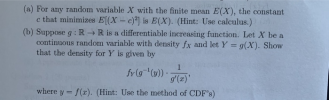 Prove these following statements.
(please provide me the correct explanation for this
problem.)
(a) For any random variable X with the finite mean E(X), the constant c that minimizes E[(x - c)] is E(X). (Hint: Use calculus.) (b) Suppose g: R R is a differentiable increasing function. Let X be a continuous random variable with density fx and let Y = g(X). Show that the density for Y is given by fy(g~(y))'() where y = f(x). (Hint: Use the method...
Prove these following statements.
(please provide me the correct explanation for this
problem.)
(a) For any random variable X with the finite mean E(X), the constant c that minimizes E[(x - c)] is E(X). (Hint: Use calculus.) (b) Suppose g: R R is a differentiable increasing function. Let X be a continuous random variable with density fx and let Y = g(X). Show that the density for Y is given by fy(g~(y))'() where y = f(x). (Hint: Use the method...
Open book, open notes. No collaboration. Return this sheet along with your answers (17) 1. Assume...
 Open book, open notes. No collaboration. Return this sheet along with your answers (17) 1. Assume that a binary communication system sends message "O" as -5 V and message l" as +5 V randomly but with a "I" three times as likely as a "O". Because of uniformly-distributed noise picked up during transmission, a "o" arrives at the receiver input as a voltage uniformly distributed between -7 V and -3 V, and a "" arrives at the receiver input as...
2-2.3 A probability distribution function for a random variable has the form F,(x) = A(1-exp[-(x-1)) 1...
 2-2.3 A probability distribution function for a random variable has the form F,(x) = A(1-exp[-(x-1)) 1 < x < oo -00<xs1 a) For what value of A is this a valid probability distribution function? b) What is Fx (2)? c) What is the probability that the random variable lies in the interval 2 X < 00? d) What is the probability that the random variable lies in the interval 1 <X s3?
I am studying Continuous Random Variables. Hope can some one tell me the solutions of these two problems! II.1 Let X be...
 I am studying Continuous Random Variables.
Hope can some one tell me the solutions of these two
problems!
II.1 Let X be a continuous random variable with the density function 1/4 if x E (-2,2) 0 otherwise &Cx)={ Find the probability density function of Z = X density function fx. Find the distribution function Fy (t) and the density function f,(t) of Y=지 (in terms of Fx and fx).
II.1 Let X be a continuous random variable with the density...
I am studying Continuous Random Variables.
Hope can some one tell me the solutions of these two
problems!
II.1 Let X be a continuous random variable with the density function 1/4 if x E (-2,2) 0 otherwise &Cx)={ Find the probability density function of Z = X density function fx. Find the distribution function Fy (t) and the density function f,(t) of Y=지 (in terms of Fx and fx).
II.1 Let X be a continuous random variable with the density...
show steps thank you . Additional Problem 6. Let X be a continuous random variable with...
 show steps thank you
. Additional Problem 6. Let X be a continuous random variable with pdf f(x) = (z + 1), -1 x 2. (a) Compute E(X), the mean of X. (b) Compute Var(X), the variance of X (c) Find an expression for Fx(), the edf of X. (d) Calculate P(X > 0). (e) Compute the mean of Y, where Y (f) Find mp, the pth quantile of X X-1 X+1
show steps thank you
. Additional Problem 6. Let X be a continuous random variable with pdf f(x) = (z + 1), -1 x 2. (a) Compute E(X), the mean of X. (b) Compute Var(X), the variance of X (c) Find an expression for Fx(), the edf of X. (d) Calculate P(X > 0). (e) Compute the mean of Y, where Y (f) Find mp, the pth quantile of X X-1 X+1
 C2.3 Let X and Y be random variables with finite variance, so that EX2o0 (i) Show that E(X) - (EX) E(X - EX)2, and hence that the variance of (ii) By considering (|XI Y)2, or otherwise, show that XY has finite expecta- (iii) Let q(t) = E(X + tY)2. Show that q(t)2 0, and by considering the roots of and EY2 < oo. X is always non-negative. tion the equation q(t) 0, deduce that
 Let X be a continuous random variable uniformly distributed on the unit interval (0, 1), .e X has a density f(x) = { 1, 0<r<1 f (x)- 0, elsewhere μ+ơX, where-oo < μ < 00, σ > 0 (a) Find the density of Y (b) Find E(Y) and V(Y)
 Please show work step by
step
3) Two random variables X and Y have the following joint PDF fx(x, y) = 1zu(x)u(y) e “CI)-(3) Calculate: a) P (2<x<4, -1<Y<5); b) P (0<x< 00, -00<Y<-2).
Please show work step by
step
3) Two random variables X and Y have the following joint PDF fx(x, y) = 1zu(x)u(y) e “CI)-(3) Calculate: a) P (2<x<4, -1<Y<5); b) P (0<x< 00, -00<Y<-2).
 The random variables X and Y are independent with exponential densities fx (x) = e-"u(x) (a) Let Z = 2X + and w =-. Find the joint density of random variables Z and W (b) Find the density of random variable W (c) Find the density of random variable Z
The random variables X and Y are independent with exponential densities fx (x) = e-"u(x) (a) Let Z = 2X + and w =-. Find the joint density of random...
The random variables X and Y are independent with exponential densities fx (x) = e-"u(x) (a) Let Z = 2X + and w =-. Find the joint density of random variables Z and W (b) Find the density of random variable W (c) Find the density of random variable Z
The random variables X and Y are independent with exponential densities fx (x) = e-"u(x) (a) Let Z = 2X + and w =-. Find the joint density of random...
 Problem 5 of 5Sum of random variables Let Mr(μ, σ2) denote the Gaussian (or normal) pdf with Inean ,, and variance σ2, namely, fx (x) = exp ( 2-2 . Let X and Y be two i.i.d. random variables distributed as Gaussian with mean 0 and variance 1. Show that Z-XY is again a Gaussian random variable but with mean 0 and variance 2. Show your full proof with integrals. 2. From above, can you derive what will be the...
 Prove these following statements.
(please provide me the correct explanation for this
problem.)
(a) For any random variable X with the finite mean E(X), the constant c that minimizes E[(x - c)] is E(X). (Hint: Use calculus.) (b) Suppose g: R R is a differentiable increasing function. Let X be a continuous random variable with density fx and let Y = g(X). Show that the density for Y is given by fy(g~(y))'() where y = f(x). (Hint: Use the method...
Prove these following statements.
(please provide me the correct explanation for this
problem.)
(a) For any random variable X with the finite mean E(X), the constant c that minimizes E[(x - c)] is E(X). (Hint: Use calculus.) (b) Suppose g: R R is a differentiable increasing function. Let X be a continuous random variable with density fx and let Y = g(X). Show that the density for Y is given by fy(g~(y))'() where y = f(x). (Hint: Use the method...
 Open book, open notes. No collaboration. Return this sheet along with your answers (17) 1. Assume that a binary communication system sends message "O" as -5 V and message l" as +5 V randomly but with a "I" three times as likely as a "O". Because of uniformly-distributed noise picked up during transmission, a "o" arrives at the receiver input as a voltage uniformly distributed between -7 V and -3 V, and a "" arrives at the receiver input as...
 2-2.3 A probability distribution function for a random variable has the form F,(x) = A(1-exp[-(x-1)) 1 < x < oo -00<xs1 a) For what value of A is this a valid probability distribution function? b) What is Fx (2)? c) What is the probability that the random variable lies in the interval 2 X < 00? d) What is the probability that the random variable lies in the interval 1 <X s3?
 I am studying Continuous Random Variables.
Hope can some one tell me the solutions of these two
problems!
II.1 Let X be a continuous random variable with the density function 1/4 if x E (-2,2) 0 otherwise &Cx)={ Find the probability density function of Z = X density function fx. Find the distribution function Fy (t) and the density function f,(t) of Y=지 (in terms of Fx and fx).
II.1 Let X be a continuous random variable with the density...
I am studying Continuous Random Variables.
Hope can some one tell me the solutions of these two
problems!
II.1 Let X be a continuous random variable with the density function 1/4 if x E (-2,2) 0 otherwise &Cx)={ Find the probability density function of Z = X density function fx. Find the distribution function Fy (t) and the density function f,(t) of Y=지 (in terms of Fx and fx).
II.1 Let X be a continuous random variable with the density...
 show steps thank you
. Additional Problem 6. Let X be a continuous random variable with pdf f(x) = (z + 1), -1 x 2. (a) Compute E(X), the mean of X. (b) Compute Var(X), the variance of X (c) Find an expression for Fx(), the edf of X. (d) Calculate P(X > 0). (e) Compute the mean of Y, where Y (f) Find mp, the pth quantile of X X-1 X+1
show steps thank you
. Additional Problem 6. Let X be a continuous random variable with pdf f(x) = (z + 1), -1 x 2. (a) Compute E(X), the mean of X. (b) Compute Var(X), the variance of X (c) Find an expression for Fx(), the edf of X. (d) Calculate P(X > 0). (e) Compute the mean of Y, where Y (f) Find mp, the pth quantile of X X-1 X+1
Most questions answered within 3 hours.
-
Where is the error in this code sequence?
String s1 = "Hello";
String s2 = "ello";...
asked 10 months ago -
Financial data for Joel de Paris, Inc., for last year
follow:
Joel de Paris, Inc.
Balance...
asked 10 months ago -
Consider this reaction:
Al2(SO4)3 (aq)+ BaCl3
(aq) Al2Cl6 (aq)- +
3BaSO4(s) . What is the...
asked 10 months ago -
Suppose that Savneet is considering increasing her
recent random sample from 20 car rentals to 40...
asked 10 months ago -
Trucks arrive at an unloading terminal at an average rate of 120
per hour.
Trucks arrive...
asked 10 months ago -
Why are methanol and ethanol completely soluble in water while
octanol is not very little soluble....
asked 10 months ago -
A facilities manager at a university reads in a research report
that the mean amount of...
asked 10 months ago -
When the CuSO4 is rehydrated by adding water to the anhydrous
compound, is this an endothermic...
asked 10 months ago -
A ray of sunlight is passing from diamond into crown glass; the
angle of incidence is...
asked 10 months ago -
A block of mass 0.249 kg is placed on top of a light, vertical
spring of...
asked 10 months ago -
how do the kidneys compensate in the presences of acidosis
a) trigger hyperventilate
b) reserve acid...
asked 10 months ago -
Question 501 pts
The rental rate of capital to the firm increases. Which of the
following...
asked 10 months ago