

Homework Answers
Add Answer to:
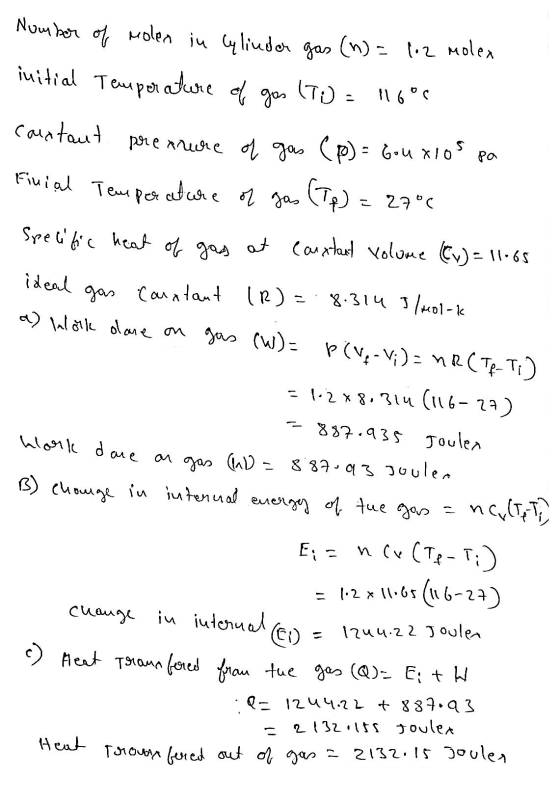
A cylinder contains 1.2 moles of ideal gas, initially at a temperature of 116°C. The cylinder...
A cylinder contains 9.8 moles of ideal gas, initially at a temperature of 119°C. The cylinder is provided with a frictio...
A cylinder contains 9.8 moles of ideal gas, initially at a temperature of 119°C. The cylinder is provided with a frictionless piston, which maintains a constant pressure of 7.4 × 10⁵ Pa on the gas. The gas is cooled until its temperature has decreased to 27°C. For the gas CV = 14.41 J/mol ∙ K, and the ideal gas constant R = 8.314 J/mol · K. (a) Find the work done by (or on) the gas during this process. Is...
A 12 cm -diameter cylinder contains argon gas at 10 atm pressure and a temperature of...
 A 12 cm -diameter cylinder contains argon gas at 10 atm pressure and a temperature of 50 °C. A piston can slide Part in and out of the cylinder. The cylinder's initial length is 21 cm. 2700 J of heat are transferred to the gas, What is the final temperature of the cylinder? causing the gas to expand at constant pressure. Express your answer to two significant figures and include the appropriate units. ? degC Value TTinal Request Answer Submit...
ANSWER ALL PARTS As shown in the pV diagram, an ideal gas moves through a cycle...
 ANSWER ALL PARTS
As shown in the pV diagram, an ideal gas moves through a cycle from A to B to C and then back to A. From state A to state B, the ideal gas absorbs 80.0 J of heat and its internal (i.e. its thermal) energy increases by 30.0 J. From state B to state C, the internal energy of the ideal gas decreases by 20.0 J. As such, determine the following quantities: B V The work done...
ANSWER ALL PARTS
As shown in the pV diagram, an ideal gas moves through a cycle from A to B to C and then back to A. From state A to state B, the ideal gas absorbs 80.0 J of heat and its internal (i.e. its thermal) energy increases by 30.0 J. From state B to state C, the internal energy of the ideal gas decreases by 20.0 J. As such, determine the following quantities: B V The work done...
d. Two moles of an ideal gas are compressed in a cylinder at a constant temperature...
 d. Two moles of an ideal gas are compressed in a cylinder at a constant temperature of (75°C) until the original pressure, (2x10$ Pa), is tripled. Given that (R = 8.314 J/mol-K), Find: (1) The amount of work done. () The final volume of the gas.
1.06 mol of an ideal gas in a piston-cylinder initially occupies 9.0 L at 320 °C...
 1.06 mol of an ideal gas in a piston-cylinder initially occupies 9.0 L at 320 °C and constant pressure. Part A Suppose the temperature increases to 399 °C. Calculate the work in )) done on or by the gas. Express your answer using 3 significant figures. ΑΣΦ 2 ? w= Submit Previous Answers Request Answer
During an adiabatic expansion the temperature of 0.490 mol of argon (Ar) drops from 64.0 °C...
 During an adiabatic expansion the temperature of 0.490 mol of argon (Ar) drops from 64.0 °C to 10.0 °C. The argon may be treated as an ideal gas. How much work does the gas do? Express your answer with the appropriate units. t μΑ ? 288 W J Submit Previous Answers Request Answer X Incorrect; Try Again; 2 attempts remaining You may have forgotten that the process is adiabatic, not isobaric. Recall the definition of this process, and use the...
Part A Constants One mole of ideal gas is slowly compressed to one-third of its original...
 Part A Constants One mole of ideal gas is slowly compressed to one-third of its original volume. In this compression, the work done on the gas has magnitude 694 J. For the gas, Cp 7R/2. If the process is isothermal, what is the heat flow Q for the gas? Express your answer to three significant figures and include the appropriate units. Q- 1 Value Submit tAnswer ▼ Part B Does heat flow into or out of the gas? O Heat...
A cylinder of monatomic ideal gas is sealed in a cylinder by a piston. Initially, the...
A cylinder of monatomic ideal gas is sealed in a cylinder by a piston. Initially, the gas occupies a volume of 2.50 L and the pressure is initially 125 kPa. The cylinder is placed in an oven that maintains the temperature at a constant value. 80.0 J of work is then done on the piston, compressing the gas (in other words, the gas does -80 J of work). The work is done very slowly so that the gas maintains a...
A cylinder contains 0.300 mol of carbon dioxide (CO2)gas at a temperature of 23.0 ∘C. The...
A cylinder contains 0.300 mol of carbon dioxide (CO2)gas at a temperature of 23.0 ∘C. The cylinder is provided with a frictionless piston, which maintains a constant pressure of 1.00 atm on the gas. The cylinder is placed on a hot plate and a 920 J of heat flows into the gas, thereby raising its temperature to 130 ∘C. Assume that the CO2 may be treated as an ideal gas. 1. What is the change in internal energy of the...
A monatomic ideal gas has pressure pi and temperature Ti. It is contained in a cylinder...
 A monatomic ideal gas has pressure pi and temperature Ti. It is contained in a cylinder of volume V1 with a movable piston, so that it can do work on the outside world. Part A Consider the following three-step transformation of the gas: 1. The gas is heated at constant volume until the pressure reaches Apı (where A>1). 2. The gas is then expanded at constant temperature until the pressure returns to Pi. 3. The gas is then cooled at...
 A 12 cm -diameter cylinder contains argon gas at 10 atm pressure and a temperature of 50 °C. A piston can slide Part in and out of the cylinder. The cylinder's initial length is 21 cm. 2700 J of heat are transferred to the gas, What is the final temperature of the cylinder? causing the gas to expand at constant pressure. Express your answer to two significant figures and include the appropriate units. ? degC Value TTinal Request Answer Submit...
 ANSWER ALL PARTS
As shown in the pV diagram, an ideal gas moves through a cycle from A to B to C and then back to A. From state A to state B, the ideal gas absorbs 80.0 J of heat and its internal (i.e. its thermal) energy increases by 30.0 J. From state B to state C, the internal energy of the ideal gas decreases by 20.0 J. As such, determine the following quantities: B V The work done...
ANSWER ALL PARTS
As shown in the pV diagram, an ideal gas moves through a cycle from A to B to C and then back to A. From state A to state B, the ideal gas absorbs 80.0 J of heat and its internal (i.e. its thermal) energy increases by 30.0 J. From state B to state C, the internal energy of the ideal gas decreases by 20.0 J. As such, determine the following quantities: B V The work done...
 d. Two moles of an ideal gas are compressed in a cylinder at a constant temperature of (75°C) until the original pressure, (2x10$ Pa), is tripled. Given that (R = 8.314 J/mol-K), Find: (1) The amount of work done. () The final volume of the gas.
 1.06 mol of an ideal gas in a piston-cylinder initially occupies 9.0 L at 320 °C and constant pressure. Part A Suppose the temperature increases to 399 °C. Calculate the work in )) done on or by the gas. Express your answer using 3 significant figures. ΑΣΦ 2 ? w= Submit Previous Answers Request Answer
 During an adiabatic expansion the temperature of 0.490 mol of argon (Ar) drops from 64.0 °C to 10.0 °C. The argon may be treated as an ideal gas. How much work does the gas do? Express your answer with the appropriate units. t μΑ ? 288 W J Submit Previous Answers Request Answer X Incorrect; Try Again; 2 attempts remaining You may have forgotten that the process is adiabatic, not isobaric. Recall the definition of this process, and use the...
 Part A Constants One mole of ideal gas is slowly compressed to one-third of its original volume. In this compression, the work done on the gas has magnitude 694 J. For the gas, Cp 7R/2. If the process is isothermal, what is the heat flow Q for the gas? Express your answer to three significant figures and include the appropriate units. Q- 1 Value Submit tAnswer ▼ Part B Does heat flow into or out of the gas? O Heat...
 A monatomic ideal gas has pressure pi and temperature Ti. It is contained in a cylinder of volume V1 with a movable piston, so that it can do work on the outside world. Part A Consider the following three-step transformation of the gas: 1. The gas is heated at constant volume until the pressure reaches Apı (where A>1). 2. The gas is then expanded at constant temperature until the pressure returns to Pi. 3. The gas is then cooled at...
Most questions answered within 3 hours.
-
Where is the error in this code sequence?
String s1 = "Hello";
String s2 = "ello";...
asked 11 months ago -
Financial data for Joel de Paris, Inc., for last year
follow:
Joel de Paris, Inc.
Balance...
asked 11 months ago -
Consider this reaction:
Al2(SO4)3 (aq)+ BaCl3
(aq) Al2Cl6 (aq)- +
3BaSO4(s) . What is the...
asked 11 months ago -
Suppose that Savneet is considering increasing her
recent random sample from 20 car rentals to 40...
asked 11 months ago -
Trucks arrive at an unloading terminal at an average rate of 120
per hour.
Trucks arrive...
asked 11 months ago -
Why are methanol and ethanol completely soluble in water while
octanol is not very little soluble....
asked 11 months ago -
A facilities manager at a university reads in a research report
that the mean amount of...
asked 11 months ago -
When the CuSO4 is rehydrated by adding water to the anhydrous
compound, is this an endothermic...
asked 11 months ago -
A ray of sunlight is passing from diamond into crown glass; the
angle of incidence is...
asked 11 months ago -
A block of mass 0.249 kg is placed on top of a light, vertical
spring of...
asked 11 months ago -
how do the kidneys compensate in the presences of acidosis
a) trigger hyperventilate
b) reserve acid...
asked 11 months ago -
Question 501 pts
The rental rate of capital to the firm increases. Which of the
following...
asked 11 months ago