A system is given by two compartments separated by a thin membrane, and solute moves from one compartment to the other by diffusion. The volume of compartment 1 is 0.03 cm^3 and compartment 2 is 0.01 cm^3. Suppose 50 M of solute is dumped into compartment 2, and the concentration response for compartment 1 is c1(t)= 1250(1- e^(-0.01t) u(t) M/cm^3 . (a) Find the transfer rate. (b) Solve for the concentration in compartment 2.

Homework Answers
Here the transfer rate is net Number of moles passing the meberane in a second.This net number of moles passing can be found by measuring the change in the number of moles of solute in any of the compartments.As we are given the concentration function of compartment 1,
Concentration (M/cm3)x volume of compartment
1(cm3) =(  x 0.03
)M gives the number of moles.So the change in number of moles in
this compartment with time an be found by differentiating the above
with respect to time.
x 0.03
)M gives the number of moles.So the change in number of moles in
this compartment with time an be found by differentiating the above
with respect to time.



Transfer Rate (Num. of moles per second)
b)For finding c2(t),
We know that sum of number of moles of solute in both compartments will always be equal to 50M[As there is no removal or addition of further solute to the system]
Number of moles in compartment 1 = c1t x volume of compartment 1 = c1(t) x 0.03 M
Number of moles in compartment 2 = c2t x volume of compartment 2 = c2(t) x 0.01 M
Sum of both number of moles =50M





At time t=0, concentration in compartment 2 = No of moles / volume = 50/0.01 =5000M/cm3
We can verify c2(t),by substitutuing t= 0, and we get 5000 .So verified.
Hope it helps and if it does plz give thumbs up.
Thank You and All the Best
Add Answer to:
A system is given by two compartments separated by a thin
membrane, and solute moves from...
MASS TRANSFER III. A solute diffuses through a membrane that separates two compartments A and B...
 MASS TRANSFER
III. A solute diffuses through a membrane that separates two compartments A and B that have different initial concentrations. The solute concentrations in the two compartments as a function of time, CA and CB are shown in Figure III-. The volumes of the two compartments are VA and (A) VA< VB (B) Solute diffuses from compartment B to A. c. Only B is true d. A and B are false a. A and B are true b. Only...
MASS TRANSFER
III. A solute diffuses through a membrane that separates two compartments A and B that have different initial concentrations. The solute concentrations in the two compartments as a function of time, CA and CB are shown in Figure III-. The volumes of the two compartments are VA and (A) VA< VB (B) Solute diffuses from compartment B to A. c. Only B is true d. A and B are false a. A and B are true b. Only...
a A rigid, tank contains two compartments, each of volume 1m2, separated by a membrane. Compartment...
 a A rigid, tank contains two compartments, each of volume 1m2, separated by a membrane. Compartment A initially has R-134a at 20C and quality 15%. Compartment B is initially evacuated. The membrane ruptures and the final pressures in both compartments equalize. The temperature is constant throughout at 20 R-134A evacuated VA 1m3Vei 1m Membrane R-134A 20c otal V of tan is constant Ruptures State 1 State 2 a. What is the specific volume in compartment A at state 1? b....
Ilustrated is a completely isolated system comprised of two compartments A & B) containing two monovalent...
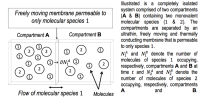 Ilustrated is a completely isolated system comprised of two compartments A & B) containing two monovalent molecular species (1 & 2). The compartments are separated by an ultrathin, freely moving and thermally conducting membrane that is permeable to only species 1. NA and N denote the number of molecules of species 1 occupying, respecively, compartments A and B at time t and NA and NB denote the number of molecules of species 2 occupying, respectively, compartments Freely moving membrane permeable...
help with volume calculation and percent change calculation CHEM 1151 - Lab Manual REPORT SHEET Osmosis-The...
 help with volume calculation and percent change
calculation
CHEM 1151 - Lab Manual REPORT SHEET Osmosis-The Potato Lab Name Catherine Crumley_ Date ID|3119_Section 33 Partner's Name Brooke Cline Instructor N. Msimanga Data: Potato Disks BEFORE Soaking (1 point for each blank) Mass Diameter Height Potato Disk "A 20 % w/ Naci 2.66e8a 2.50cm 0.40 cm Potato Disk "B" 0.9 % w/v NaCl 2.6829 2.30 cm 0.50 cm Potato Disk "C" Distilled Water 2.874 2.50 cm 0.50 cm Data: Potato Disks...
help with volume calculation and percent change
calculation
CHEM 1151 - Lab Manual REPORT SHEET Osmosis-The Potato Lab Name Catherine Crumley_ Date ID|3119_Section 33 Partner's Name Brooke Cline Instructor N. Msimanga Data: Potato Disks BEFORE Soaking (1 point for each blank) Mass Diameter Height Potato Disk "A 20 % w/ Naci 2.66e8a 2.50cm 0.40 cm Potato Disk "B" 0.9 % w/v NaCl 2.6829 2.30 cm 0.50 cm Potato Disk "C" Distilled Water 2.874 2.50 cm 0.50 cm Data: Potato Disks...
Question 6: What percentage error would result from miscounting the bars by one? EXPERIMENT 10 THIN...
 Question 6:
What percentage error would result from miscounting
the bars by one?
EXPERIMENT 10 THIN FILM INTERFERENCE Light from a monochromatic source is shined downward on two glass plates that are separated at one end by a hair. Light that is reflected from the top and bottom surfaces of the wedge-shaped thin film of air undergoes interference, and a series of dark and light lines are seen. By counting the number of dark or light lines over a known...
Question 6:
What percentage error would result from miscounting
the bars by one?
EXPERIMENT 10 THIN FILM INTERFERENCE Light from a monochromatic source is shined downward on two glass plates that are separated at one end by a hair. Light that is reflected from the top and bottom surfaces of the wedge-shaped thin film of air undergoes interference, and a series of dark and light lines are seen. By counting the number of dark or light lines over a known...
B Frequency Response Modeling Frequency response modeling of a linear system is based on the prem...
 Please explain every step as clearly and detailed as
possible.
B Frequency Response Modeling Frequency response modeling of a linear system is based on the premise that the dynamics of a linear system can be recovered from a knowledge of how the system responds to sinusoidal inputs. (This will be made mathematically precise in Theorem 13.) In other words, to determine (or iden- tify) a linear system, all one has to do is observe how the system reacts to sinusoidal...
Please explain every step as clearly and detailed as
possible.
B Frequency Response Modeling Frequency response modeling of a linear system is based on the premise that the dynamics of a linear system can be recovered from a knowledge of how the system responds to sinusoidal inputs. (This will be made mathematically precise in Theorem 13.) In other words, to determine (or iden- tify) a linear system, all one has to do is observe how the system reacts to sinusoidal...
DATE: NURS 208A NAME: 1. The function of ribosomes is to: 6. Inb Digest foreign bacteria...
 DATE: NURS 208A NAME: 1. The function of ribosomes is to: 6. Inb Digest foreign bacteria and toxic substances Produces energy from glucose y Aid in cell division Synthesize proteins Which of the following statement is false about the cell membrane? 2. Cell membrane is composed of phospholipid layer The cell membrane prefers large molecules to pass through freely Cell membrane is a semipermeable boundary which determines what can enter and ex the cell The exterior surface is hydrophilic phosphate...
 MASS TRANSFER
III. A solute diffuses through a membrane that separates two compartments A and B that have different initial concentrations. The solute concentrations in the two compartments as a function of time, CA and CB are shown in Figure III-. The volumes of the two compartments are VA and (A) VA< VB (B) Solute diffuses from compartment B to A. c. Only B is true d. A and B are false a. A and B are true b. Only...
MASS TRANSFER
III. A solute diffuses through a membrane that separates two compartments A and B that have different initial concentrations. The solute concentrations in the two compartments as a function of time, CA and CB are shown in Figure III-. The volumes of the two compartments are VA and (A) VA< VB (B) Solute diffuses from compartment B to A. c. Only B is true d. A and B are false a. A and B are true b. Only...
 a A rigid, tank contains two compartments, each of volume 1m2, separated by a membrane. Compartment A initially has R-134a at 20C and quality 15%. Compartment B is initially evacuated. The membrane ruptures and the final pressures in both compartments equalize. The temperature is constant throughout at 20 R-134A evacuated VA 1m3Vei 1m Membrane R-134A 20c otal V of tan is constant Ruptures State 1 State 2 a. What is the specific volume in compartment A at state 1? b....
 Ilustrated is a completely isolated system comprised of two compartments A & B) containing two monovalent molecular species (1 & 2). The compartments are separated by an ultrathin, freely moving and thermally conducting membrane that is permeable to only species 1. NA and N denote the number of molecules of species 1 occupying, respecively, compartments A and B at time t and NA and NB denote the number of molecules of species 2 occupying, respectively, compartments Freely moving membrane permeable...
 help with volume calculation and percent change
calculation
CHEM 1151 - Lab Manual REPORT SHEET Osmosis-The Potato Lab Name Catherine Crumley_ Date ID|3119_Section 33 Partner's Name Brooke Cline Instructor N. Msimanga Data: Potato Disks BEFORE Soaking (1 point for each blank) Mass Diameter Height Potato Disk "A 20 % w/ Naci 2.66e8a 2.50cm 0.40 cm Potato Disk "B" 0.9 % w/v NaCl 2.6829 2.30 cm 0.50 cm Potato Disk "C" Distilled Water 2.874 2.50 cm 0.50 cm Data: Potato Disks...
help with volume calculation and percent change
calculation
CHEM 1151 - Lab Manual REPORT SHEET Osmosis-The Potato Lab Name Catherine Crumley_ Date ID|3119_Section 33 Partner's Name Brooke Cline Instructor N. Msimanga Data: Potato Disks BEFORE Soaking (1 point for each blank) Mass Diameter Height Potato Disk "A 20 % w/ Naci 2.66e8a 2.50cm 0.40 cm Potato Disk "B" 0.9 % w/v NaCl 2.6829 2.30 cm 0.50 cm Potato Disk "C" Distilled Water 2.874 2.50 cm 0.50 cm Data: Potato Disks...
 Question 6:
What percentage error would result from miscounting
the bars by one?
EXPERIMENT 10 THIN FILM INTERFERENCE Light from a monochromatic source is shined downward on two glass plates that are separated at one end by a hair. Light that is reflected from the top and bottom surfaces of the wedge-shaped thin film of air undergoes interference, and a series of dark and light lines are seen. By counting the number of dark or light lines over a known...
Question 6:
What percentage error would result from miscounting
the bars by one?
EXPERIMENT 10 THIN FILM INTERFERENCE Light from a monochromatic source is shined downward on two glass plates that are separated at one end by a hair. Light that is reflected from the top and bottom surfaces of the wedge-shaped thin film of air undergoes interference, and a series of dark and light lines are seen. By counting the number of dark or light lines over a known...
 Please explain every step as clearly and detailed as
possible.
B Frequency Response Modeling Frequency response modeling of a linear system is based on the premise that the dynamics of a linear system can be recovered from a knowledge of how the system responds to sinusoidal inputs. (This will be made mathematically precise in Theorem 13.) In other words, to determine (or iden- tify) a linear system, all one has to do is observe how the system reacts to sinusoidal...
Please explain every step as clearly and detailed as
possible.
B Frequency Response Modeling Frequency response modeling of a linear system is based on the premise that the dynamics of a linear system can be recovered from a knowledge of how the system responds to sinusoidal inputs. (This will be made mathematically precise in Theorem 13.) In other words, to determine (or iden- tify) a linear system, all one has to do is observe how the system reacts to sinusoidal...
 DATE: NURS 208A NAME: 1. The function of ribosomes is to: 6. Inb Digest foreign bacteria and toxic substances Produces energy from glucose y Aid in cell division Synthesize proteins Which of the following statement is false about the cell membrane? 2. Cell membrane is composed of phospholipid layer The cell membrane prefers large molecules to pass through freely Cell membrane is a semipermeable boundary which determines what can enter and ex the cell The exterior surface is hydrophilic phosphate...
Most questions answered within 3 hours.
-
Where is the error in this code sequence?
String s1 = "Hello";
String s2 = "ello";...
asked 10 months ago -
Financial data for Joel de Paris, Inc., for last year
follow:
Joel de Paris, Inc.
Balance...
asked 10 months ago -
Consider this reaction:
Al2(SO4)3 (aq)+ BaCl3
(aq) Al2Cl6 (aq)- +
3BaSO4(s) . What is the...
asked 10 months ago -
Suppose that Savneet is considering increasing her
recent random sample from 20 car rentals to 40...
asked 10 months ago -
Trucks arrive at an unloading terminal at an average rate of 120
per hour.
Trucks arrive...
asked 10 months ago -
Why are methanol and ethanol completely soluble in water while
octanol is not very little soluble....
asked 10 months ago -
A facilities manager at a university reads in a research report
that the mean amount of...
asked 10 months ago -
When the CuSO4 is rehydrated by adding water to the anhydrous
compound, is this an endothermic...
asked 10 months ago -
A ray of sunlight is passing from diamond into crown glass; the
angle of incidence is...
asked 10 months ago -
A block of mass 0.249 kg is placed on top of a light, vertical
spring of...
asked 10 months ago -
how do the kidneys compensate in the presences of acidosis
a) trigger hyperventilate
b) reserve acid...
asked 10 months ago -
Question 501 pts
The rental rate of capital to the firm increases. Which of the
following...
asked 10 months ago