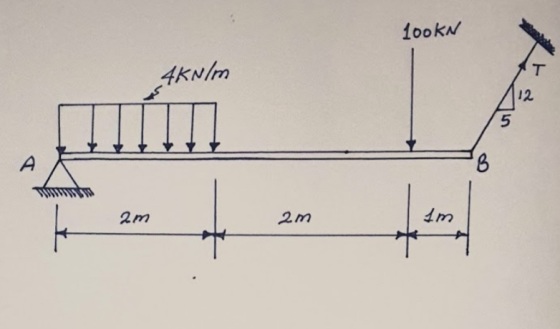
the values of reactions at A and B is : *
Homework Answers
Request Answer!
We need at least 10 more requests to produce the answer.
0 / 10 have requested this problem solution
The more requests, the faster the answer.
Given the following enthalpy change values for the reactions below: A + B → 2C ;...
 Given the following enthalpy change values for the reactions below: A + B → 2C ; ΔH =-228.3 kJ mol-1 C +2D E+F AH 493.9 kJ mol -1 E + G → H ; ΔH = 314.3 kJ mor! Calculate ΔΗ for the following reaction (in kJ mol-1) using Hess's Law: A B4D+4G-4H+2F
Given the following enthalpy change values for the reactions below: A + B → 2C ;...
Given the following enthalpy change values for the reactions below: A + B → 2C ; ΔH = -461.7 kJ mol-1 E + F → C + 2D ; ΔH = 279.9 kJ mol-1 ½ E + G → H ; ΔH = -203.2 kJ mol-1 Calculate ΔH for the following reaction (in kJ mol-1) using Hess's Law: A + B + 4G +4D → 4H + 2F
31. If the AG values for reactions A and B are -100 kj/mol and -10 kJ/mol,...
 31. If the AG values for reactions A and B are -100 kj/mol and -10 kJ/mol, then: a. Reaction A proceeds at a faster rate than reaction B b. Reaction B proceeds at a faster rate than reaction A C. Only reaction A is spontaneous d. Only reaction B is spontaneous e. No conclusion can be deduced regarding the rates of the reactions 32. On the following plot, the estimated Vmax for the enzyme is: a. -0.02 b. 25 C....
For the reactions in parts A and B...... For the reactions in parts A and B,...
 For the reactions in parts A and B......
For the reactions in parts A and B, calculate the value of the equilibrium constant (Keq). In addition, calculate the electrode potential of the system at the equivalence point (Eea) of a hypothetical titration. Finally, choose the indicator from the list below that can be used to signal the end point of the hypothetical titration Number Number ECO 3 +/Co2 + 1.900 V ec Choose the correct indicator. Shown in parenthesis is...
For the reactions in parts A and B......
For the reactions in parts A and B, calculate the value of the equilibrium constant (Keq). In addition, calculate the electrode potential of the system at the equivalence point (Eea) of a hypothetical titration. Finally, choose the indicator from the list below that can be used to signal the end point of the hypothetical titration Number Number ECO 3 +/Co2 + 1.900 V ec Choose the correct indicator. Shown in parenthesis is...
what is the a and b reactions? what is the a and b reactions? a =...
 what is the a and b reactions?
 a = Proton transfer b = Lewis acid/base c = Radical chain substitution d = Radical chain addition e = Electrophilic addition f = E1 Elimination g = E2 Elimination h = S_N1 Nucleophilic substitution i = S_N2 Nucleophilic substitution Identify the mechanism by which each of the reactions above proceeds from among the mechanisms listed. Use the letters a - i for your answers.
what is the a and b reactions?
what is the a and b reactions? a = Proton transfer b = Lewis acid/base c = Radical chain substitution d = Radical chain addition e = Electrophilic addition f = E1 Elimination g = E2 Elimination h = S_N1 Nucleophilic substitution i = S_N2 Nucleophilic substitution Identify the mechanism by which each of the reactions above proceeds from among the mechanisms listed. Use the letters a - i for your answers.
Calculate AS values for the following reactions using the tabulated values in Appendix C. In each...
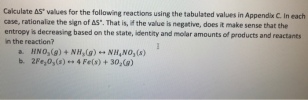 Calculate AS values for the following reactions using the tabulated values in Appendix C. In each case, rationalize the sign of AS°. That is, if the value is negative, does it make sense that the entropy is decreasing based on the state, identity and molar amounts of products and reactants in the reaction? a. HNO3 (g) + NH3(g) NH,NO3 (s) b. 2Fe203 (s)4 Fe(s) +302(g)
The magnitude of the enthalpy values for the successive reactions of ethylenediamine with aqueous CUSO4 are...
The magnitude of the enthalpy values for the successive reactions of ethylenediamine with aqueous CUSO4 are larger than than the corresponding values with NiSO4. Suggest two possible explanations for this
Match the p values with the appropriate reactions. Explain your reasoning. The p values are +3.8, +1.9, -1.1, -6.8 (...
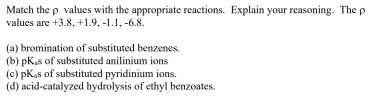 Match the p values with the appropriate reactions. Explain your reasoning. The p values are +3.8, +1.9, -1.1, -6.8 (a) bromination of substituted benzenes. (b) pKas of substituted anilinium ions (c) pKas of substituted pyridinium ions (d) acid-catalyzed hydrolysis of ethyl benzoates.
Calculate ∆? for the following reactions by balancing them and using values of ∆f? from the...
Calculate ∆? for the following reactions by balancing them and using values of ∆f? from the textbook: (A) Complete combustion of ethanol in oxygen. (B) Decomposition of solid ammonium chloride to gaseous ammonia and hydrogen chloride.
For each of the acid-base reactions in Section, compare the pKa values of the acids on...
 For each of the acid-base reactions in Section, compare the pKa values of the acids on either side of the equilibrium arrows and convince yourself that the position of equilibrium is in the direction indicated. (The pka values you need can be found in Section 2.3 or in Problem.) Problem: a. Which is a stronger base, CH3COO-or HCOO-? (The pKa of CH3COOH is 4.8; the p£a of HCOOH is 3.8.) b. Which is a stronger base, HO- or-NH2? (The pka...
 Given the following enthalpy change values for the reactions below: A + B → 2C ; ΔH =-228.3 kJ mol-1 C +2D E+F AH 493.9 kJ mol -1 E + G → H ; ΔH = 314.3 kJ mor! Calculate ΔΗ for the following reaction (in kJ mol-1) using Hess's Law: A B4D+4G-4H+2F
 31. If the AG values for reactions A and B are -100 kj/mol and -10 kJ/mol, then: a. Reaction A proceeds at a faster rate than reaction B b. Reaction B proceeds at a faster rate than reaction A C. Only reaction A is spontaneous d. Only reaction B is spontaneous e. No conclusion can be deduced regarding the rates of the reactions 32. On the following plot, the estimated Vmax for the enzyme is: a. -0.02 b. 25 C....
 For the reactions in parts A and B......
For the reactions in parts A and B, calculate the value of the equilibrium constant (Keq). In addition, calculate the electrode potential of the system at the equivalence point (Eea) of a hypothetical titration. Finally, choose the indicator from the list below that can be used to signal the end point of the hypothetical titration Number Number ECO 3 +/Co2 + 1.900 V ec Choose the correct indicator. Shown in parenthesis is...
For the reactions in parts A and B......
For the reactions in parts A and B, calculate the value of the equilibrium constant (Keq). In addition, calculate the electrode potential of the system at the equivalence point (Eea) of a hypothetical titration. Finally, choose the indicator from the list below that can be used to signal the end point of the hypothetical titration Number Number ECO 3 +/Co2 + 1.900 V ec Choose the correct indicator. Shown in parenthesis is...
 what is the a and b reactions?
 a = Proton transfer b = Lewis acid/base c = Radical chain substitution d = Radical chain addition e = Electrophilic addition f = E1 Elimination g = E2 Elimination h = S_N1 Nucleophilic substitution i = S_N2 Nucleophilic substitution Identify the mechanism by which each of the reactions above proceeds from among the mechanisms listed. Use the letters a - i for your answers.
what is the a and b reactions?
what is the a and b reactions? a = Proton transfer b = Lewis acid/base c = Radical chain substitution d = Radical chain addition e = Electrophilic addition f = E1 Elimination g = E2 Elimination h = S_N1 Nucleophilic substitution i = S_N2 Nucleophilic substitution Identify the mechanism by which each of the reactions above proceeds from among the mechanisms listed. Use the letters a - i for your answers.
 Calculate AS values for the following reactions using the tabulated values in Appendix C. In each case, rationalize the sign of AS°. That is, if the value is negative, does it make sense that the entropy is decreasing based on the state, identity and molar amounts of products and reactants in the reaction? a. HNO3 (g) + NH3(g) NH,NO3 (s) b. 2Fe203 (s)4 Fe(s) +302(g)
 Match the p values with the appropriate reactions. Explain your reasoning. The p values are +3.8, +1.9, -1.1, -6.8 (a) bromination of substituted benzenes. (b) pKas of substituted anilinium ions (c) pKas of substituted pyridinium ions (d) acid-catalyzed hydrolysis of ethyl benzoates.
 For each of the acid-base reactions in Section, compare the pKa values of the acids on either side of the equilibrium arrows and convince yourself that the position of equilibrium is in the direction indicated. (The pka values you need can be found in Section 2.3 or in Problem.) Problem: a. Which is a stronger base, CH3COO-or HCOO-? (The pKa of CH3COOH is 4.8; the p£a of HCOOH is 3.8.) b. Which is a stronger base, HO- or-NH2? (The pka...
Most questions answered within 3 hours.
-
Where is the error in this code sequence?
String s1 = "Hello";
String s2 = "ello";...
asked 11 months ago -
Financial data for Joel de Paris, Inc., for last year
follow:
Joel de Paris, Inc.
Balance...
asked 11 months ago -
Consider this reaction:
Al2(SO4)3 (aq)+ BaCl3
(aq) Al2Cl6 (aq)- +
3BaSO4(s) . What is the...
asked 11 months ago -
Suppose that Savneet is considering increasing her
recent random sample from 20 car rentals to 40...
asked 11 months ago -
Trucks arrive at an unloading terminal at an average rate of 120
per hour.
Trucks arrive...
asked 11 months ago -
Why are methanol and ethanol completely soluble in water while
octanol is not very little soluble....
asked 11 months ago -
A facilities manager at a university reads in a research report
that the mean amount of...
asked 11 months ago -
When the CuSO4 is rehydrated by adding water to the anhydrous
compound, is this an endothermic...
asked 11 months ago -
A ray of sunlight is passing from diamond into crown glass; the
angle of incidence is...
asked 11 months ago -
A block of mass 0.249 kg is placed on top of a light, vertical
spring of...
asked 11 months ago -
how do the kidneys compensate in the presences of acidosis
a) trigger hyperventilate
b) reserve acid...
asked 11 months ago -
Question 501 pts
The rental rate of capital to the firm increases. Which of the
following...
asked 11 months ago