True and False 1. If two particles of different masses have equal kinetic energy they also...
True and False
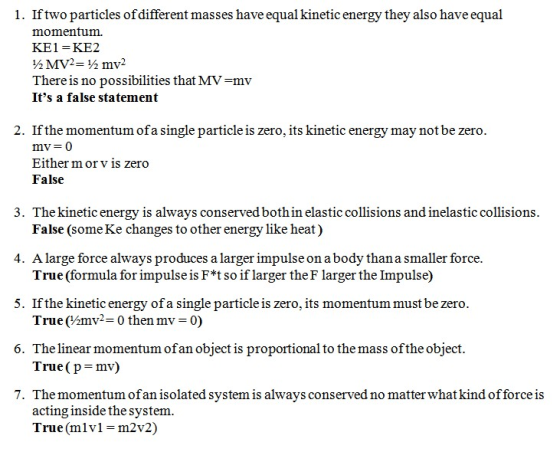
1. If two particles of different masses have equal kinetic energy
they also have equal momentum.
2. If the momentum of a single particle is zero, its kinetic energy may not be zero.
3. The kinetic energy is always conserved both in elastic collisions and inelastic collisions.
4. A large force always produces a larger impulse on a body than a smaller force.
5. If the kinetic energy of a single particle is zero, its momentum must be zero.
6. The linear momentum of an object is proportional to the mass of the object.
7. The momentum of an isolated system is always conserved no matter what kind of force is acting inside the system.
Homework Answers
1) False
2) False
3) False
4)Falso
5) True
6) True
7) True (note: I take "isolated system" to mean "closed system")
Add Answer to:
True and False
1. If two particles of different masses have equal kinetic energy
they also...
V If two particles of different masses have equal kinetic energy they also have equal momentum....
 V If two particles of different masses have equal kinetic energy they also have equal momentum. The kinetic energy is always conserved both in elastic collisions and inelastic collisions. If the momentum of a single particle is zero, its kinetic energy may not be zero. The linear momentum of an object is proportional to the mass of the object. A large force always produces a larger impulse on a body than a smaller force. If the kinetic energy of a...
Kinetic energy is only conserved in an inelastic collision. True False Two objects collide ans stick...
 Kinetic energy is only conserved in an inelastic collision. True False Two objects collide ans stick together. This is an elastic collision. True False Momentum is conserved in both elastic and inelastic collisions. True False
True or false question: Kinetic energy is a state scalar quantity and depends on reference system....
True or false question: Kinetic energy is a state scalar quantity and depends on reference system. Which one of the following statements about the completely INELASTIC collision between two particles is NOT correct? (A) They have common speed after collision. (B) The kinetic energy of the system is conserved before and after the collision. (C) The internal force can change the momentum of each particle. (D) The momentum of the system is conserved before and after the collision.
Question 33 Which statement is TRUE according to the kinetic molecular theory? The average kinetic energy...
 Question 33 Which statement is TRUE according to the kinetic molecular theory? The average kinetic energy of a particle is proportional to the temperature in Kelvin. The size of the particle is large compared to the volume. The collisions of particles with one another is not completely elastic. A single particle does not move in a straight line.
Problem 1 A 0.150 kg baseball pitched at 40.0 m/s is hit on a horizontal line...
Problem 1 A 0.150 kg baseball pitched at 40.0 m/s is hit on a horizontal line drive straight back at the pitcher at 50.0 m/s. a) If the contact time between bat and ball is 3.90×10⁻³ s, calculate the magnitude of the force (assumed to be constant) between the ball and bat. b) Determine the direction of the force exerted on a ball. Problem 2 Indicate whether the following statements are true for both inelastic collisions and elastic collisions. a)...
The energy of motion is called: Kinetic energy. potential energy, inertial energy. Power. In an inelastic...
 The energy of motion is called: Kinetic energy. potential energy, inertial energy. Power. In an inelastic collision: momentum is conserved. kinetic energy is conserved, both (a) and (b). If the velocity of a moving object is doubled and its mass is cut in half, the kinetic energy of the object is; remains the same, doubled quadrupled, cut in half. When the net work done on an object is speed of the object is me on an object is zero; the...
True-False (2 points each). Circle the correct answer. 1) D F An isolated system has a...
 True-False (2 points each). Circle the correct answer. 1) D F An isolated system has a net external force of zero. 2)TF Momentum is conserved in an isolated system. 3) TT The definition of work is W = Fdcos(0) 4) T (F) The spring force is proportional to the displacement of the spring end. 5) O T Engines and generators can be 100% efficient. 6) DF The impulse is equal to the change in momentum. 7) DF In an isolated...
1. Is it possible for a system to have negative gravitational potential energy? a) Yes, as...
1. Is it possible for a system to have negative gravitational potential energy? a) Yes, as long as the kinetic energy is positive. b) Yes, as long as the total energy is positive. c) Yes, since the choice of zero of gravitational potential energy is arbitrary. d) No, because the kinetic energy of a system must equal its gravitational potential energy. e) No, because you can't have negative energy. 2. In an isolated system, for which of the following types...
3. (10 pts) High energy particle accelerators convert part of the energy of colliding particles into...
 3. (10 pts) High energy particle accelerators convert part of the energy of colliding particles into the masses of particles produced in the collisions. Consider a collision of two protons that produces two charged kaons. The mass of the proton is mp- 938.3 MeV/c2, and the mass of each kaon is mK 493.7 MeV/c2. The reaction is a) The total energy (kinetic energy and rest energy) and total momentum is conserved. Suppose one of the protons is at rest in...
 V If two particles of different masses have equal kinetic energy they also have equal momentum. The kinetic energy is always conserved both in elastic collisions and inelastic collisions. If the momentum of a single particle is zero, its kinetic energy may not be zero. The linear momentum of an object is proportional to the mass of the object. A large force always produces a larger impulse on a body than a smaller force. If the kinetic energy of a...
 Kinetic energy is only conserved in an inelastic collision. True False Two objects collide ans stick together. This is an elastic collision. True False Momentum is conserved in both elastic and inelastic collisions. True False
 Question 33 Which statement is TRUE according to the kinetic molecular theory? The average kinetic energy of a particle is proportional to the temperature in Kelvin. The size of the particle is large compared to the volume. The collisions of particles with one another is not completely elastic. A single particle does not move in a straight line.
 The energy of motion is called: Kinetic energy. potential energy, inertial energy. Power. In an inelastic collision: momentum is conserved. kinetic energy is conserved, both (a) and (b). If the velocity of a moving object is doubled and its mass is cut in half, the kinetic energy of the object is; remains the same, doubled quadrupled, cut in half. When the net work done on an object is speed of the object is me on an object is zero; the...
 True-False (2 points each). Circle the correct answer. 1) D F An isolated system has a net external force of zero. 2)TF Momentum is conserved in an isolated system. 3) TT The definition of work is W = Fdcos(0) 4) T (F) The spring force is proportional to the displacement of the spring end. 5) O T Engines and generators can be 100% efficient. 6) DF The impulse is equal to the change in momentum. 7) DF In an isolated...
 3. (10 pts) High energy particle accelerators convert part of the energy of colliding particles into the masses of particles produced in the collisions. Consider a collision of two protons that produces two charged kaons. The mass of the proton is mp- 938.3 MeV/c2, and the mass of each kaon is mK 493.7 MeV/c2. The reaction is a) The total energy (kinetic energy and rest energy) and total momentum is conserved. Suppose one of the protons is at rest in...
Most questions answered within 3 hours.
-
Where is the error in this code sequence?
String s1 = "Hello";
String s2 = "ello";...
asked 10 months ago -
Financial data for Joel de Paris, Inc., for last year
follow:
Joel de Paris, Inc.
Balance...
asked 10 months ago -
Consider this reaction:
Al2(SO4)3 (aq)+ BaCl3
(aq) Al2Cl6 (aq)- +
3BaSO4(s) . What is the...
asked 10 months ago -
Suppose that Savneet is considering increasing her
recent random sample from 20 car rentals to 40...
asked 10 months ago -
Trucks arrive at an unloading terminal at an average rate of 120
per hour.
Trucks arrive...
asked 10 months ago -
Why are methanol and ethanol completely soluble in water while
octanol is not very little soluble....
asked 10 months ago -
A facilities manager at a university reads in a research report
that the mean amount of...
asked 10 months ago -
When the CuSO4 is rehydrated by adding water to the anhydrous
compound, is this an endothermic...
asked 10 months ago -
A ray of sunlight is passing from diamond into crown glass; the
angle of incidence is...
asked 10 months ago -
A block of mass 0.249 kg is placed on top of a light, vertical
spring of...
asked 10 months ago -
how do the kidneys compensate in the presences of acidosis
a) trigger hyperventilate
b) reserve acid...
asked 10 months ago -
Question 501 pts
The rental rate of capital to the firm increases. Which of the
following...
asked 10 months ago