Example of a normal extension which is not an algebraic closure of F
Example of a normal extension which is not an algebraic closure of F
Homework Answers
Request Answer!
We need at least 10 more requests to produce the answer.
0 / 10 have requested this problem solution
The more requests, the faster the answer.
Add Answer to:
Example of a normal extension which is not an algebraic closure of F
An algebraic closure of a field F is a field K such that: 1) K/F is an algebraic field extension,...
An algebraic closure of a field F is a field K such that: 1) K/F is an algebraic field extension, and 2) every nonconstant polynomial in K[x] has a root in K. If K is an algebraic closure of F, prove that every polynomial p(x) ∈ F[x] splits in K[x].
Let k C F = kla) be a simple algebraic extension. Prove that F is normal...
 Let k C F = kla) be a simple algebraic extension. Prove that F is normal over k if and only if for every algebraic extension FC K and every o E Autk(K),(F) = F.
Let E = F(a) be a (simple) extension of F. wherea E E is algebraic over F. Suppose the degree of ...
Let E = F(a) be a (simple) extension of F. wherea E E is algebraic over F. Suppose the degree of α over F is n Then every β E E can be expressed uniquely in the form β-bo-b10 + +b-1a-1 for some bi F. (a) Show every element can be written as f (a) for some polynomial f(x) E F (b) Let m(x) be the minimal polynomial of α over F. Write m(x) r" +an-11n-1+--+ n_1α α0. Use this...
9. Let E be an extension field of a field F. (1) What does it mean...
 9. Let E be an extension field of a field F. (1) What does it mean for an element z EE being algebraic over F? (2) What does it mean for an element z E E being transcendental over F? (3) Can you find any element r e C such that r is transcendental over Q? (4) Can you prove that if a E E is algebraic over F then (F(a): F] is finite? (5) Can you prove that if...
Example 4.2.4 shows f=x^n+px+p with p prime implies that f is irreducible over Q by Eisenstein...
 Example 4.2.4 shows f=x^n+px+p with p prime implies that f is
irreducible over Q by Eisenstein criterion
Exercise 1. Lemma 4.4.2 shows that a finite extension is algebraic. Here we will give an example to show that the converse is false. The field of algebraic numbersis by definition algebraic over Q. You will show that :Ql oo as follows. (a) Given n 22 in Z, use Example 4.2.4 from Section 4.2 to show that @ has a subficld such that...
Example 4.2.4 shows f=x^n+px+p with p prime implies that f is
irreducible over Q by Eisenstein criterion
Exercise 1. Lemma 4.4.2 shows that a finite extension is algebraic. Here we will give an example to show that the converse is false. The field of algebraic numbersis by definition algebraic over Q. You will show that :Ql oo as follows. (a) Given n 22 in Z, use Example 4.2.4 from Section 4.2 to show that @ has a subficld such that...
plz solve this question. For an extension L/K, let a € L be an algebraic element...
 plz solve this question.
For an extension L/K, let a € L be an algebraic element over K. Find the minimal polynomial of 1/a over K with respect to the minimal polynomial ma.kx) of a.
plz solve this question.
For an extension L/K, let a € L be an algebraic element over K. Find the minimal polynomial of 1/a over K with respect to the minimal polynomial ma.kx) of a.
5. Let E be a normal extension of Q, and let Fi, F CE be two normal subex- tensionsnAssume also that Fin F2 Prove that...
 5. Let E be a normal extension of Q, and let Fi, F CE be two normal subex- tensionsnAssume also that Fin F2 Prove that Gal( E/O) Q and that Fi and F2 generate E is a field isomorphic to the product Gal(F/Q) x Gal(F2/Q) is X
5. Let E be a normal extension of Q, and let Fi, F CE be two normal subex- tensionsnAssume also that Fin F2 Prove that Gal( E/O) Q and that Fi and F2...
5. Let E be a normal extension of Q, and let Fi, F CE be two normal subex- tensionsnAssume also that Fin F2 Prove that Gal( E/O) Q and that Fi and F2 generate E is a field isomorphic to the product Gal(F/Q) x Gal(F2/Q) is X
5. Let E be a normal extension of Q, and let Fi, F CE be two normal subex- tensionsnAssume also that Fin F2 Prove that Gal( E/O) Q and that Fi and F2...
(1)Give an example of a function f : (0, 1) → R which is continuous, but...
(1)Give an example of a function f : (0, 1) → R which is continuous, but such that there is no continuous function g : [0, 1] → R which agrees with f on (0, 1). (2)Suppose f : A (⊂ Rn) → R. Prove that if f is uniformly continuous then there is a unique continuous function g : B → R which agrees with f on A.(B is closure of A)
Prove that f and g are equivalent using both the graphical and algebraic approach. If they are not, provide a counter-example that shows how they are not equivalent.
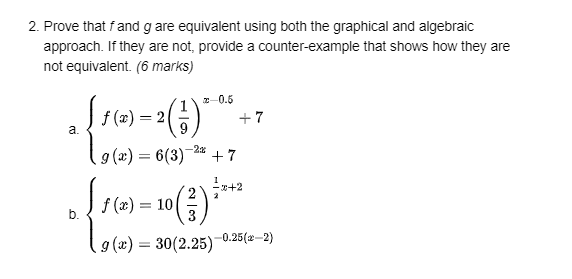 Prove that f and g are equivalent using both the graphical and algebraic approach. If they are not, provide a counter-example that shows how they are not equivalent. https://i.gyazo.com/df6c283c040522b4baab4e52d0b91104.png
Question 2. Give an example of the following, or if no example exists state that. As always, prove your answer in e...
 Question 2. Give an example of the following, or if no example exists state that. As always, prove your answer in either case. (a) A finite non-normal extension of Q (b) A finite non-normal extension of R (c) A finite non-normal extension of F7
Question 2. Give an example of the following, or if no example exists state that. As always, prove your answer in either case. (a) A finite non-normal extension of Q (b) A finite non-normal extension of...
Question 2. Give an example of the following, or if no example exists state that. As always, prove your answer in either case. (a) A finite non-normal extension of Q (b) A finite non-normal extension of R (c) A finite non-normal extension of F7
Question 2. Give an example of the following, or if no example exists state that. As always, prove your answer in either case. (a) A finite non-normal extension of Q (b) A finite non-normal extension of...
 Let k C F = kla) be a simple algebraic extension. Prove that F is normal over k if and only if for every algebraic extension FC K and every o E Autk(K),(F) = F.
 9. Let E be an extension field of a field F. (1) What does it mean for an element z EE being algebraic over F? (2) What does it mean for an element z E E being transcendental over F? (3) Can you find any element r e C such that r is transcendental over Q? (4) Can you prove that if a E E is algebraic over F then (F(a): F] is finite? (5) Can you prove that if...
 Example 4.2.4 shows f=x^n+px+p with p prime implies that f is
irreducible over Q by Eisenstein criterion
Exercise 1. Lemma 4.4.2 shows that a finite extension is algebraic. Here we will give an example to show that the converse is false. The field of algebraic numbersis by definition algebraic over Q. You will show that :Ql oo as follows. (a) Given n 22 in Z, use Example 4.2.4 from Section 4.2 to show that @ has a subficld such that...
Example 4.2.4 shows f=x^n+px+p with p prime implies that f is
irreducible over Q by Eisenstein criterion
Exercise 1. Lemma 4.4.2 shows that a finite extension is algebraic. Here we will give an example to show that the converse is false. The field of algebraic numbersis by definition algebraic over Q. You will show that :Ql oo as follows. (a) Given n 22 in Z, use Example 4.2.4 from Section 4.2 to show that @ has a subficld such that...
 plz solve this question.
For an extension L/K, let a € L be an algebraic element over K. Find the minimal polynomial of 1/a over K with respect to the minimal polynomial ma.kx) of a.
plz solve this question.
For an extension L/K, let a € L be an algebraic element over K. Find the minimal polynomial of 1/a over K with respect to the minimal polynomial ma.kx) of a.
 5. Let E be a normal extension of Q, and let Fi, F CE be two normal subex- tensionsnAssume also that Fin F2 Prove that Gal( E/O) Q and that Fi and F2 generate E is a field isomorphic to the product Gal(F/Q) x Gal(F2/Q) is X
5. Let E be a normal extension of Q, and let Fi, F CE be two normal subex- tensionsnAssume also that Fin F2 Prove that Gal( E/O) Q and that Fi and F2...
5. Let E be a normal extension of Q, and let Fi, F CE be two normal subex- tensionsnAssume also that Fin F2 Prove that Gal( E/O) Q and that Fi and F2 generate E is a field isomorphic to the product Gal(F/Q) x Gal(F2/Q) is X
5. Let E be a normal extension of Q, and let Fi, F CE be two normal subex- tensionsnAssume also that Fin F2 Prove that Gal( E/O) Q and that Fi and F2...
 Question 2. Give an example of the following, or if no example exists state that. As always, prove your answer in either case. (a) A finite non-normal extension of Q (b) A finite non-normal extension of R (c) A finite non-normal extension of F7
Question 2. Give an example of the following, or if no example exists state that. As always, prove your answer in either case. (a) A finite non-normal extension of Q (b) A finite non-normal extension of...
Question 2. Give an example of the following, or if no example exists state that. As always, prove your answer in either case. (a) A finite non-normal extension of Q (b) A finite non-normal extension of R (c) A finite non-normal extension of F7
Question 2. Give an example of the following, or if no example exists state that. As always, prove your answer in either case. (a) A finite non-normal extension of Q (b) A finite non-normal extension of...
Most questions answered within 3 hours.
-
Where is the error in this code sequence?
String s1 = "Hello";
String s2 = "ello";...
asked 10 months ago -
Financial data for Joel de Paris, Inc., for last year
follow:
Joel de Paris, Inc.
Balance...
asked 10 months ago -
Consider this reaction:
Al2(SO4)3 (aq)+ BaCl3
(aq) Al2Cl6 (aq)- +
3BaSO4(s) . What is the...
asked 10 months ago -
Suppose that Savneet is considering increasing her
recent random sample from 20 car rentals to 40...
asked 10 months ago -
Trucks arrive at an unloading terminal at an average rate of 120
per hour.
Trucks arrive...
asked 10 months ago -
Why are methanol and ethanol completely soluble in water while
octanol is not very little soluble....
asked 10 months ago -
A facilities manager at a university reads in a research report
that the mean amount of...
asked 10 months ago -
When the CuSO4 is rehydrated by adding water to the anhydrous
compound, is this an endothermic...
asked 10 months ago -
A ray of sunlight is passing from diamond into crown glass; the
angle of incidence is...
asked 10 months ago -
A block of mass 0.249 kg is placed on top of a light, vertical
spring of...
asked 10 months ago -
how do the kidneys compensate in the presences of acidosis
a) trigger hyperventilate
b) reserve acid...
asked 10 months ago -
Question 501 pts
The rental rate of capital to the firm increases. Which of the
following...
asked 10 months ago