A furniture firm makes three types of tables: coffee table, side table and dining room table, and two types of chairs : arm chair and side chair. A coffee table requires 35 unit s of wood, a side table needs 45 units of wood, and a dining room table requires 95 units of wood. In addition, an arm chair requires 40 units of wood and a side chair needs 30 units of wood. There are at most 9800 units of wood. Moreover, each coffee table needs 25 minutes of production time , a side table requires 20 minutes of production time and each dining room table requires 80 minutes of production time. The following table presents the same information (in minutes) for the two types of chairs.
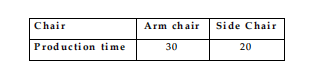
There are also 110 hours of production time. Assume the net profit for producing a coffee table is $ 30, a side table is $28 and for a dining room table is $50. In addition, each arm chair and side chair would generate a profit of $15 and $25, respectively. How many from each types of tables and chairs should be produced in order to maximize the total profit of the furniture firm?
Solve the problem using Excel Solver and find the optimal solution.
Homework Answers
here, we will maximize the Profit,
Maximize objective function = 30*X1 +28*X2+50*X3+15*X4+25*X5
Constraints
35*X1+45*X2+95*X3+40*X4+30*X5=<9800
25*X1+20*X2+80*X3+30*X4+20*X4=<110
X1, X2, X3, X4 and X5 >= 0
Decision Variables:
X1 = Number of coffee table
X2 = Number of side table
X3 = Dining room table
X4 = Arm Chair
X5 = Side chair
| 1 | B | C | D | E | F | G | H | I | J |
| 2 | Profit per Coffee table | 30 | |||||||
| 3 | Profit per side table | 28 | |||||||
| 4 | Profit per dining room table | 50 | |||||||
| 5 | profit per arm chair | 15 | |||||||
| 6 | Profit per side chair | 25 | |||||||
| 7 | |||||||||
| 8 | Coffee table | side table | dining room table | arm chair | side chair | ||||
| 9 | Unit Sold | 0 | 5 | 0 | 0 | 0 | |||
| 10 | Profit Generated | 30 | 28 | 50 | 15 | 25 | |||
| 11 | Coffee table | side table | dining room table | arm chair | side chair | ||||
| 12 | woods | 35 | 45 | 95 | 40 | 30 | 247 | =< | 9800 |
| 13 | time | 25 | 20 | 80 | 30 | 20 | 110 | =< | 110 |
| 14 | 1 | 0 | 0 | 0 | 0 | 0 | >= | 0 | |
| 15 | 0 | 1 | 0 | 0 | 0 | 5 | >= | 0 | |
| 16 | 0 | 0 | 1 | 0 | 0 | 0 | >= | 0 | |
| 17 | 0 | 0 | 0 | 1 | 0 | 0 | >= | 0 | |
| 18 | 0 | 0 | 0 | 0 | 1 | 0 | >= | 0 | |
| 19 | Total Profit generated- Maximum | 154 |
Excel Formula:
| 1 | B | C | D | E | F | G | H | I | J |
| 2 | Profit per Coffee table | 30 | |||||||
| 3 | Profit per side table | 28 | |||||||
| 4 | Profit per dining room table | 50 | |||||||
| 5 | profit per arm chair | 15 | |||||||
| 6 | Profit per side chair | 25 | |||||||
| 7 | |||||||||
| 8 | Coffee table | side table | dining room table | arm chair | side chair | ||||
| 9 | Unit Sold | 0 | 5.49999999995946 | 8.63380915319896E-12 | 4.00520012538094E-12 | 0 | |||
| 10 | Profit Generated | 30 | 28 | 50 | 15 | 25 | |||
| 11 | Coffee table | side table | dining room table | arm chair | side chair | ||||
| 12 | woods | 35 | 45 | 95 | 40 | 30 | =SUMPRODUCT($C$9:$G$9,C12:G12) | =< | 9800 |
| 13 | time | 25 | 20 | 80 | 30 | 20 | =SUMPRODUCT($C$9:$G$9,C13:G13) | =< | 110 |
| 14 | 1 | 0 | 0 | 0 | 0 | =SUMPRODUCT($C$9:$G$9,C14:G14) | >= | 0 | |
| 15 | 0 | 1 | 0 | 0 | 0 | =SUMPRODUCT($C$9:$G$9,C15:G15) | >= | 0 | |
| 16 | 0 | 0 | 1 | 0 | 0 | =SUMPRODUCT($C$9:$G$9,C16:G16) | >= | 0 | |
| 17 | 0 | 0 | 0 | 1 | 0 | =SUMPRODUCT($C$9:$G$9,C17:G17) | >= | 0 | |
| 18 | 0 | 0 | 0 | 0 | 1 | =SUMPRODUCT($C$9:$G$9,C18:G18) | >= | 0 | |
| 19 | Total Profit generated- Maximum | =SUMPRODUCT(C9:G9,C10:G10) |
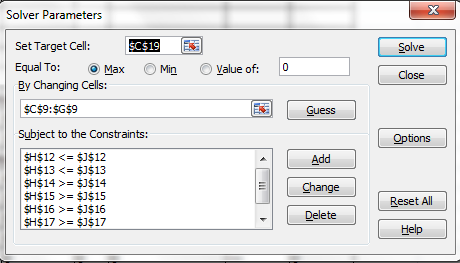
Solver Parameter :
Add Answer to:
A furniture firm makes three types of tables: coffee table, side
table and dining room table,...
40. Furniture. A furniture manufacturing company manufac- tures dining-room tables and chairs. The relevant manufactur- ing...
 40. Furniture. A furniture manufacturing company manufac- tures dining-room tables and chairs. The relevant manufactur- ing data are given in the table below. oitoon Labor-Hours per Unit Maximum Labor-Hours Table Chair Available per Day 8 2 400 Department Assembly Finishing Profit per unit 1200 $25 (A) How many tables and chairs should be manufactured each day to realize a maximum profit? What is the maximum profit? (B) Discuss the effect on the production schedule and the maximum profit if the...
A furniture manufacturing company manufactures dining-room tables and chairs. A table requires 10 labor-hours for a...
 A furniture manufacturing company manufactures dining-room tables and chairs. A table requires 10 labor-hours for assembly and 4 labor-hours for finishing. A chair requires 6 labor-hours for assembly and 2 labor-hours for finishing The maximum labor hours available per day for assembly and finishing are 350 and 90, respectively. Write a system of linear inequalities that represents this situation. Use the following variables: Use z for the number of tables and y for the number of chairs manufactured in a...
The Pine Furniture Company makes fine country furniture. The company’s current product lines consist of end tables, coffee tables, and dining room tables. The production of each of these ta- bles requires 8, 15, and 80 pounds of pine wood, respectively. T
The Pine Furniture Company makes fine country furniture. The company’s current product lines consist of end tables, coffee tables, and dining room tables. The production of each of these ta- bles requires 8, 15, and 80 pounds of pine wood, respectively. The tables are handmade, and require one hour, two hours, and four hours, respectively. Each table sold generates $50, $100, and $220 profit, respectively. The company has 3,000 pounds of pine wood and 200 hours of labor available for...
Brown Furniture Company makes three kinds of office furniture: chairs, desks, and tables. Each product requires...
 Brown Furniture Company makes three kinds of office furniture:
chairs, desks, and tables. Each product requires skilled labor in
the parts fabrication department, unskilled labor in the assembly
department, machining on some key pieces of equipment, and some
wood as raw material. At current prices, the unit profit
contribution for each product is known, and the company can sell
everything it manufactures. The size of the workforce has been
established, so the number of skilled and unskilled labor hours is...
Brown Furniture Company makes three kinds of office furniture:
chairs, desks, and tables. Each product requires skilled labor in
the parts fabrication department, unskilled labor in the assembly
department, machining on some key pieces of equipment, and some
wood as raw material. At current prices, the unit profit
contribution for each product is known, and the company can sell
everything it manufactures. The size of the workforce has been
established, so the number of skilled and unskilled labor hours is...
A Furniture Company produces chairs and tables from two resources- labor and wood. The company has 125 hours of labor an...
A Furniture Company produces chairs and tables from two resources- labor and wood. The company has 125 hours of labor and 45 board-ft. of wood available each day. Demand for chairs is limited to 5 per day. Each chair requires 7 hours of labor and 3.5 board-ft. of wood, whereas a table requires 14 hours of labor and 7 board-ft. of wood. The profit derived from each chair is $325 and from each table, $120. The company wants to determine...
In the furniture store that sells tables and chairs, business is good and so the demand...
In the furniture store that sells tables and chairs, business is good and so the demand for tables is up to 500 pieces per week and for chairs up to 300 pieces. The production has a weekly capacity of 1200 hours, with a table taking 40 minutes to produce and a chair 80 minutes. Each table nets a profit of $7/piece but a chair’s profit is now $10. The manager’s goals are to attain a profit of $10,000; to avoid...
A furniture manufacturer makes two type of products, chairs and tables. Processing of these products is...
A furniture manufacturer makes two type of products, chairs and tables. Processing of these products is done on two machines A and B. A chair requires 2 hrs on machine A and 6 hrs on machine B. A table requires 5 hrs on machine A and no time on machine B. There are 16 hrs per day available on machine A and 30 hrs on machine B. Profit gained by manufacturer from 33 a chair and a table is USD...
A carpenter makes tables and chairs. Each table can be sold for a profit of £30...
A carpenter makes tables and chairs. Each table can be sold for a profit of £30 and each chair for a profit of £10. The carpenter can afford to spend up to 40 hours per week working and takes six hours to make a table and three hours to make a chair. Customer demand requires that he makes at least three times as many chairs as tables. Tables take up four times as much storage space as chairs and there...
ables from two resources-laborat h Solve LDS TUT The Pinewood Furniture Company produces chairs and tables...
 ables from two resources-laborat h Solve LDS TUT The Pinewood Furniture Company produces chairs and tables from two mnany has 80 hours of labor and 36 board-ft. of wood available each do for chairs is limited to 6 per day. Each chair requires 8 hours of labor and 2 board. whereas a table requires 10 hours of labor and 6 board-ft. of wood. The profit derived from chair is $400 and from each table, $100. The company wants to determine...
2 lbs of wicker. Product B requires cing two types of furmiture. Product and 1000 lbs...
 2 lbs of wicker. Product B requires cing two types of furmiture. Product and 1000 lbs of wicker. Product A earns a profit margin of $30 a unit board feet of wood and Produc is Producing two types of furniture. Product A requires 8 2000 board feet of and avalilable forres 6 board feet of wood and 6 Ibs of wicker. There ane a profit margin of $40 a unit. Formulate the problem as a linear rog 4) Susanna Nanna...
 40. Furniture. A furniture manufacturing company manufac- tures dining-room tables and chairs. The relevant manufactur- ing data are given in the table below. oitoon Labor-Hours per Unit Maximum Labor-Hours Table Chair Available per Day 8 2 400 Department Assembly Finishing Profit per unit 1200 $25 (A) How many tables and chairs should be manufactured each day to realize a maximum profit? What is the maximum profit? (B) Discuss the effect on the production schedule and the maximum profit if the...
 A furniture manufacturing company manufactures dining-room tables and chairs. A table requires 10 labor-hours for assembly and 4 labor-hours for finishing. A chair requires 6 labor-hours for assembly and 2 labor-hours for finishing The maximum labor hours available per day for assembly and finishing are 350 and 90, respectively. Write a system of linear inequalities that represents this situation. Use the following variables: Use z for the number of tables and y for the number of chairs manufactured in a...
 Brown Furniture Company makes three kinds of office furniture:
chairs, desks, and tables. Each product requires skilled labor in
the parts fabrication department, unskilled labor in the assembly
department, machining on some key pieces of equipment, and some
wood as raw material. At current prices, the unit profit
contribution for each product is known, and the company can sell
everything it manufactures. The size of the workforce has been
established, so the number of skilled and unskilled labor hours is...
Brown Furniture Company makes three kinds of office furniture:
chairs, desks, and tables. Each product requires skilled labor in
the parts fabrication department, unskilled labor in the assembly
department, machining on some key pieces of equipment, and some
wood as raw material. At current prices, the unit profit
contribution for each product is known, and the company can sell
everything it manufactures. The size of the workforce has been
established, so the number of skilled and unskilled labor hours is...
 ables from two resources-laborat h Solve LDS TUT The Pinewood Furniture Company produces chairs and tables from two mnany has 80 hours of labor and 36 board-ft. of wood available each do for chairs is limited to 6 per day. Each chair requires 8 hours of labor and 2 board. whereas a table requires 10 hours of labor and 6 board-ft. of wood. The profit derived from chair is $400 and from each table, $100. The company wants to determine...
 2 lbs of wicker. Product B requires cing two types of furmiture. Product and 1000 lbs of wicker. Product A earns a profit margin of $30 a unit board feet of wood and Produc is Producing two types of furniture. Product A requires 8 2000 board feet of and avalilable forres 6 board feet of wood and 6 Ibs of wicker. There ane a profit margin of $40 a unit. Formulate the problem as a linear rog 4) Susanna Nanna...
Most questions answered within 3 hours.
-
Where is the error in this code sequence?
String s1 = "Hello";
String s2 = "ello";...
asked 11 months ago -
Financial data for Joel de Paris, Inc., for last year
follow:
Joel de Paris, Inc.
Balance...
asked 11 months ago -
Consider this reaction:
Al2(SO4)3 (aq)+ BaCl3
(aq) Al2Cl6 (aq)- +
3BaSO4(s) . What is the...
asked 11 months ago -
Suppose that Savneet is considering increasing her
recent random sample from 20 car rentals to 40...
asked 11 months ago -
Trucks arrive at an unloading terminal at an average rate of 120
per hour.
Trucks arrive...
asked 11 months ago -
Why are methanol and ethanol completely soluble in water while
octanol is not very little soluble....
asked 11 months ago -
A facilities manager at a university reads in a research report
that the mean amount of...
asked 11 months ago -
When the CuSO4 is rehydrated by adding water to the anhydrous
compound, is this an endothermic...
asked 11 months ago -
A ray of sunlight is passing from diamond into crown glass; the
angle of incidence is...
asked 11 months ago -
A block of mass 0.249 kg is placed on top of a light, vertical
spring of...
asked 11 months ago -
how do the kidneys compensate in the presences of acidosis
a) trigger hyperventilate
b) reserve acid...
asked 11 months ago -
Question 501 pts
The rental rate of capital to the firm increases. Which of the
following...
asked 11 months ago