A 0.304-m-thick sheet of ice covers a lake. The air temperature at the ice surface is...
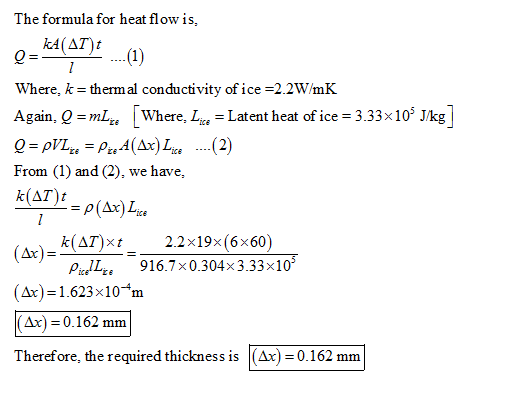
A 0.304-m-thick sheet of ice covers a lake. The air temperature at the ice surface is -19.0 °C. In 6.00 minutes, the ice thickens by a small amount. Assume that no heat flows from the ground below into the water and that the added ice is very thin compared to 0.304 m. Calculate the number of millimeters by which the ice thickens
Homework Answers
Add Answer to:
A 0.304-m-thick sheet of ice covers a lake. The air temperature
at the ice surface is...
A 0.30-m-thick sheet of ice covers a lake. The air temperature at the ice surface is...
A 0.30-m-thick sheet of ice covers a lake. The air temperature at the ice surface is −15∘C In five minutes, the ice thickens by a small amount. Assume that no heat flows from the ground below into the water and that the added ice is very thin compared to 0.30 m. Find the number of millimeters by which the ice thicken please do not skip steps
An ice sheet forms on a lake. The air above the sheet is – 15oC ,...
An ice sheet forms on a lake. The air above the sheet is – 15oC , Where as the water is at 0oC. Assume the heat of fusion of water freezing on the lower surface is conducted through the sheet to the air above. How Much time will it take to form a sheet of ice 25 cm thick ?.
When the air temperature is below 0 C, the water at the surface of a lake...
When the air temperature is below 0 C, the water at the surface of a lake freezes to form an ice sheet. The longer the air remains at this temperature, the thicker the ice sheet will become. Will a lake in Minnesota that is uniformly 40 m deep ever freeze solid? To answer this, calculate how long it would take to freeze all the water in the lake. Assume that the upper surface of the ice sheet is steady at...
10) When the air temperature is below 0 Celsius, the water of a lake freezes to...
 10) When the air temperature is below 0 Celsius, the water of a lake freezes to form an ice sheet. The time required to freeze the ice sheet is proportional to the thickness squared if the heat of fusion of the water freezing on the underside of the sheet is conducted through the sheet. Assuming the upper surface of the sheet is at -10 Celsius and the bottom at 0 Celsius, calculate the time it will take to form an...
Please include a clear picture showing the variables in the problem. Thanks OO0Kg? on salbly CafTy...
 Please include a clear picture showing the variables in the
problem. Thanks
OO0Kg? on salbly CafTy 2. Do you like ice skating? A 0.3 m (approximately 1ft) thick sheet of ice covers a lake. The air temperature above the ice is -15 °C (5F) and the water temperature is essentially 0 °C (32F), Assume that the heat flow through the ice freezes a thin layer of water onto the bottom of the sheet. How thick a layer is created in...
Please include a clear picture showing the variables in the
problem. Thanks
OO0Kg? on salbly CafTy 2. Do you like ice skating? A 0.3 m (approximately 1ft) thick sheet of ice covers a lake. The air temperature above the ice is -15 °C (5F) and the water temperature is essentially 0 °C (32F), Assume that the heat flow through the ice freezes a thin layer of water onto the bottom of the sheet. How thick a layer is created in...
A circular pond of radius 12 m has a layer of ice 0.25 m thick. On...
A circular pond of radius 12 m has a layer of ice 0.25 m thick. On a spring day, the temperature of the water below the ice is 4.0°C and the temperature of the air above is 11°C. What is the rate of heat transfer through the ice, in kW?
A scuba diver is 45 m below the surface of a lake, where the temperature is...
 A scuba diver is 45 m below the surface of a lake, where the
temperature is 5°C. He releases an air bubble with a volume of 10
cm3. The bubble rises to the surface, where the
temperature is 25°C. Assume that the air in the bubble is always in
thermal equilibrium with the surrounding water, and assume that
there is no exchange of molecules between the bubble and the
surrounding water. What is the volume of the bubble right before...
A scuba diver is 45 m below the surface of a lake, where the
temperature is 5°C. He releases an air bubble with a volume of 10
cm3. The bubble rises to the surface, where the
temperature is 25°C. Assume that the air in the bubble is always in
thermal equilibrium with the surrounding water, and assume that
there is no exchange of molecules between the bubble and the
surrounding water. What is the volume of the bubble right before...
An air bubble released by a submersible vehicle, 120 m below the surface of a lake,...
An air bubble released by a submersible vehicle, 120 m below the surface of a lake, has a volume of 1.55 cm3. The surface of the lake is at sea level, and the density of the lake water can be approximated as that of pure water. As the bubble rises to the surface, the temperature of the water and the number of air molecules in the bubble can each be approximated as constant. Find the volume (in cm3) of the...
Fill the ice mold with tap water and put it in a freezer for 24 hours....
 Fill the ice mold with tap water and put it in a freezer for
24 hours. Remove the
mold from the freezer, loosen the ice but do not remove the
ice and place the mold upside
down in a thin paper plate and place the plate on a thick
coffee table or dining table (see
Figure 1). Wait for about 30 minutes, using the cell-phone or
digital watch as a timer, and
then measure the amount of water in the...
Fill the ice mold with tap water and put it in a freezer for
24 hours. Remove the
mold from the freezer, loosen the ice but do not remove the
ice and place the mold upside
down in a thin paper plate and place the plate on a thick
coffee table or dining table (see
Figure 1). Wait for about 30 minutes, using the cell-phone or
digital watch as a timer, and
then measure the amount of water in the...
An air bubble released by a deep-water diver, 120 m below the surface of a lake,...
 An air bubble released by a deep-water diver, 120 m below the surface of a lake, has a volume of 1.65 cm3. The surface of the lake is at sea level, and the density of the lake water can be approximated as that of pure water. As the bubble rises to the surface, the temperature of the water and the number of air molecules in the bubble can each be approximated as constant. Find the volume (in cm) of the...
 10) When the air temperature is below 0 Celsius, the water of a lake freezes to form an ice sheet. The time required to freeze the ice sheet is proportional to the thickness squared if the heat of fusion of the water freezing on the underside of the sheet is conducted through the sheet. Assuming the upper surface of the sheet is at -10 Celsius and the bottom at 0 Celsius, calculate the time it will take to form an...
 Please include a clear picture showing the variables in the
problem. Thanks
OO0Kg? on salbly CafTy 2. Do you like ice skating? A 0.3 m (approximately 1ft) thick sheet of ice covers a lake. The air temperature above the ice is -15 °C (5F) and the water temperature is essentially 0 °C (32F), Assume that the heat flow through the ice freezes a thin layer of water onto the bottom of the sheet. How thick a layer is created in...
Please include a clear picture showing the variables in the
problem. Thanks
OO0Kg? on salbly CafTy 2. Do you like ice skating? A 0.3 m (approximately 1ft) thick sheet of ice covers a lake. The air temperature above the ice is -15 °C (5F) and the water temperature is essentially 0 °C (32F), Assume that the heat flow through the ice freezes a thin layer of water onto the bottom of the sheet. How thick a layer is created in...
 A scuba diver is 45 m below the surface of a lake, where the
temperature is 5°C. He releases an air bubble with a volume of 10
cm3. The bubble rises to the surface, where the
temperature is 25°C. Assume that the air in the bubble is always in
thermal equilibrium with the surrounding water, and assume that
there is no exchange of molecules between the bubble and the
surrounding water. What is the volume of the bubble right before...
A scuba diver is 45 m below the surface of a lake, where the
temperature is 5°C. He releases an air bubble with a volume of 10
cm3. The bubble rises to the surface, where the
temperature is 25°C. Assume that the air in the bubble is always in
thermal equilibrium with the surrounding water, and assume that
there is no exchange of molecules between the bubble and the
surrounding water. What is the volume of the bubble right before...
 Fill the ice mold with tap water and put it in a freezer for
24 hours. Remove the
mold from the freezer, loosen the ice but do not remove the
ice and place the mold upside
down in a thin paper plate and place the plate on a thick
coffee table or dining table (see
Figure 1). Wait for about 30 minutes, using the cell-phone or
digital watch as a timer, and
then measure the amount of water in the...
Fill the ice mold with tap water and put it in a freezer for
24 hours. Remove the
mold from the freezer, loosen the ice but do not remove the
ice and place the mold upside
down in a thin paper plate and place the plate on a thick
coffee table or dining table (see
Figure 1). Wait for about 30 minutes, using the cell-phone or
digital watch as a timer, and
then measure the amount of water in the...
 An air bubble released by a deep-water diver, 120 m below the surface of a lake, has a volume of 1.65 cm3. The surface of the lake is at sea level, and the density of the lake water can be approximated as that of pure water. As the bubble rises to the surface, the temperature of the water and the number of air molecules in the bubble can each be approximated as constant. Find the volume (in cm) of the...
Most questions answered within 3 hours.
-
Where is the error in this code sequence?
String s1 = "Hello";
String s2 = "ello";...
asked 11 months ago -
Financial data for Joel de Paris, Inc., for last year
follow:
Joel de Paris, Inc.
Balance...
asked 11 months ago -
Consider this reaction:
Al2(SO4)3 (aq)+ BaCl3
(aq) Al2Cl6 (aq)- +
3BaSO4(s) . What is the...
asked 11 months ago -
Suppose that Savneet is considering increasing her
recent random sample from 20 car rentals to 40...
asked 11 months ago -
Trucks arrive at an unloading terminal at an average rate of 120
per hour.
Trucks arrive...
asked 11 months ago -
Why are methanol and ethanol completely soluble in water while
octanol is not very little soluble....
asked 11 months ago -
A facilities manager at a university reads in a research report
that the mean amount of...
asked 11 months ago -
When the CuSO4 is rehydrated by adding water to the anhydrous
compound, is this an endothermic...
asked 11 months ago -
A ray of sunlight is passing from diamond into crown glass; the
angle of incidence is...
asked 11 months ago -
A block of mass 0.249 kg is placed on top of a light, vertical
spring of...
asked 11 months ago -
how do the kidneys compensate in the presences of acidosis
a) trigger hyperventilate
b) reserve acid...
asked 11 months ago -
Question 501 pts
The rental rate of capital to the firm increases. Which of the
following...
asked 11 months ago