Draw a mech. For polymerization using butylithium as initiator. Show the initiation one chain propagation step...
 Draw a mech. For polymerization using butylithium as initiator.
Show the initiation one chain propagation step and use H+ to
terminate growth.
Draw a mech. For polymerization using butylithium as initiator.
Show the initiation one chain propagation step and use H+ to
terminate growth.Homework Answers
 ======================XXXXXXXXXXXXXXXXXX=========================
Add Answer to:
Draw a mech. For polymerization using butylithium as initiator.
Show the initiation one chain propagation step...
Draw the mechanism for the cationic polymerization of styrene using H2SO4 as initiator. Include initiation, propagation,...
Draw the mechanism for the cationic polymerization of styrene using H2SO4 as initiator. Include initiation, propagation, ion pair rearrangement, and chain transfer to monomer
reaction mech: initiation , propagation, and termination of the synthesis of polystyrene Polymersti 2. Write the...
 reaction mech: initiation , propagation, and termination of
the synthesis of polystyrene
Polymersti 2. Write the reaction mechanism (showing arrows) of the synthesis of polystyrene. 4pts • Include and show arrows in 2 initiation steps with benzoyl peroxide forming the phenyl radical. (this is shown in Figure 9 of the lab- just add all arrows) A propagation step of the styrene (the monomer) and phenyl radical. A second propagation step showing polymer growth by reacting styrene and the radical product...
reaction mech: initiation , propagation, and termination of
the synthesis of polystyrene
Polymersti 2. Write the reaction mechanism (showing arrows) of the synthesis of polystyrene. 4pts • Include and show arrows in 2 initiation steps with benzoyl peroxide forming the phenyl radical. (this is shown in Figure 9 of the lab- just add all arrows) A propagation step of the styrene (the monomer) and phenyl radical. A second propagation step showing polymer growth by reacting styrene and the radical product...
Draw curved arrow mechanisms for the rin cationic initiator and (b) an anionic initiator You should Then, comment o...
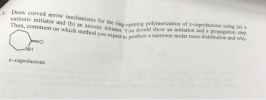 Draw curved arrow mechanisms for the rin cationic initiator and (b) an anionic initiator You should Then, comment on which method you expect to produce a s for the ring-opening polymerization of E-caprolactone using (a) a monic initiator Vou should show an initiation and a propagation step. od you expect to produce a narrower molar mass distribution and why. -NH E-caprolactone
In normal free radical processes with added initiator, the polymerization rate and kinetic chain length are...
In normal free radical processes with added initiator, the polymerization rate and kinetic chain length are proportional to the first power of monomer concentration. What would be the effect of monomer concentration on rate and chain length in the thermal polymerization of styrene (which involves no initiator)? Derive a kinetics expression to show this.Assume that initiation is based on the following equation: M + M -> 2 M. (radical in the product).
Draw the mechanism of radical polymerization of N-isopropylacrylamide including initiation, propagation, and termination steps.
Draw the mechanism of radical polymerization of N-isopropylacrylamide including initiation, propagation, and termination steps.
1. What is the mechanism of polymerization of styrene with AIBN? Initiation: Propagation: Termination (Show self-termination...
1. What is the mechanism of polymerization of styrene with AIBN? Initiation: Propagation: Termination (Show self-termination only):
show the polymerization of styrene using SnCl4 as the initiator
show the polymerization of styrene using SnCl4 as the initiator
Which step of the chain process does the following reaction represent? a) initiation b) propagation c)...
 Which step of the chain process does the following reaction represent? a) initiation b) propagation c) termination d) substitution
For polymerization of styrene in tetrahydrofuran at 25°C using sodium naphthalide initiator, the rate coefficient for...
For polymerization of styrene in tetrahydrofuran at 25°C using sodium naphthalide initiator, the rate coefficient for propagation is 550 dm^3 mol^-1 s^-1. If the initial mass concentration of styrene is 156 g dm^-3 and that of sodium naphthalide is 3.02x10^-2 g dm^-3, calculate the initial rate of polymerization and, for complete converison of the styrene, the number-average molar mass of polystyrene formed. Comment upon the expected value of molar mass dispersity (Mw/Mn) and the stereoregularity of the polystyrene produced. Assume:...
Give the initiation and propagations steps for the radical polymerization of styrene using benzoyl peroxide as...
Give the initiation and propagations steps for the radical polymerization of styrene using benzoyl peroxide as the initiator.
 reaction mech: initiation , propagation, and termination of
the synthesis of polystyrene
Polymersti 2. Write the reaction mechanism (showing arrows) of the synthesis of polystyrene. 4pts • Include and show arrows in 2 initiation steps with benzoyl peroxide forming the phenyl radical. (this is shown in Figure 9 of the lab- just add all arrows) A propagation step of the styrene (the monomer) and phenyl radical. A second propagation step showing polymer growth by reacting styrene and the radical product...
reaction mech: initiation , propagation, and termination of
the synthesis of polystyrene
Polymersti 2. Write the reaction mechanism (showing arrows) of the synthesis of polystyrene. 4pts • Include and show arrows in 2 initiation steps with benzoyl peroxide forming the phenyl radical. (this is shown in Figure 9 of the lab- just add all arrows) A propagation step of the styrene (the monomer) and phenyl radical. A second propagation step showing polymer growth by reacting styrene and the radical product...
 Draw curved arrow mechanisms for the rin cationic initiator and (b) an anionic initiator You should Then, comment on which method you expect to produce a s for the ring-opening polymerization of E-caprolactone using (a) a monic initiator Vou should show an initiation and a propagation step. od you expect to produce a narrower molar mass distribution and why. -NH E-caprolactone
 Which step of the chain process does the following reaction represent? a) initiation b) propagation c) termination d) substitution
Most questions answered within 3 hours.
-
Where is the error in this code sequence?
String s1 = "Hello";
String s2 = "ello";...
asked 11 months ago -
Financial data for Joel de Paris, Inc., for last year
follow:
Joel de Paris, Inc.
Balance...
asked 11 months ago -
Consider this reaction:
Al2(SO4)3 (aq)+ BaCl3
(aq) Al2Cl6 (aq)- +
3BaSO4(s) . What is the...
asked 11 months ago -
Suppose that Savneet is considering increasing her
recent random sample from 20 car rentals to 40...
asked 11 months ago -
Trucks arrive at an unloading terminal at an average rate of 120
per hour.
Trucks arrive...
asked 11 months ago -
Why are methanol and ethanol completely soluble in water while
octanol is not very little soluble....
asked 11 months ago -
A facilities manager at a university reads in a research report
that the mean amount of...
asked 11 months ago -
When the CuSO4 is rehydrated by adding water to the anhydrous
compound, is this an endothermic...
asked 11 months ago -
A ray of sunlight is passing from diamond into crown glass; the
angle of incidence is...
asked 11 months ago -
A block of mass 0.249 kg is placed on top of a light, vertical
spring of...
asked 11 months ago -
how do the kidneys compensate in the presences of acidosis
a) trigger hyperventilate
b) reserve acid...
asked 11 months ago -
Question 501 pts
The rental rate of capital to the firm increases. Which of the
following...
asked 11 months ago