Question
Let  and
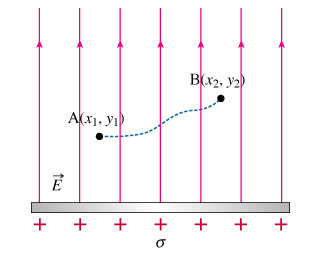
and  be two points near and on the same side of acharged sheet with
surface charge density
be two points near and on the same side of acharged sheet with
surface charge density  .
The electric field
.
The electric field  due to
such a charged sheet has magnitude
due to
such a charged sheet has magnitude  everywhere, and the field points away from thesheet, as shown in
the diagram.
everywhere, and the field points away from thesheet, as shown in
the diagram. 
 and
and  be two points near and on the same side of acharged sheet with
surface charge density
be two points near and on the same side of acharged sheet with
surface charge density  .
The electric field
.
The electric field  due to
such a charged sheet has magnitude
due to
such a charged sheet has magnitude  everywhere, and the field points away from thesheet, as shown in
the diagram.
everywhere, and the field points away from thesheet, as shown in
the diagram. 

What is the potential difference  between points A and B?
 between points A and B?
Express your answer in terms of
someor all of  ,
, ,
,
 ,
,
 , and
, and
 .
.
 ,
, ,
,
 ,
,
 , and
, and
 .
.Homework Answers
Request Professional Answer
Request Answer!
We need at least 10 more requests to produce the answer.
0 / 10 have requested this problem solution
The more requests, the faster the answer.
All students who have requested the answer will be notified once they are available.
Know the answer?
Add Answer to:
Let
and
be two points near and on the same side of acharged sheet with
surface...
Similar Homework Help Questions
The figure below shows two points in an electric field. Point 1 is at (X1,Y1) =...
 The figure below shows two points in an electric field. Point 1
is at (X1,Y1) = (3,4), and point 2 is at (X2,Y2) = (12,9). (The
coordinates are given in meters.) The electric field is constant
with a magnitude of 62.3 V/m, and is directed parallel to the
+X-axis. The potential at point 1 is 1200.0 V.
Calculate the potential at point 2.
Calculate the work required to move a negative charge of
Q=-470.0 μC from point 1 to point...
The figure below shows two points in an electric field. Point 1
is at (X1,Y1) = (3,4), and point 2 is at (X2,Y2) = (12,9). (The
coordinates are given in meters.) The electric field is constant
with a magnitude of 62.3 V/m, and is directed parallel to the
+X-axis. The potential at point 1 is 1200.0 V.
Calculate the potential at point 2.
Calculate the work required to move a negative charge of
Q=-470.0 μC from point 1 to point...
The figure below shows two points in an electric field. Point 1 is at (X1,Y1) =...
The figure below shows two points in an electric field. Point 1 is at (X1,Y1) = (3,4), and point 2 is at (X2,Y2) = (12,9). (The coordinates are given in meters.) The electric field is constant with a magnitude of 74.3 V/m, and is directed parallel to the +X-axis. The potential at point 1 is 1200.0 V. Calculate the potential at point 2. 5.31×10² V. Previous Tries Calculate the work required to move a negative charge of Q=-493.0 μC from...
The figure below shows two points in an E-field: Point 1 is at (X1,Y1) = (3,4) in...
 The figure below shows two points in an E-field:
Point 1 is at (X1,Y1) =
(3,4) in m, and
Point 2 is at (X2,Y2) = (12,9) in
m.
The Electric Field is constant, with a magnitude of 74
V/m, and is directed parallel to the +X-axis. The
potential at point 2 is 434 V. Calculate the potential at
point 1.
Calculate the work required for an external force to move a
negative charge of Q = -516 microC at constant
speed...
The figure below shows two points in an E-field:
Point 1 is at (X1,Y1) =
(3,4) in m, and
Point 2 is at (X2,Y2) = (12,9) in
m.
The Electric Field is constant, with a magnitude of 74
V/m, and is directed parallel to the +X-axis. The
potential at point 2 is 434 V. Calculate the potential at
point 1.
Calculate the work required for an external force to move a
negative charge of Q = -516 microC at constant
speed...
The figure below shows two points in an electric field. Point 1 is at (X1,Y1) =...
 The figure below shows two points in an electric field. Point 1 is at (X1,Y1) = (3,4), and point 2 is at (X2,Y2) = (12,9). (The coordinates are given in meters.) The electric field is constant with a magnitude of 53.3 V/m, and is directed parallel to the +X-axis. The potential at point 1 is 1200.0 V. Calculate the potential at point 2 Submit Answer Tries 0/12 Calculate the work required to move a negative charge of Q=-470.0 μC from...
The figure below shows two points in an electric field. Point 1 is at (X1,Y1)-(3,4), and...
 The figure below shows two points in an electric field. Point 1 is at (X1,Y1)-(3,4), and point 2 is at (X2,Y2) - (12,9). (The coordinates are given in meters.) The electric field is constant with a magnitude of 56.3 V/m, and is directed parallel to the +X-axis. The potential at point 1 is 1200.0 V Calculate the work required to move a negative charge of Q-608.0 HC from point 1 to point 2. (in J) C: E: F: 1.31x10⁻¹ 1.74x10⁻¹...
The figure below shows two points in an electric field. Point 1 is at (X1,Y1)-(3,4), and...
 The figure below shows two points in an electric field. Point 1 is at (X1,Y1)-(3,4), and point 2 is at (X2,Y2)-(12,9). (The coordinates are given in meters.) The electric field is constant with a magnitude of 62.3 V/m, and is directed parallel to the +X-axis. The potential at point 1 is 1000.0 V. Calculate the potential at point 2 Submit Answer Tries 0/12 Calculate the work required to move a negative charge of Q=-539.0 pC from point 1 to point...
The electric field near the surface of Earth points downward and has a magnitude of 152...
The electric field near the surface of Earth points downward and has a magnitude of 152 N/C. What is the ratio of the magnitude of the upward electric force on an electron to the magnitude of gravitational force on the electron? What charge should be placed on a plastic ball of mass 4.06 g so that the electric force balances the weight of the ball near Earth's surface?
A long, solid, conducting cylinder has a radius of 2.0 cm. The electric field at the...
A long, solid, conducting cylinder has a radius of 2.0 cm. The electric field at the surface of the cylinder is 780 N/C, directed radially outward. Let A, B, and C be points that are 1.1 cm, 2.0 cm, and 8.2 cm, respectively, from the central axis of the cylinder. What are (a) the magnitude of the electric field at C and the electric potential differences (b)VB – VC and (c)VA – VB?
The electric field near the surface of Earth points downward and has a magnitude of 148...
The electric field near the surface of Earth points downward and has a magnitude of 148 N/C. What is the ratio of the magnitude of the upward electric force on an electron to the magnitude of gravitational force on the electron? Problem 21-40b: What charge should be placed on a plastic ball of mass 5.38 g so that the electric force balances the weight of the ball near Earth's surface?
Near the surface of the Earth, an electric field points radially downward and has a magnitude...
Near the surface of the Earth, an electric field points radially downward and has a magnitude of 100 N/C. What charge (magnitude and sign) would have to be placed on a penny that has a mass of 3.11 g to cause it to rise in the air with an upward acceleration of 0.19 m/s2? Draw a diagram of your solution and show your work.
 The figure below shows two points in an E-field:
Point 1 is at (X1,Y1) =
(3,4) in m, and
Point 2 is at (X2,Y2) = (12,9) in
m.
The Electric Field is constant, with a magnitude of 74
V/m, and is directed parallel to the +X-axis. The
potential at point 2 is 434 V. Calculate the potential at
point 1.
Calculate the work required for an external force to move a
negative charge of Q = -516 microC at constant
speed...
The figure below shows two points in an E-field:
Point 1 is at (X1,Y1) =
(3,4) in m, and
Point 2 is at (X2,Y2) = (12,9) in
m.
The Electric Field is constant, with a magnitude of 74
V/m, and is directed parallel to the +X-axis. The
potential at point 2 is 434 V. Calculate the potential at
point 1.
Calculate the work required for an external force to move a
negative charge of Q = -516 microC at constant
speed...
 The figure below shows two points in an electric field. Point 1 is at (X1,Y1) = (3,4), and point 2 is at (X2,Y2) = (12,9). (The coordinates are given in meters.) The electric field is constant with a magnitude of 53.3 V/m, and is directed parallel to the +X-axis. The potential at point 1 is 1200.0 V. Calculate the potential at point 2 Submit Answer Tries 0/12 Calculate the work required to move a negative charge of Q=-470.0 μC from...
 The figure below shows two points in an electric field. Point 1 is at (X1,Y1)-(3,4), and point 2 is at (X2,Y2) - (12,9). (The coordinates are given in meters.) The electric field is constant with a magnitude of 56.3 V/m, and is directed parallel to the +X-axis. The potential at point 1 is 1200.0 V Calculate the work required to move a negative charge of Q-608.0 HC from point 1 to point 2. (in J) C: E: F: 1.31x10⁻¹ 1.74x10⁻¹...
 The figure below shows two points in an electric field. Point 1 is at (X1,Y1)-(3,4), and point 2 is at (X2,Y2)-(12,9). (The coordinates are given in meters.) The electric field is constant with a magnitude of 62.3 V/m, and is directed parallel to the +X-axis. The potential at point 1 is 1000.0 V. Calculate the potential at point 2 Submit Answer Tries 0/12 Calculate the work required to move a negative charge of Q=-539.0 pC from point 1 to point...
ADVERTISEMENT
Need Online Homework Help?
Ask
a QuestionGet Answers For Free
Most questions answered within 3 hours.
Most questions answered within 3 hours.
ADVERTISEMENT
Active Questions
-
Where is the error in this code sequence?
String s1 = "Hello";
String s2 = "ello";...
asked 10 months ago -
Financial data for Joel de Paris, Inc., for last year
follow:
Joel de Paris, Inc.
Balance...
asked 10 months ago -
Consider this reaction:
Al2(SO4)3 (aq)+ BaCl3
(aq) Al2Cl6 (aq)- +
3BaSO4(s) . What is the...
asked 10 months ago -
Suppose that Savneet is considering increasing her
recent random sample from 20 car rentals to 40...
asked 10 months ago -
Trucks arrive at an unloading terminal at an average rate of 120
per hour.
Trucks arrive...
asked 10 months ago -
Why are methanol and ethanol completely soluble in water while
octanol is not very little soluble....
asked 10 months ago -
A facilities manager at a university reads in a research report
that the mean amount of...
asked 10 months ago -
When the CuSO4 is rehydrated by adding water to the anhydrous
compound, is this an endothermic...
asked 10 months ago -
A ray of sunlight is passing from diamond into crown glass; the
angle of incidence is...
asked 10 months ago -
A block of mass 0.249 kg is placed on top of a light, vertical
spring of...
asked 10 months ago -
how do the kidneys compensate in the presences of acidosis
a) trigger hyperventilate
b) reserve acid...
asked 10 months ago -
Question 501 pts
The rental rate of capital to the firm increases. Which of the
following...
asked 10 months ago
ADVERTISEMENT