
Homework Answers


Add Answer to:
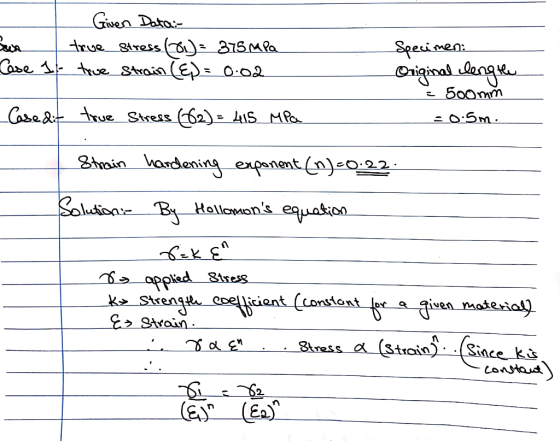
For some metal alloy, a true stress of 345 MPa (50,000 psi) produces a plastic true...
55 min. Question 1 For some metal alloy, a true stress of 345 MPa (50040 psi)...
 55 min. Question 1 For some metal alloy, a true stress of 345 MPa (50040 psi) produces a plastic true strain of 0.02. How much will a specimen of this material elangate when a true stress of 414 MPa (60050 psi) is applied if the original length is 540 mm (21.26 in.)? Assume a value of 0.22 for the strain-hardening exponent, n the tolerance is +-2% 一曲. By accessing this Question Assistance, you will learn while you earn points based...
A cylindrical specimen of a metal alloy 47.9 mm long and 9.72 mm in diameter is...
A cylindrical specimen of a metal alloy 47.9 mm long and 9.72 mm in diameter is stressed in tension. A true stress of 379 MPa causes the specimen to plastically elongate to a length of 52.5 mm. If it is known that the strain-hardening exponent for this alloy is 0.2, calculate the true stress (in MPa) necessary to plastically elongate a specimen of this same material from a length of 47.9 mm to a length of 57.6 mm.
A cylindrical specimen of a metal alloy 47.8 mm long and 9.72 mm in diameter is...
A cylindrical specimen of a metal alloy 47.8 mm long and 9.72 mm in diameter is stressed in tension. A true stress of 399 MPa causes the specimen to plastically elongate to a length of 51.9 mm. If it is known that the strain-hardening exponent for this alloy is 0.3, calculate the true stress (in MPa) necessary to plastically elongate a specimen of this same material from a length of 47.8 mm to a length of 57.4 mm.
For a brass alloy, the stress at which plastic deformation begins is 345 MPa and the...
 For a brass alloy, the stress at which plastic deformation begins is 345 MPa and the modulus of elasticity is 103 GPa. What is the maximum load that may be applied to a specimen with a cross-sectional area of 130 mm without plastic deformation?
For a brass alloy, the stress at which plastic deformation begins is 345 MP a, and...
For a brass alloy, the stress at which plastic deformation begins is 345 MP a, and the modulus of elasticity is 103 GP a. (a) What is the maximum load that can be applied to a specimen with a crosssectional area of 90 mm2 without plastic deformation? (b) If the original specimen length is 46 mm, what is the maximum length to which it can be stretched without causing plastic deformation?
For a bronze alloy, the stress at which plastic deformation begins is 278 MPa and the...
For a bronze alloy, the stress at which plastic deformation begins is 278 MPa and the modulus of elasticity is 111 GPa. (a) What is the maximum load that may be applied to a specimen having a cross-sectional area of 349 mm2 without plastic deformation? (b) If the original specimen length is 119 mm, what is the maximum length to which it may be stretched without causing plastic deformation?
A brass alloy is known to have a yield strength of 275 MPa (40,000 psi), a...
A brass alloy is known to have a yield strength of 275 MPa (40,000 psi), a tensile strength of 380 MPa (55,000 psi), and an elastic modulus of 103 GPa (15.0×10⁶ psi). A cylindrical specimen of this alloy 9.0 mm (0.35 in.) in diameter and 245 mm (9.65 in.) long is stressed in tension and found to elongate 9.0 mm (0.35 in.). A) What is the yield strain? B) What is the test strain?
Draw a schematic stress-strain diagram for steel. Make sure you mark all the important points and regions on it
 1. Draw a schematic stress-strain diagram for steel. Make sure you mark all the important points and regions on it. Provide a one-two sentence explanation for each point and region along the diagram. 2. A cylindrical specimen of a nickel alloy having an elastic modulus of 207 GPa (30 x 10* psi) and an original diameter of 10.2 mm (0.40 In.) will experience only elastic deformation when a tensile load of 8900 N (2000 Ibe) is applied. Compute the maximum length...
Chapter 06, Problem 6.50 A steel alloy specimen having a rectangular cross section of dimensions 19.0...
 Chapter 06, Problem 6.50 A steel alloy specimen having a rectangular cross section of dimensions 19.0 mm x 3.2 mm (0.7480 in. x 0.1260 in.) has the stress-strain behavior shown in the Animated Figure. If this specimen is subjected to a tensile force of 100900 N (22680 lbf) then (a) Determine the amount of elastic strain induced. (b) Determine the amount of plastic strain induced. (c) If its original length is 400 mm, what will be its final length after...
Assignment 01 TOT Mechanical Properties of Materials 1. A tensile test specimen has a gage length...
 Assignment 01 TOT Mechanical Properties of Materials 1. A tensile test specimen has a gage length = 50 mm and its cross-sectional area = 100 mm. The specimen yields at 48,000 N, and the corresponding gage length - 50.23 mm. This is the 0.2 ent yield point. The maximum load of 87,000 N is reached at a gage length 64.2 mm. Determine (a) yield strength, (b) modulus of elasticity, and (c) tensile strength. (d) If fracture occurs at a gage...
 55 min. Question 1 For some metal alloy, a true stress of 345 MPa (50040 psi) produces a plastic true strain of 0.02. How much will a specimen of this material elangate when a true stress of 414 MPa (60050 psi) is applied if the original length is 540 mm (21.26 in.)? Assume a value of 0.22 for the strain-hardening exponent, n the tolerance is +-2% 一曲. By accessing this Question Assistance, you will learn while you earn points based...
 For a brass alloy, the stress at which plastic deformation begins is 345 MPa and the modulus of elasticity is 103 GPa. What is the maximum load that may be applied to a specimen with a cross-sectional area of 130 mm without plastic deformation?
 Chapter 06, Problem 6.50 A steel alloy specimen having a rectangular cross section of dimensions 19.0 mm x 3.2 mm (0.7480 in. x 0.1260 in.) has the stress-strain behavior shown in the Animated Figure. If this specimen is subjected to a tensile force of 100900 N (22680 lbf) then (a) Determine the amount of elastic strain induced. (b) Determine the amount of plastic strain induced. (c) If its original length is 400 mm, what will be its final length after...
 Assignment 01 TOT Mechanical Properties of Materials 1. A tensile test specimen has a gage length = 50 mm and its cross-sectional area = 100 mm. The specimen yields at 48,000 N, and the corresponding gage length - 50.23 mm. This is the 0.2 ent yield point. The maximum load of 87,000 N is reached at a gage length 64.2 mm. Determine (a) yield strength, (b) modulus of elasticity, and (c) tensile strength. (d) If fracture occurs at a gage...
Most questions answered within 3 hours.
-
Where is the error in this code sequence?
String s1 = "Hello";
String s2 = "ello";...
asked 11 months ago -
Financial data for Joel de Paris, Inc., for last year
follow:
Joel de Paris, Inc.
Balance...
asked 11 months ago -
Consider this reaction:
Al2(SO4)3 (aq)+ BaCl3
(aq) Al2Cl6 (aq)- +
3BaSO4(s) . What is the...
asked 11 months ago -
Suppose that Savneet is considering increasing her
recent random sample from 20 car rentals to 40...
asked 11 months ago -
Trucks arrive at an unloading terminal at an average rate of 120
per hour.
Trucks arrive...
asked 11 months ago -
Why are methanol and ethanol completely soluble in water while
octanol is not very little soluble....
asked 11 months ago -
A facilities manager at a university reads in a research report
that the mean amount of...
asked 11 months ago -
When the CuSO4 is rehydrated by adding water to the anhydrous
compound, is this an endothermic...
asked 11 months ago -
A ray of sunlight is passing from diamond into crown glass; the
angle of incidence is...
asked 11 months ago -
A block of mass 0.249 kg is placed on top of a light, vertical
spring of...
asked 11 months ago -
how do the kidneys compensate in the presences of acidosis
a) trigger hyperventilate
b) reserve acid...
asked 11 months ago -
Question 501 pts
The rental rate of capital to the firm increases. Which of the
following...
asked 11 months ago