
Homework Answers
Add Answer to:
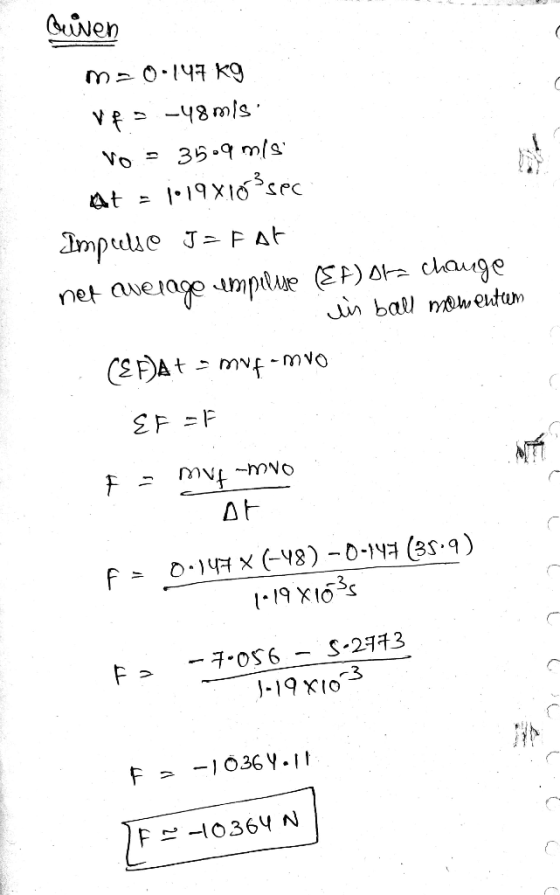
A baseball (m = 147 g) approaches a bat horizontally at a speed of 35.9 m/s...
A baseball mass 250.00 g approaches a bat horizontally at a speed of 40.20 m/s and...
A baseball mass 250.00 g approaches a bat horizontally at a speed of 40.20 m/s and is hit straight back at a speed of 51.50 m/s . If the ball is in contact with the bat for a time of 1.60 ms, what is the average force exerted on the ball by the bat? Neglect the weight of the ball, since it is so much less than the force of the bat. Choose the direction of the incoming ball as...
Interactive LearningWare 7.1 reviews the approach that is necessary for solving problems such as this one....
Interactive LearningWare 7.1 reviews the approach that is necessary for solving problems such as this one. A baseball (m = 150 g) approaches a bat horizontally at a speed of 41.1 m/s (92.0 mi/h) and is hit straight back at a speed of 47.8 m/s (107 mi/h). If the ball is in contact with the bat for a time of 1.19 ms, what is the average force exerted on the ball by the bat? Neglect the weight of the bat,...
reviews the approach that is necessary for solving problems such as this one. A baseball (m...
reviews the approach that is necessary for solving problems such as this one. A baseball (m = 145 g) approaches a bat horizontally at a speed of 42.1 m/s (94.2 mi/h) and is hit straight back at a speed of 46.5 m/s (104 mi/h). If the ball is in contact with the bat for a time of 1.30 ms, what is the average force exerted on the ball by the bat? Neglect the weight of the bat, since it is...
A baseball with a mass of 140 g is thrown horizontally with a speed of 39.8...
A baseball with a mass of 140 g is thrown horizontally with a speed of 39.8 m/s (89 mi/h) at a bat. The ball is in contact with the bat for 1.15 msand then travels straight back at a speed of 45.2 m/s (101 mi/h). Determine the average force (in N) exerted on the ball by the bat. Neglect the weight of the ball (it is much smaller than the force of the bat) and choose the direction of the...
A baseball with a mass of 137 g is thrown horizontally with a speed of 40.4...
 A baseball with a mass of 137 g is thrown horizontally with a speed of 40.4 m/s (90 mi/h) at a bat. The ball is in contact with the bat for 1.15 ms and then travels straight back at a speed of 45.1 m/s (101 mi/h). Determine the average force in N) exerted on the ball by the bat. Neglect the weight of the ball (it is much smaller than the force of the bat) and choose the direction of...
A baseball with a mass of 152 g is thrown horizontally with a speed of 40.7...
 A baseball with a mass of 152 g is thrown horizontally with a speed of 40.7 m/s (91 mi/h) at a bat. The ball is in contact with the bat for 1.15 ms and then travels straight back at a speed of 45.0 m/s (101 mi/h). Determine the average force (in N) exerted on the ball by the bat. Neglect the weight of the ball (it is much smaller than the force of the bat) and choose the direction of...
A baseball with a mass of 141 g is thrown horizontally with a speed of 40.1...
 A baseball with a mass of 141 g is thrown horizontally with a speed of 40.1 m/s (90 mi/h) at a bat. The ball is in contact with the bat for 1.05 ms and then travels straight back at a speed of 45.2 m/s (101 mi/h). Determine the average force exerted on the ball by the bat. Neglect the weight of the ball (it is much smaller than the force of the bat) and choose the direction of the incoming...
A baseball with a mass of 146.7 g is thrown horizontally with a speed of 36.5m/s...
A baseball with a mass of 146.7 g is thrown horizontally with a speed of 36.5m/s at a bat. The ball is in contact with the bat for 1.857 ms and then travels straight back at a speed of 54.8. Determine the average force exerted on the ball by the bat. Neglect the weight of the ball (it is much smaller than the force of the bat).
A baseball approaches home plate at a speed of 40.0 m/s, moving horizontally just before being...
 A baseball approaches home plate at a speed of 40.0 m/s, moving horizontally just before being hit by a bat. The batter hits a pop-up such that after hitting the bat, the baseball is moving at 56.0 m/s straight up. The ball has a mass of 145 g and is in contact with the bat for 2.10 ms. What is the average vector force the ball exerts on the bat during their interaction? (Let the +x-direction be in the initial...
A baseball approaches home plate at a speed of 41.0 m/s, moving horizontally just before being...
A baseball approaches home plate at a speed of 41.0 m/s, moving horizontally just before being hit by a bat. The batter hits a pop-up such that after hitting the bat, the baseball is moving at 56.0 m/s straight up. The ball has a mass of 145 g and is in contact with the bat for 1.70 ms. What is the average vector force the ball exerts on the bat during their interaction? (Let the +x-direction be in the initial...
 A baseball with a mass of 137 g is thrown horizontally with a speed of 40.4 m/s (90 mi/h) at a bat. The ball is in contact with the bat for 1.15 ms and then travels straight back at a speed of 45.1 m/s (101 mi/h). Determine the average force in N) exerted on the ball by the bat. Neglect the weight of the ball (it is much smaller than the force of the bat) and choose the direction of...
 A baseball with a mass of 152 g is thrown horizontally with a speed of 40.7 m/s (91 mi/h) at a bat. The ball is in contact with the bat for 1.15 ms and then travels straight back at a speed of 45.0 m/s (101 mi/h). Determine the average force (in N) exerted on the ball by the bat. Neglect the weight of the ball (it is much smaller than the force of the bat) and choose the direction of...
 A baseball with a mass of 141 g is thrown horizontally with a speed of 40.1 m/s (90 mi/h) at a bat. The ball is in contact with the bat for 1.05 ms and then travels straight back at a speed of 45.2 m/s (101 mi/h). Determine the average force exerted on the ball by the bat. Neglect the weight of the ball (it is much smaller than the force of the bat) and choose the direction of the incoming...
 A baseball approaches home plate at a speed of 40.0 m/s, moving horizontally just before being hit by a bat. The batter hits a pop-up such that after hitting the bat, the baseball is moving at 56.0 m/s straight up. The ball has a mass of 145 g and is in contact with the bat for 2.10 ms. What is the average vector force the ball exerts on the bat during their interaction? (Let the +x-direction be in the initial...
Most questions answered within 3 hours.
-
Where is the error in this code sequence?
String s1 = "Hello";
String s2 = "ello";...
asked 10 months ago -
Financial data for Joel de Paris, Inc., for last year
follow:
Joel de Paris, Inc.
Balance...
asked 10 months ago -
Consider this reaction:
Al2(SO4)3 (aq)+ BaCl3
(aq) Al2Cl6 (aq)- +
3BaSO4(s) . What is the...
asked 10 months ago -
Suppose that Savneet is considering increasing her
recent random sample from 20 car rentals to 40...
asked 10 months ago -
Trucks arrive at an unloading terminal at an average rate of 120
per hour.
Trucks arrive...
asked 10 months ago -
Why are methanol and ethanol completely soluble in water while
octanol is not very little soluble....
asked 10 months ago -
A facilities manager at a university reads in a research report
that the mean amount of...
asked 10 months ago -
When the CuSO4 is rehydrated by adding water to the anhydrous
compound, is this an endothermic...
asked 10 months ago -
A ray of sunlight is passing from diamond into crown glass; the
angle of incidence is...
asked 10 months ago -
A block of mass 0.249 kg is placed on top of a light, vertical
spring of...
asked 10 months ago -
how do the kidneys compensate in the presences of acidosis
a) trigger hyperventilate
b) reserve acid...
asked 10 months ago -
Question 501 pts
The rental rate of capital to the firm increases. Which of the
following...
asked 10 months ago