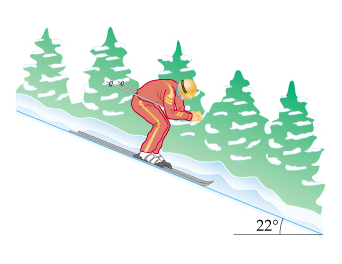
A 63-kg skier speeds down a trail, as shown in the figure (Figure 1) . The...
A 63-kg skier speeds down a trail, as shown in the figure
(Figure 1) . The surface is smooth and inclined at an angle of 22 ?
with the horizontal.
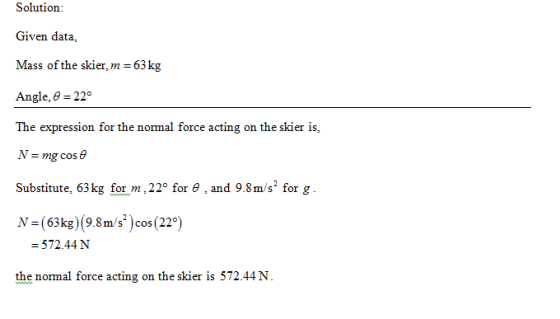
Determine the normal force acting on the
skier.
Express your answer using two significant figures.
please show work, thank you
Homework Answers
Add Answer to:
A 63-kg skier speeds down a trail, as shown in the figure
(Figure 1) . The...
6. A 71 kg skier speeds down a trail, as shown in the figure. The surface...
 6. A 71 kg skier speeds down a trail, as shown in the figure. The surface is smooth and inclined at an angle of theta = 26 degree with the horizontal. (a) Draw a free-body diagram for the skier. (Do this on paper. Your instructor may ask you to turn in this diagram.) (b) Determine the magnitude of the normal force acting on the skier.
A skier speeds down a smooth ski slope which is at an angle of e 20°...
 A skier speeds down a smooth ski slope which is at an angle of e 20° with the horizontal. The mass of the skier is 61 kg. Take the downhill direction to be positive and uphill to be negative. (a) What net force (in N) is acting on the skier? (Indicate the direction with the sign of your answer.) N (b) What is the acceleration (in m/s2) experienced by the skier? (Indicate the direction with the sign of your answer.)...
A skier speeds down a smooth ski slope which is at an angle of e 20°...
 A skier speeds down a smooth ski slope which is at an angle of e 20° with the horizontal. The mass of the skier is 61 kg. Take the downhill direction to be positive and uphill to be negative. (a) What net force (in N) is acting on the skier? (Indicate the direction with the sign of your answer.) N (b) What is the acceleration (in m/s2) experienced by the skier? (Indicate the direction with the sign of your answer.)...
A 66 kg water skier is being accelerated by a ski boat on a flat ("glassy")...
A 66 kg water skier is being accelerated by a ski boat on a flat ("glassy") lake. The coefficient of kinetic friction between the skier's skis and the water surface is μk = 0.28.What is the skier's acceleration if the rope pulling the skier behind the boat applies a horizontal tension force of magnitude FT = 240 N to the skier (θ=0∘)? Express your answer to two significant figures and include the appropriate units. a A =???? What is the...
A skier, starting from rest, skis 100 m down a smooth, flat slope inclined at 13...
A skier, starting from rest, skis 100 m down a smooth, flat slope inclined at 13 degrees. If the surface is frictionless what is the skier's final speed at the bottom? *Please be conscientious of significant figures.
When the 150-a, skier is at point a he has a speed of 5 ft/s. When...
 When the 150-a, skier is at point a he has a speed of 5 ft/s. When the skier reaches point B on the smooth slope, the slope follows the cosine curve shown. Suppose that y (x) = 63 cos (x/100 x) ft. where x is in ft. Neglect friction and air resistance. Determine the skier's speed when he reaches point b on the smooth slope Express your answer to three significant figures and include the appropriate units. What is the...
A 70- kg skier slides down a frictionless slope which forms a 30° angle above horizontal....
A 70- kg skier slides down a frictionless slope which forms a 30° angle above horizontal. Calculate the normal force and the acceleration of the skier.
A 63 kg skier skis directly down a frictionless slope angled at 20° to the horizontal....
A 63 kg skier skis directly down a frictionless slope angled at 20° to the horizontal. Assume the skier moves in the negative direction of an x axis along the slope. A wind force with component Fx acts on the skier. (Indicate the direction with the sign of your answer.) (a) What is Fx if the magnitude of the skier's velocity is constant? N (b) What is Fx if the magnitude of the skier's velocity is increasing at a rate...
Interactive Exercises 5.12: Applying Newton's Laws (Alpine Skier) An alpine skier-see Fig. 5.12.1-has total mass (including...
 Interactive Exercises 5.12: Applying Newton's Laws (Alpine Skier) An alpine skier-see Fig. 5.12.1-has total mass (including equipment) of m 75.0 kg and is skiing down a smooth slope that makes an angle of strong wind blows directly up the slope, which results in a force of 50.0 N acting on the skier opposite to his motion 30.0 to the horizontal. It is a windy day and a Interactive Figure 5.12.1: An alpine skier travels downhill. His motion is modeled as...
A 70 Kg block slides down a smooth inclined surface as shown in the figure. Determine...
 A 70 Kg block slides down a smooth inclined surface as shown in the figure. Determine the terminal velocity of the block (in m/s) and the surface contains 0.1 mm oil. Assume the velocity distribution in the gap is liner, and the area of the block in contact with the oil is 0.30 m2 Take the oil viscosity = 0.41 N.S/m2
 6. A 71 kg skier speeds down a trail, as shown in the figure. The surface is smooth and inclined at an angle of theta = 26 degree with the horizontal. (a) Draw a free-body diagram for the skier. (Do this on paper. Your instructor may ask you to turn in this diagram.) (b) Determine the magnitude of the normal force acting on the skier.
 A skier speeds down a smooth ski slope which is at an angle of e 20° with the horizontal. The mass of the skier is 61 kg. Take the downhill direction to be positive and uphill to be negative. (a) What net force (in N) is acting on the skier? (Indicate the direction with the sign of your answer.) N (b) What is the acceleration (in m/s2) experienced by the skier? (Indicate the direction with the sign of your answer.)...
 A skier speeds down a smooth ski slope which is at an angle of e 20° with the horizontal. The mass of the skier is 61 kg. Take the downhill direction to be positive and uphill to be negative. (a) What net force (in N) is acting on the skier? (Indicate the direction with the sign of your answer.) N (b) What is the acceleration (in m/s2) experienced by the skier? (Indicate the direction with the sign of your answer.)...
 When the 150-a, skier is at point a he has a speed of 5 ft/s. When the skier reaches point B on the smooth slope, the slope follows the cosine curve shown. Suppose that y (x) = 63 cos (x/100 x) ft. where x is in ft. Neglect friction and air resistance. Determine the skier's speed when he reaches point b on the smooth slope Express your answer to three significant figures and include the appropriate units. What is the...
 Interactive Exercises 5.12: Applying Newton's Laws (Alpine Skier) An alpine skier-see Fig. 5.12.1-has total mass (including equipment) of m 75.0 kg and is skiing down a smooth slope that makes an angle of strong wind blows directly up the slope, which results in a force of 50.0 N acting on the skier opposite to his motion 30.0 to the horizontal. It is a windy day and a Interactive Figure 5.12.1: An alpine skier travels downhill. His motion is modeled as...
 A 70 Kg block slides down a smooth inclined surface as shown in the figure. Determine the terminal velocity of the block (in m/s) and the surface contains 0.1 mm oil. Assume the velocity distribution in the gap is liner, and the area of the block in contact with the oil is 0.30 m2 Take the oil viscosity = 0.41 N.S/m2
Most questions answered within 3 hours.
-
Where is the error in this code sequence?
String s1 = "Hello";
String s2 = "ello";...
asked 11 months ago -
Financial data for Joel de Paris, Inc., for last year
follow:
Joel de Paris, Inc.
Balance...
asked 11 months ago -
Consider this reaction:
Al2(SO4)3 (aq)+ BaCl3
(aq) Al2Cl6 (aq)- +
3BaSO4(s) . What is the...
asked 11 months ago -
Suppose that Savneet is considering increasing her
recent random sample from 20 car rentals to 40...
asked 11 months ago -
Trucks arrive at an unloading terminal at an average rate of 120
per hour.
Trucks arrive...
asked 11 months ago -
Why are methanol and ethanol completely soluble in water while
octanol is not very little soluble....
asked 11 months ago -
A facilities manager at a university reads in a research report
that the mean amount of...
asked 11 months ago -
When the CuSO4 is rehydrated by adding water to the anhydrous
compound, is this an endothermic...
asked 11 months ago -
A ray of sunlight is passing from diamond into crown glass; the
angle of incidence is...
asked 11 months ago -
A block of mass 0.249 kg is placed on top of a light, vertical
spring of...
asked 11 months ago -
how do the kidneys compensate in the presences of acidosis
a) trigger hyperventilate
b) reserve acid...
asked 11 months ago -
Question 501 pts
The rental rate of capital to the firm increases. Which of the
following...
asked 11 months ago