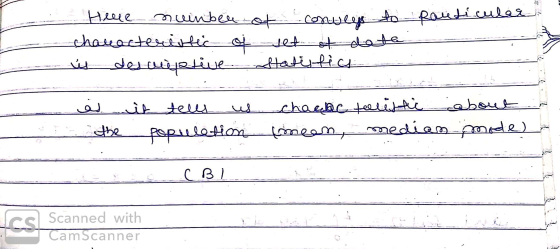
What is a number that conveys a particular characteristic of a set of data? inferential statistic...
What is a number that conveys a particular characteristic of a set of data?
|
inferential statistic |
||
|
descriptive statistic |
||
|
nominal scale |
||
|
variable |
Homework Answers
Add Answer to:
What is a number that conveys a particular characteristic of a
set of data?
inferential statistic...
The following problem will use the sashelp.baseball data set that is already in SAS Write a...
The following problem will use the sashelp.baseball data set that is already in SAS Write a SAS macro called descripstat that will calculate a descriptive statistic for a variable, in an arbitrary SAS data set. The statistic, the variable, and the name of the data set should be macro parameters. The descriptive statistic should be one that can be calculated by PROC MEANS. Have the macro include a title on the output that describes exactly what is being calculated. [Hint:...
Write a SAS macro called descripstat that will calculate a descriptive statistic for a variable, in...
Write a SAS macro called descripstat that will calculate a descriptive statistic for a variable, in an arbitrary SAS data set. The statistic, the variable, and the name of the data set should be macro parameters. The descriptive statistic should be one that can be calculated by PROC MEANS. Have the macro include a title on the output that describes exactly what is being calculated.
Share what you learned about descriptive analysis (statistics), inferential analysis (statistics), and qualitative analysis of data;...
Share what you learned about descriptive analysis (statistics), inferential analysis (statistics), and qualitative analysis of data; include something that you learned that was interesting to you and your thoughts on why data analysis is necessary for discovering credible findings for nursing. Compare clinical significance and statistical significance; include which one is more meaningful to you when considering application of findings to nursing practice.
Question 17 (2.5 points) A characteristic that describes a sample is called a Statistic Parameter Mean...
 Question 17 (2.5 points) A characteristic that describes a sample is called a Statistic Parameter Mean Meter Question 18 (2.5 points) Sensitivity of a test shows the proportion of people who have disease and test positive True False Question 19 (2.5 points) Body Mass Index (BMI) is an example of what kind of data? discrete nominal ordinal continuous Question 2012 5 points)
Justify the selection of the specific data analysis method of inferential statistics for this data set....
Justify the selection of the specific data analysis method of inferential statistics for this data set. Shift Stress 1 2 1 5 1 7 1 8 1 5 1 4 1 3 1 6 1 5 1 4 2 4 2 5 2 3 2 6 2 16 2 11 2 9 2 8 2 12 3 7 3 13 3 10 3 16 3 11 3 11 3 7 3 3 3 10 3 15 3 12
4) Which statement is true about statistics and data? a) There are two types of statistics...
4) Which statement is true about statistics and data? a) There are two types of statistics – inferential and descriptive b) Variables come in two types – categorical and quantitative c) Letter grade is a type of categorical and ordinal data d) Hair color is a type of categorial and nominal data e) Number of leaves on a tree is a type of quantitative, discrete data f) All of the above g) None of the above
Part A: Inferential Statistics Data Analysis Plan and Computation Variables Selected: Table 1: Variables Selected for...
 Part A: Inferential Statistics Data Analysis Plan and Computation Variables Selected: Table 1: Variables Selected for Analysis Variable Name in the Data Set Variable Type Variable1 Variable2 Variable 3 Data Analysis: 1. Confidence Interval Analysis: For one expenditure variable, select and run the appropriate method for estimating a parameter, based on a statistic (i.e, confidence interval method) and complete the following table (Note: Format follows Kozak outline): Table 2: Confidence Interval Information and Name of Variable: State the Random Variable...
The number of passengers "bumped" on a particular airline flight is ____________ data. Multiple Choice ratio...
The number of passengers "bumped" on a particular airline flight is ____________ data. Multiple Choice ratio interval nominal ordinal
To determine if a set of ungrouped raw data is normally distributed, what test statistic would...
To determine if a set of ungrouped raw data is normally distributed, what test statistic would we use? Select one: a. A z-statistic b. An F-statistic c. Anderson-Darling d. A chi-square
Briefly define, illustrate or explain at least five of the following important terms. Do not repeat...
 Briefly define, illustrate or explain at least five of the following important terms. Do not repeat any previously posted by a classmate. 1. Descriptive Statistics 2. Inferential Statistics 3. Population 4. Parameter 5. Sample 6. Statistic 7. Statistical Inference 8. Confidence Level 9. Significance Level 10. Variable 11. Nominal Data 12. Ordinal Data 13. Interval Data 14. Ratio Data 15. Quantitative 16. Qualitative 17. Frequency Distribution 18. Histogram 19. Bar Chart 20. Pie Chart
 Question 17 (2.5 points) A characteristic that describes a sample is called a Statistic Parameter Mean Meter Question 18 (2.5 points) Sensitivity of a test shows the proportion of people who have disease and test positive True False Question 19 (2.5 points) Body Mass Index (BMI) is an example of what kind of data? discrete nominal ordinal continuous Question 2012 5 points)
 Part A: Inferential Statistics Data Analysis Plan and Computation Variables Selected: Table 1: Variables Selected for Analysis Variable Name in the Data Set Variable Type Variable1 Variable2 Variable 3 Data Analysis: 1. Confidence Interval Analysis: For one expenditure variable, select and run the appropriate method for estimating a parameter, based on a statistic (i.e, confidence interval method) and complete the following table (Note: Format follows Kozak outline): Table 2: Confidence Interval Information and Name of Variable: State the Random Variable...
 Briefly define, illustrate or explain at least five of the following important terms. Do not repeat any previously posted by a classmate. 1. Descriptive Statistics 2. Inferential Statistics 3. Population 4. Parameter 5. Sample 6. Statistic 7. Statistical Inference 8. Confidence Level 9. Significance Level 10. Variable 11. Nominal Data 12. Ordinal Data 13. Interval Data 14. Ratio Data 15. Quantitative 16. Qualitative 17. Frequency Distribution 18. Histogram 19. Bar Chart 20. Pie Chart
Most questions answered within 3 hours.
-
Where is the error in this code sequence?
String s1 = "Hello";
String s2 = "ello";...
asked 10 months ago -
Financial data for Joel de Paris, Inc., for last year
follow:
Joel de Paris, Inc.
Balance...
asked 10 months ago -
Consider this reaction:
Al2(SO4)3 (aq)+ BaCl3
(aq) Al2Cl6 (aq)- +
3BaSO4(s) . What is the...
asked 10 months ago -
Suppose that Savneet is considering increasing her
recent random sample from 20 car rentals to 40...
asked 10 months ago -
Trucks arrive at an unloading terminal at an average rate of 120
per hour.
Trucks arrive...
asked 10 months ago -
Why are methanol and ethanol completely soluble in water while
octanol is not very little soluble....
asked 10 months ago -
A facilities manager at a university reads in a research report
that the mean amount of...
asked 10 months ago -
When the CuSO4 is rehydrated by adding water to the anhydrous
compound, is this an endothermic...
asked 10 months ago -
A ray of sunlight is passing from diamond into crown glass; the
angle of incidence is...
asked 10 months ago -
A block of mass 0.249 kg is placed on top of a light, vertical
spring of...
asked 10 months ago -
how do the kidneys compensate in the presences of acidosis
a) trigger hyperventilate
b) reserve acid...
asked 10 months ago -
Question 501 pts
The rental rate of capital to the firm increases. Which of the
following...
asked 10 months ago