a) describe a branched hydrocarbon b) what are the steps for naming a branched hydrocarbon c)how...
a) describe a branched hydrocarbon
b) what are the steps for naming a branched hydrocarbon
c)how does the branching of a hydrocarbon affect the physical and
chemical properties? why?
d)what are saturated and unsaturated hydrocarbons? which
hydrocarbons are also known as saturated hydrocarbons?
Homework Answers
a) A branched hydrocarbon is a hydrocarbon where at least one of its C atom is connected by a direct covalent bond to atleast 3 other C atom in the molecule.
For example, In isobutane, one of the carbon is connected to 3 other carbon. Hence it is a branched hydrocarbon.
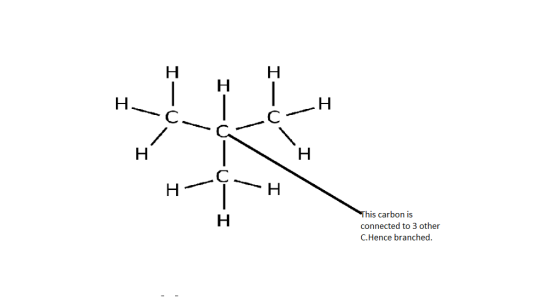
We can compare this to an unbranched hydrocarbon like, n-pentane.

Here all the carbon atoms are connected to either one or two other carbon atom, hence unbranched.
B)
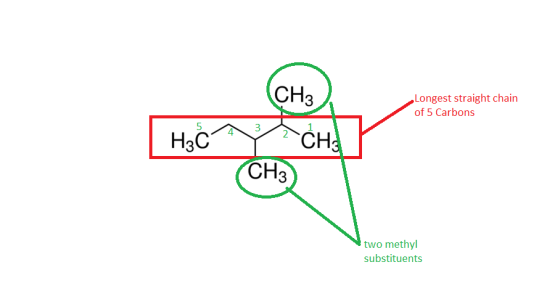
- First step of naming a branched hydrocarbon is to find out the longest possible straight chain of C-C in the molecule. For example: in the above structure of isobutane the longest straight chain possible consists of 3 carbon atoms.
- Second step is to find out all other substituents attached to the straight chain you found out on step one. If two substitutents are same you have to use di-, tri-, tetra- infront of them depending on their number.
- Step three is to number the straight chain in such a way that the substituents are attached to the carbons with smallest number.
- Now, right the name of the substituents alphabetically(without considering the di-, tri- part) with prefix of the carbon numebr they are attached to. For example, in isobutane the methyl group is attached to carbon 2, Hence, it will be written as 2-methylpropane.
- The last part is naming the straight chain alkane, in case of isobutane the straight chain is 3 carbon long, hence the suffix propane.
Here is 2,3 - dimethylpentane as another example.
c) The unbranched hydrocarbons are linear. Hence they are easier to line up against each other resulting in a more compact structure. Hence more energy is need to break their van der waals attraction. This results in higher boiling point of unbranched alkanes.
However in case of branched hydrocarbons have smaller area of contact between the molecules resulting in weak van der waals force between them, hence lower boiling point.
Chemically, they differ a lot as to how they form products in different kind of reaction based on their stability of cations and anions formed. It is because the stabilizing effect such as inductive effect differ in branched and unbranched hydrocarbon when they form cation, anions or radicals, the active species that undergoes reaction.
d) Saturated hydrocarbons are those, which does
not contain any pi- bond in them. In other words there is no C=C or
 present in the saturated hydrocarbons. The "saturation" term here
means saturated with hydrogen. In saturated hydrocarbon, the carbon
atoms are bonded to maximum possible number of hydrogen. For
example, Propane
present in the saturated hydrocarbons. The "saturation" term here
means saturated with hydrogen. In saturated hydrocarbon, the carbon
atoms are bonded to maximum possible number of hydrogen. For
example, Propane
 .
It has only single bonds.
.
It has only single bonds.
However, in unsaturated hydrocarbons, there is atleast a C=C present. It is called unsaturated because it still can accept a H2 molecule per pi bond to make it saturated.
For example, ethylene:
 .
Here there is a double bond between two C atoms.
.
Here there is a double bond between two C atoms.
Alkanes are otherwise known as saturated hydrocarbons. It is because they do not contain any pi bond in them.
For example, methane, ethane, butane, propane, isobutane, 2,3-dimethylpentane, all of these are examples of saturated hydrocarbons.
Add Answer to:
a) describe a branched hydrocarbon
b) what are the steps for naming a branched hydrocarbon
c)how...
What is a hydrocarbon? How is the polarity of hydrburbur, its solubility, its density and its...
What is a hydrocarbon? How is the polarity of hydrburbur, its solubility, its density and its viscosity? What are the physical and chemical properties of hydrocarbons and water? How are the molecular structures of hydrocarbons in petroleum and water? What method or technique can be used for the separation of hydrocarbons from water? What are the intermolecular interactions between the chemicals involved (hydrocarbons and water)?
5. What is the difference between the hybridization of carbon atoms' valence orbitals in saturated and...
 5. What is the difference between the hybridization of carbon atoms' valence orbitals in saturated and unsaturated hydrocarbons? A. In saturated hydrocarbons, the hybridization on atoms is sp.: in unsaturated hydrocarbons, some of the hybridization on atoms is sp or sp hybrid. B. In saturated hydrocarbons, the hybridization on atoms is sp': in unsaturated hydrocarbons, some of the hybridization on atoms is sp or sp hybrid. C. In saturated hydrocarbons, the hybridization on atoms is sp; in unsaturated hydrocarbons, some...
1. compare the naming rules for carboxylic acids, carboxylic salts and esters. 2. how does the...
1. compare the naming rules for carboxylic acids, carboxylic salts and esters. 2. how does the classification of an amide affect its physical properties? 3. what are the laboratory tests that relate to carbonyl compounds ? which ones would you use to distinguish an aldehyde from a ketone ? 4. why do ammonium and amine salts form acidic solution ? Please help answer ALL questions. Thank you
10. Identify each as a saturated or unsaturated hydrocarbon (5 points): a. Chlorobenzene b. Cyclobutene c....
 10. Identify each as a saturated or unsaturated hydrocarbon (5 points): a. Chlorobenzene b. Cyclobutene c. 3-methylhexane d. Propyne e. Ethanoic acid
Which terms from this list BEST describe the following compound? H-C=c- I. Alkane II. Alkene III....
 Which terms from this list BEST describe the following compound? H-C=c- I. Alkane II. Alkene III. Alkyne IV. Aromatic V. Saturated hydrocarbon VI. Unsaturated hydrocarbon I and V B. II and VI II and V C. III and VI D. E. III and V
which fatty acid is unsaturated Lipids b. Which fatty acid is unsaturated? c. The melting point...
 which fatty acid is unsaturated
Lipids b. Which fatty acid is unsaturated? c. The melting point of stearic acid is 70°C, and that of oleic acid is 4°C. Explain the difference. From the results of experiment C, how can you tell which is more unsaturated, oleic acid or steari d. acid? 04. How does omitting triethanolamine affect the properties and appearance of the hand lotion? Q5. How does omitting stearic acid affect the properties and appearance of the hand lotion?...
which fatty acid is unsaturated
Lipids b. Which fatty acid is unsaturated? c. The melting point of stearic acid is 70°C, and that of oleic acid is 4°C. Explain the difference. From the results of experiment C, how can you tell which is more unsaturated, oleic acid or steari d. acid? 04. How does omitting triethanolamine affect the properties and appearance of the hand lotion? Q5. How does omitting stearic acid affect the properties and appearance of the hand lotion?...
Please answer all 4 questions 1) Draw condensed structure formulas for the following compounds 2) How...
 Please answer all 4 questions
1) Draw condensed structure formulas for the following
compounds
2) How would you describe the difference between saturated and
unsaturated hydrocarbons and what is a distinguishing feature of
aromatic hydrocarbons?
5) Do you expect the aromatic hydrocarbons to react in a similar
way to the cyclic alkenes, since they are both cyclic compounds and
have a double bond? explain
6) write the structure of the product. if no reaction occurs
write NR
Final questions 1....
Please answer all 4 questions
1) Draw condensed structure formulas for the following
compounds
2) How would you describe the difference between saturated and
unsaturated hydrocarbons and what is a distinguishing feature of
aromatic hydrocarbons?
5) Do you expect the aromatic hydrocarbons to react in a similar
way to the cyclic alkenes, since they are both cyclic compounds and
have a double bond? explain
6) write the structure of the product. if no reaction occurs
write NR
Final questions 1....
2. . An unknown, non-branched saturated hydrocarbon has the mass spectrum s below. What is the...
 2. . An unknown, non-branched saturated hydrocarbon has the mass spectrum s below. What is the structure of the unknown hydrocarbon? 100) 3. "19 127 141 158 189 188 107 211 225 241 20 40 60 80 100 120 140 160 180 200 220 240 An unknown compound with formula C H100, RVO negative tent with 2.4 dinitrophenylhydrazine; however, the unknown tested positive with the Jones reagent. When added to a solution of bromine dissolved in methylene, the reddin solution...
Hi, answer all of these correctly. Thanks! This is the data sheet POST-LAB GUIDE QUESTIONS 1....
 Hi, answer all of these correctly. Thanks!
This is the data sheet
POST-LAB GUIDE QUESTIONS 1. Which among the hydrocarbons used in the experiment is/are A. saturated? B. actively unsaturated? C. aromatic? 2. Octane is an unbranched alkane of formula CeHa. Based on your observations in this experiment, predict the following: a. Solubility in water: b. Solubility in CCl: c. Combustion characteristics: d. Density versus water: 3.1-Hexene is an alkene. Based on your observations in this experiment, what should you...
Hi, answer all of these correctly. Thanks!
This is the data sheet
POST-LAB GUIDE QUESTIONS 1. Which among the hydrocarbons used in the experiment is/are A. saturated? B. actively unsaturated? C. aromatic? 2. Octane is an unbranched alkane of formula CeHa. Based on your observations in this experiment, predict the following: a. Solubility in water: b. Solubility in CCl: c. Combustion characteristics: d. Density versus water: 3.1-Hexene is an alkene. Based on your observations in this experiment, what should you...
7. What do you know about intermolecular force and intramolecular force? Can you describe each force?...
 7. What do you know about intermolecular force and intramolecular force? Can you describe each force? What properties that could give information regarding the intermolecular forces from macroscopic measurements? 8. How do you describe the conditions which are called unsaturated, saturated and supersaturated solution? How is the relation of Solubility (s) with the solubility product constant (Ksp)? 9. Why the solubility of ionic solutions depends on the temperature? explain the reasons.
 5. What is the difference between the hybridization of carbon atoms' valence orbitals in saturated and unsaturated hydrocarbons? A. In saturated hydrocarbons, the hybridization on atoms is sp.: in unsaturated hydrocarbons, some of the hybridization on atoms is sp or sp hybrid. B. In saturated hydrocarbons, the hybridization on atoms is sp': in unsaturated hydrocarbons, some of the hybridization on atoms is sp or sp hybrid. C. In saturated hydrocarbons, the hybridization on atoms is sp; in unsaturated hydrocarbons, some...
 10. Identify each as a saturated or unsaturated hydrocarbon (5 points): a. Chlorobenzene b. Cyclobutene c. 3-methylhexane d. Propyne e. Ethanoic acid
 Which terms from this list BEST describe the following compound? H-C=c- I. Alkane II. Alkene III. Alkyne IV. Aromatic V. Saturated hydrocarbon VI. Unsaturated hydrocarbon I and V B. II and VI II and V C. III and VI D. E. III and V
 which fatty acid is unsaturated
Lipids b. Which fatty acid is unsaturated? c. The melting point of stearic acid is 70°C, and that of oleic acid is 4°C. Explain the difference. From the results of experiment C, how can you tell which is more unsaturated, oleic acid or steari d. acid? 04. How does omitting triethanolamine affect the properties and appearance of the hand lotion? Q5. How does omitting stearic acid affect the properties and appearance of the hand lotion?...
which fatty acid is unsaturated
Lipids b. Which fatty acid is unsaturated? c. The melting point of stearic acid is 70°C, and that of oleic acid is 4°C. Explain the difference. From the results of experiment C, how can you tell which is more unsaturated, oleic acid or steari d. acid? 04. How does omitting triethanolamine affect the properties and appearance of the hand lotion? Q5. How does omitting stearic acid affect the properties and appearance of the hand lotion?...
 Please answer all 4 questions
1) Draw condensed structure formulas for the following
compounds
2) How would you describe the difference between saturated and
unsaturated hydrocarbons and what is a distinguishing feature of
aromatic hydrocarbons?
5) Do you expect the aromatic hydrocarbons to react in a similar
way to the cyclic alkenes, since they are both cyclic compounds and
have a double bond? explain
6) write the structure of the product. if no reaction occurs
write NR
Final questions 1....
Please answer all 4 questions
1) Draw condensed structure formulas for the following
compounds
2) How would you describe the difference between saturated and
unsaturated hydrocarbons and what is a distinguishing feature of
aromatic hydrocarbons?
5) Do you expect the aromatic hydrocarbons to react in a similar
way to the cyclic alkenes, since they are both cyclic compounds and
have a double bond? explain
6) write the structure of the product. if no reaction occurs
write NR
Final questions 1....
 2. . An unknown, non-branched saturated hydrocarbon has the mass spectrum s below. What is the structure of the unknown hydrocarbon? 100) 3. "19 127 141 158 189 188 107 211 225 241 20 40 60 80 100 120 140 160 180 200 220 240 An unknown compound with formula C H100, RVO negative tent with 2.4 dinitrophenylhydrazine; however, the unknown tested positive with the Jones reagent. When added to a solution of bromine dissolved in methylene, the reddin solution...
 Hi, answer all of these correctly. Thanks!
This is the data sheet
POST-LAB GUIDE QUESTIONS 1. Which among the hydrocarbons used in the experiment is/are A. saturated? B. actively unsaturated? C. aromatic? 2. Octane is an unbranched alkane of formula CeHa. Based on your observations in this experiment, predict the following: a. Solubility in water: b. Solubility in CCl: c. Combustion characteristics: d. Density versus water: 3.1-Hexene is an alkene. Based on your observations in this experiment, what should you...
Hi, answer all of these correctly. Thanks!
This is the data sheet
POST-LAB GUIDE QUESTIONS 1. Which among the hydrocarbons used in the experiment is/are A. saturated? B. actively unsaturated? C. aromatic? 2. Octane is an unbranched alkane of formula CeHa. Based on your observations in this experiment, predict the following: a. Solubility in water: b. Solubility in CCl: c. Combustion characteristics: d. Density versus water: 3.1-Hexene is an alkene. Based on your observations in this experiment, what should you...
 7. What do you know about intermolecular force and intramolecular force? Can you describe each force? What properties that could give information regarding the intermolecular forces from macroscopic measurements? 8. How do you describe the conditions which are called unsaturated, saturated and supersaturated solution? How is the relation of Solubility (s) with the solubility product constant (Ksp)? 9. Why the solubility of ionic solutions depends on the temperature? explain the reasons.
Most questions answered within 3 hours.
-
Where is the error in this code sequence?
String s1 = "Hello";
String s2 = "ello";...
asked 10 months ago -
Financial data for Joel de Paris, Inc., for last year
follow:
Joel de Paris, Inc.
Balance...
asked 10 months ago -
Consider this reaction:
Al2(SO4)3 (aq)+ BaCl3
(aq) Al2Cl6 (aq)- +
3BaSO4(s) . What is the...
asked 10 months ago -
Suppose that Savneet is considering increasing her
recent random sample from 20 car rentals to 40...
asked 10 months ago -
Trucks arrive at an unloading terminal at an average rate of 120
per hour.
Trucks arrive...
asked 10 months ago -
Why are methanol and ethanol completely soluble in water while
octanol is not very little soluble....
asked 10 months ago -
A facilities manager at a university reads in a research report
that the mean amount of...
asked 10 months ago -
When the CuSO4 is rehydrated by adding water to the anhydrous
compound, is this an endothermic...
asked 10 months ago -
A ray of sunlight is passing from diamond into crown glass; the
angle of incidence is...
asked 10 months ago -
A block of mass 0.249 kg is placed on top of a light, vertical
spring of...
asked 10 months ago -
how do the kidneys compensate in the presences of acidosis
a) trigger hyperventilate
b) reserve acid...
asked 10 months ago -
Question 501 pts
The rental rate of capital to the firm increases. Which of the
following...
asked 10 months ago