Java Program
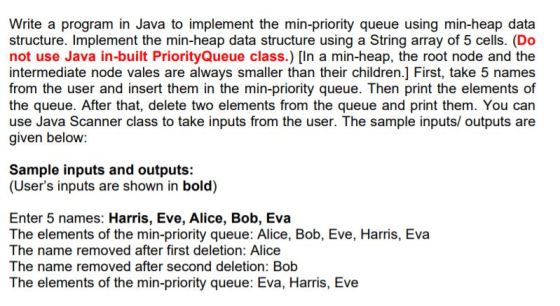
Write a program in Java to implement the min-priority queue using min-heap data structure. Implement the min-heap data structure using a String array of 5 cells. (Do not use Java in-built PriorityQueue class.) [In a min-heap, the root node and the intermediate node vales are always smaller than their children.] First, take 5 names from the user and insert them in the min-priority queue. Then print the elements of the queue. After that, delete two elements from the queue and print them. You can use Java Scanner class to take inputs from the user. The sample inputs/ outputs are given below:
Sample inputs and outputs:
(User's inputs are shown in bold)
Enter 5 names: Harris, Eve, Alice, Bob, Eva The elements of the min-priority queue: Alice, Bob, Eve, Harris, Eva The name removed after first deletion: Alice The name removed after second deletion: Bob The elements of the min-priority queue: Eva, Harris, Eve
Homework Answers
Request Answer!
10 have requested this problem solution
The more requests, the faster the answer.
Write a program in Java to implement the max-priority queue using max-heap data structure. Implement the...
Write a program in Java to implement the max-priority queue using max-heap data structure. Implement the max-heap data structure using an integer array of 10 cells. (Do not use Java in-built PriorityQueue class.) [In a max-heap, the root node and the intermediate node vales are always greater than their children.] First, take 10 integer values from the user and insert them in the max-priority queue. Then print the elements of the queue. After that, delete two elements from the queue...
In Java, create a program implementing the functionalities of a standard queue in a class called Queue3503....
In Java, create a program implementing the functionalities of a standard queue in a class called Queue3503. You will test the functionalities of the Queue3503 class from the main() method of the Main class. In a queue, first inserted items are removed first and the last items are removed at the end (imagine a line to buy tickets at a ticket counter). Do NOT change your class name from "Main". The Main class should come first in your code. Your filename should be "Main.java". The Queue3503 class will contain:...
In class, we discussed the priority queue (PQ) ADT implemented using min-heap. In a min-heap, the...
 In class, we discussed the priority queue (PQ) ADT implemented using min-heap. In a min-heap, the element of the heap with the smallest key is the root of the binary tree. On the other hand, a max-heap has as root the element with the biggest key, and the relationship between the keys of a node and its parent is reversed of that of a min-heap. We also discussed an array-based implementation of heaps. In this assignment, your task is to...
JAVA PROGRAMMING You are given an interface PriorityQueue (the source code is at the end of...
JAVA PROGRAMMING You are given an interface PriorityQueue (the source code is at the end of this document) that specifies the protocols for a priority queue with generic values and priorities, where the priorities are discretely ordered rather than comparable. Implement the class ListofQueuesPQ implements PriorityQueue to fulfill the requirements of the interface (see the Javadoc in the interface’s source code). Use an ListofQueues in order to fulfill the needs of the interface. You will need to make sub-classes within...
JAVA PROGRAMMING You are given an interface PriorityQueue (the source code is at the end of...
JAVA PROGRAMMING You are given an interface PriorityQueue (the source code is at the end of this document) that specifies the protocols for a priority queue with generic values and priorities, where the priorities are discretely ordered rather than comparable. Implement the class ArrayListPQ implements PriorityQueue to fulfill the requirements of the interface (see the Javadoc in the interface’s source code). Use an ArrayList in order to fulfill the needs of the interface. For each constructor and method in your...
Write a C++ program to implement Queue ADT using singly linked structure. The program includes the...
Write a C++ program to implement Queue ADT using singly linked structure. The program includes the following: Define the Queue class template in the header file QueueLinked.h. // QueueLinked.h #ifndef QUEUE_H #define QUEUE_H #include <iostream> using namespace std; template <typename T> class Queue { public: // Constructor Queue(); //Desctructor ~Queue(); // Makes the queue to the empty state. void make_empty(); // Checks if the queue is empty. bool empty() const; // Inserts item at the end of the queue. void...
You are given an array of N unsigned chars (symbols) where each symbol is represented by...
You are given an array of N unsigned chars (symbols) where each symbol is represented by 8-bits Design a Huffman Coder in C++ that returns the length of the codeword for each of the possible 256 symbols and the total number of bits required to encode this data Requirements: After computing the frequency of occurrence of each symbol, you must implement a min-heap (priority queue) to implement the Huffman coder. The function to fill in C++: int HuffmanCoder(vector<unsigned char> &data,...
Using C++, data structures, C++ STL, inputs and expected outputs are shown below. Max Heap Heap...
 Using C++, data structures, C++ STL, inputs and expected
outputs are shown below.
Max Heap Heap is a specialized tree-based data structure that satisfies the heap property: if P is a parent node of C, then the key (the value) of P is either > (in a max heap) or s (in a min heap) the key of C. The node at the "top" of the heap (with no parents) is called the root node. In binary-tree based heap, it...
Using C++, data structures, C++ STL, inputs and expected
outputs are shown below.
Max Heap Heap is a specialized tree-based data structure that satisfies the heap property: if P is a parent node of C, then the key (the value) of P is either > (in a max heap) or s (in a min heap) the key of C. The node at the "top" of the heap (with no parents) is called the root node. In binary-tree based heap, it...
I've posted 3 classes after the instruction that were given at start You will implement and...
I've posted 3 classes after the instruction that were given at start You will implement and test a PriorityQueue class, where the items of the priority queue are stored on a linked list. The material from Ch1 ~ 8 of the textbook can help you tremendously. You can get a lot of good information about implementing this assignment from chapter 8. There are couple notes about this assignment. 1. Using structure Node with a pointer point to Node structure to...
JAVA Have not gotten the public Iterator<Item> iterator() . Can someone explain it please? import java.util.Iterator;...
JAVA Have not gotten the public Iterator<Item> iterator() . Can someone explain it please? import java.util.Iterator; /* * GroupsQueue class supporting addition and removal of items * with respect to a given number of priorities and with * respect to the FIFO (first-in first-out) order for items * with the same priority. * * An example, where GroupsQueue would be useful is the airline * boarding process: every passenger gets assigned a priority, * usually a number, e.g., group 1,...
 In class, we discussed the priority queue (PQ) ADT implemented using min-heap. In a min-heap, the element of the heap with the smallest key is the root of the binary tree. On the other hand, a max-heap has as root the element with the biggest key, and the relationship between the keys of a node and its parent is reversed of that of a min-heap. We also discussed an array-based implementation of heaps. In this assignment, your task is to...
 Using C++, data structures, C++ STL, inputs and expected
outputs are shown below.
Max Heap Heap is a specialized tree-based data structure that satisfies the heap property: if P is a parent node of C, then the key (the value) of P is either > (in a max heap) or s (in a min heap) the key of C. The node at the "top" of the heap (with no parents) is called the root node. In binary-tree based heap, it...
Using C++, data structures, C++ STL, inputs and expected
outputs are shown below.
Max Heap Heap is a specialized tree-based data structure that satisfies the heap property: if P is a parent node of C, then the key (the value) of P is either > (in a max heap) or s (in a min heap) the key of C. The node at the "top" of the heap (with no parents) is called the root node. In binary-tree based heap, it...
Most questions answered within 3 hours.
-
Where is the error in this code sequence?
String s1 = "Hello";
String s2 = "ello";...
asked 11 months ago -
Financial data for Joel de Paris, Inc., for last year
follow:
Joel de Paris, Inc.
Balance...
asked 11 months ago -
Consider this reaction:
Al2(SO4)3 (aq)+ BaCl3
(aq) Al2Cl6 (aq)- +
3BaSO4(s) . What is the...
asked 11 months ago -
Suppose that Savneet is considering increasing her
recent random sample from 20 car rentals to 40...
asked 11 months ago -
Trucks arrive at an unloading terminal at an average rate of 120
per hour.
Trucks arrive...
asked 11 months ago -
Why are methanol and ethanol completely soluble in water while
octanol is not very little soluble....
asked 11 months ago -
A facilities manager at a university reads in a research report
that the mean amount of...
asked 11 months ago -
When the CuSO4 is rehydrated by adding water to the anhydrous
compound, is this an endothermic...
asked 11 months ago -
A ray of sunlight is passing from diamond into crown glass; the
angle of incidence is...
asked 11 months ago -
A block of mass 0.249 kg is placed on top of a light, vertical
spring of...
asked 11 months ago -
how do the kidneys compensate in the presences of acidosis
a) trigger hyperventilate
b) reserve acid...
asked 11 months ago -
Question 501 pts
The rental rate of capital to the firm increases. Which of the
following...
asked 11 months ago