In an experiment to determine the caloric value of food, a sample of food was burned...
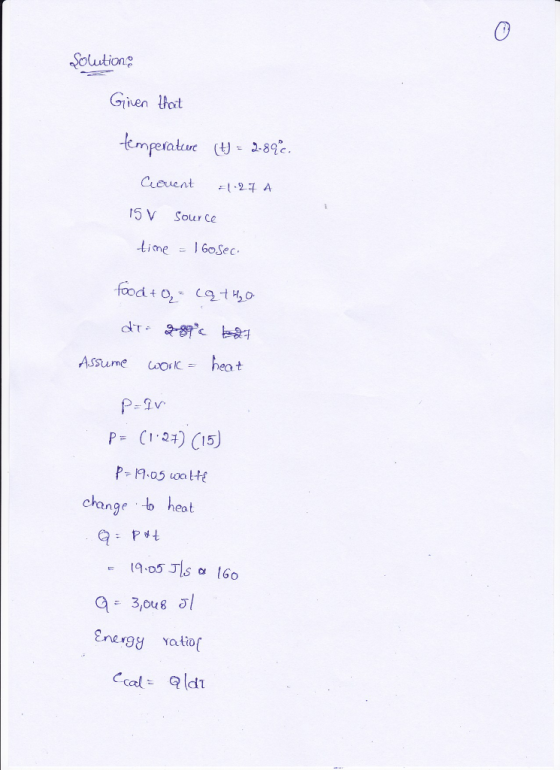
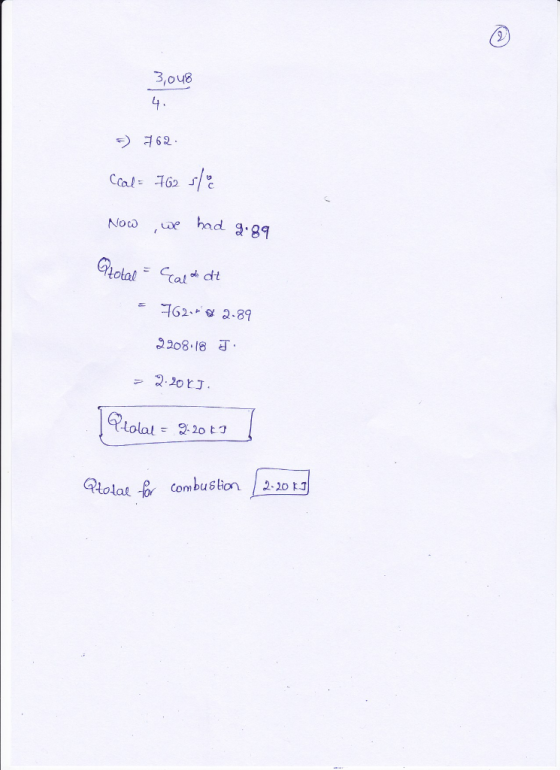
In an experiment to determine the caloric value of food, a sample of food was burned in an oxygen atmosphere and the temperature rose by 2.89°C. When a current of 1.27 A from a 15v source flowed through the same calorimeter for 160 seconds, the temperature rose by 4 °C. What is the heat released by the combustion?
Homework Answers
Add Answer to:
In an experiment to determine the caloric value of food, a
sample of food was burned...
In an experiment to determine the caloric content of a granola bar, a 0.5 g sample...
In an experiment to determine the caloric content of a granola bar, a 0.5 g sample of the bar was burned in an oxygen atmosphere and the temperature rose by 11.12 oC. In a separate experiment using the same calorimeter, a 1.27 A current from a 12.5 V source was applied for 180 s and the temperature rose 3.88 oC. (a) Calculate the heat capacity of the calorimeter. (The heat produced by electric elements is as follows: q = IVt)...
Determine the heat of combustion of sucrose (C12H22O11) in kJ/mol if 2.00g of sucrose is burned...
Determine the heat of combustion of sucrose (C12H22O11) in kJ/mol if 2.00g of sucrose is burned in a bomb calorimeter, and the temperature of the calorimeter rose from 25.33C to 28.17C. The heat capacity of the calorimeter is 11.6kJ/C.
Heat Capacity and Calorimetry A sample of ethanol, C2H5OH, weighing 2.84 g was burned in an...
 Heat Capacity and Calorimetry
A sample of ethanol, C2H5OH, weighing 2.84 g was burned in an
excess of oxygen in a bomb calorimeter. The temperature of the
calorimeter rose from 25C to 33.73C. If the heat capacity of the
calorimeter and contents is 9.63kJ/C, what is the value of q for
burning 1.00 lol of ethanol at constant volume and 25.00C.
Is q equal to U or H?
214e Questions and Problems the enthalpy change when 0.710 mol of calcium...
Heat Capacity and Calorimetry
A sample of ethanol, C2H5OH, weighing 2.84 g was burned in an
excess of oxygen in a bomb calorimeter. The temperature of the
calorimeter rose from 25C to 33.73C. If the heat capacity of the
calorimeter and contents is 9.63kJ/C, what is the value of q for
burning 1.00 lol of ethanol at constant volume and 25.00C.
Is q equal to U or H?
214e Questions and Problems the enthalpy change when 0.710 mol of calcium...
When a 3.08 g sample of liquid octane (C8H18) is burned in a bomb calorimeter, the...
When a 3.08 g sample of liquid octane (C8H18) is burned in a bomb calorimeter, the temperature of the calorimeter rises by 26.9 oC. The heat capacity of the calorimeter, measured in a separate experiment, is 6.22 kJ/∘C . The calorimeter also contains 3.00 kg of water, specific heat capacity of 4.18 J/g°C. Determine the heat of combustion of octane in units of kJ/mol octane.
7. A 2.548-9 sample of valine, CsH ,NO, (117.15 g/mol) was burned in a bomb calorimeter...
 7. A 2.548-9 sample of valine, CsH ,NO, (117.15 g/mol) was burned in a bomb calorimeter with excess oxygen. The temperature of the calorimeter and the water before combustion was 18.42 °C, after combustion the calorimeter and the water had a temperature of 29.13 °C. The calorimeter had a heat capacity of 633 J/K, and contained 1.255 kg of water. Use these data to calculate the molar heat of combustion (in kJ) of valine.
A 1.764-g sample of heptanoic acid, C7H14O2 (130.19 g/mol) was burned in a bomb calorimeter with...
A 1.764-g sample of heptanoic acid, C7H14O2 (130.19 g/mol) was burned in a bomb calorimeter with excess oxygen. The temperature of the calorimeter and the water before combustion was 23.68 °C; after combustion the calorimeter and the water had a temperature of 32.12 °C. The calorimeter had a heat capacity of 500 J/K, and contained 1.462 kg of water. Use these data to calculate the molar heat of combustion (in kJ) of heptanoic acid.
7. A 2.053-g sample of ethylene glycol, CH.02 (62.07 g/mol) was burned in a bomb calorimeter...
 7. A 2.053-g sample of ethylene glycol, CH.02 (62.07 g/mol) was burned in a bomb calorimeter with excess oxygen. The temperature of the calorimeter and the water before combustion was 16.49 °C; after combustion the calorimeter and the water had a temperature of 23.12 °C. The calorimeter had a heat capacity of 567 J/K, and contained 1.316 kg of water. Use these data to calculate the molar heat of combustion (in kJ) of ethylene glycol.
7. A 2.529-g sample of glutaric acid, CsH.O.(132.12 g/mol) was burned in a bomb calorimeter with excess oxygen. The...
 7. A 2.529-g sample of glutaric acid, CsH.O.(132.12 g/mol) was burned in a bomb calorimeter with excess oxygen. The temperature of the calorimeter and the water before combustion was 23.63 °Cafter combustion the calorimeter and the water had a temperature of 32.48 °C. The calorimeter had a heat capacity of 747 J/K, and contained 0.926 kg of water. Use these data to calculate the molar heat of combustion (in kJ) of glutaric acid.
1a) Consider the reaction: C12H22O11(s)+12O2(g)→12CO2(g)+11H2O(l) in which 10.0 g of sucrose, C12H22O11, was burned in a...
1a) Consider the reaction: C12H22O11(s)+12O2(g)→12CO2(g)+11H2O(l) in which 10.0 g of sucrose, C12H22O11, was burned in a bomb calorimeter with a heat capacity of 7.50 kJ/∘C. The temperature increase inside the calorimeter was found to be 22.0 ∘C. What is the heat of this reaction per mole of sucrose? 1b) One tablespoon of peanut butter has a mass of 17.0 g. It is combusted in a calorimeter whose heat capacity is 110 kJ/°C. The temperature of the calorimeter rises from 21.6...
A 0.437-g sample of benzil (C4HO2) is burned in a bomb calorimeter and the temperature increases...
A 0.437-g sample of benzil (C4HO2) is burned in a bomb calorimeter and the temperature increases from 24.50 C to 27.30 C. The calorimeter contains 1.04x10^3 g of water and the bomb has a heat capacity of 884 JC. Based on this experiment, calculate AE for the combustion reaction per mole of benzil burned (k/mol)
 Heat Capacity and Calorimetry
A sample of ethanol, C2H5OH, weighing 2.84 g was burned in an
excess of oxygen in a bomb calorimeter. The temperature of the
calorimeter rose from 25C to 33.73C. If the heat capacity of the
calorimeter and contents is 9.63kJ/C, what is the value of q for
burning 1.00 lol of ethanol at constant volume and 25.00C.
Is q equal to U or H?
214e Questions and Problems the enthalpy change when 0.710 mol of calcium...
Heat Capacity and Calorimetry
A sample of ethanol, C2H5OH, weighing 2.84 g was burned in an
excess of oxygen in a bomb calorimeter. The temperature of the
calorimeter rose from 25C to 33.73C. If the heat capacity of the
calorimeter and contents is 9.63kJ/C, what is the value of q for
burning 1.00 lol of ethanol at constant volume and 25.00C.
Is q equal to U or H?
214e Questions and Problems the enthalpy change when 0.710 mol of calcium...
 7. A 2.548-9 sample of valine, CsH ,NO, (117.15 g/mol) was burned in a bomb calorimeter with excess oxygen. The temperature of the calorimeter and the water before combustion was 18.42 °C, after combustion the calorimeter and the water had a temperature of 29.13 °C. The calorimeter had a heat capacity of 633 J/K, and contained 1.255 kg of water. Use these data to calculate the molar heat of combustion (in kJ) of valine.
 7. A 2.053-g sample of ethylene glycol, CH.02 (62.07 g/mol) was burned in a bomb calorimeter with excess oxygen. The temperature of the calorimeter and the water before combustion was 16.49 °C; after combustion the calorimeter and the water had a temperature of 23.12 °C. The calorimeter had a heat capacity of 567 J/K, and contained 1.316 kg of water. Use these data to calculate the molar heat of combustion (in kJ) of ethylene glycol.
 7. A 2.529-g sample of glutaric acid, CsH.O.(132.12 g/mol) was burned in a bomb calorimeter with excess oxygen. The temperature of the calorimeter and the water before combustion was 23.63 °Cafter combustion the calorimeter and the water had a temperature of 32.48 °C. The calorimeter had a heat capacity of 747 J/K, and contained 0.926 kg of water. Use these data to calculate the molar heat of combustion (in kJ) of glutaric acid.
Most questions answered within 3 hours.
-
Where is the error in this code sequence?
String s1 = "Hello";
String s2 = "ello";...
asked 10 months ago -
Financial data for Joel de Paris, Inc., for last year
follow:
Joel de Paris, Inc.
Balance...
asked 10 months ago -
Consider this reaction:
Al2(SO4)3 (aq)+ BaCl3
(aq) Al2Cl6 (aq)- +
3BaSO4(s) . What is the...
asked 10 months ago -
Suppose that Savneet is considering increasing her
recent random sample from 20 car rentals to 40...
asked 10 months ago -
Trucks arrive at an unloading terminal at an average rate of 120
per hour.
Trucks arrive...
asked 10 months ago -
Why are methanol and ethanol completely soluble in water while
octanol is not very little soluble....
asked 10 months ago -
A facilities manager at a university reads in a research report
that the mean amount of...
asked 10 months ago -
When the CuSO4 is rehydrated by adding water to the anhydrous
compound, is this an endothermic...
asked 10 months ago -
A ray of sunlight is passing from diamond into crown glass; the
angle of incidence is...
asked 10 months ago -
A block of mass 0.249 kg is placed on top of a light, vertical
spring of...
asked 10 months ago -
how do the kidneys compensate in the presences of acidosis
a) trigger hyperventilate
b) reserve acid...
asked 10 months ago -
Question 501 pts
The rental rate of capital to the firm increases. Which of the
following...
asked 10 months ago