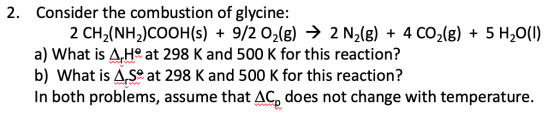
Cp N2(g) 29.125
Cp gly 99.2
Cp O2 (g) 29.355
Cp CO2(g) 37.11
Cp H2O (l) 75.291
Homework Answers

Add Answer to:
Cp N2(g) 29.125
Cp gly 99.2
Cp O2 (g) 29.355
Cp CO2(g) 37.11
Cp H2O (l)...
the enthalpy of combustion of CH4(g) to make H2O(l) and CO2(g) is -2340 kJ mol-1. The...
 the enthalpy of combustion of CH4(g) to make H2O(l) and CO2(g) is -2340 kJ mol-1. The enthalpy of combustion of CH2(g) to make H2O(l) and CO2(g) is -2760 kJ mol-1. The enthalpy of formation of H2O(l) is -286 kJ mol-1. All the data are for 298 K. The heat capacities for O2(g), CHA(8), CH3(g), H2O(l) and CO2(8) are 29, 61, 71, 75 and 37 JK"mor", respectively. Deduce a) 4U298 for the combustion of C4H8(g). 5) AH for the combustion of...
Part A N2(g)+3Br2(g)⇌2NBr3(g) K=[NBr3]2[N2][Br2]3 K=[N2][Br2]3[NBr3]2 K=[NBr3][N2][Br2] K=[NBr3]2[N2][Br2]3 Part B C(s)+O2(g)⇌CO2(g) K=[CO2][O2] K=[O2][CO2] K=[CO2][O2] K=[CO2][O2][C] When heated,...
Part A N2(g)+3Br2(g)⇌2NBr3(g) K=[NBr3]2[N2][Br2]3 K=[N2][Br2]3[NBr3]2 K=[NBr3][N2][Br2] K=[NBr3]2[N2][Br2]3 Part B C(s)+O2(g)⇌CO2(g) K=[CO2][O2] K=[O2][CO2] K=[CO2][O2] K=[CO2][O2][C] When heated, carbon reacts with water to produce carbon monoxide and hydrogen. C(s)+H2O(g)+heat⇌CO(g)+H2(g) Part C What effect does each of the following changes have on the equilibrium? Drag the appropriate stresses to their respective bins. add H2O, Add heat, lower temperature, remove CO Categories: Equilibrium shifts to products, Equilibrium shifts to reactants, Equilibrium doesn't shift
Predict the signs, comment and then calculate the enthalpy and entropy changes for the reaction of...
Predict the signs, comment and then calculate the enthalpy and entropy changes for the reaction of combustion ofmethane at 500 K. Will the reaction be spontaneous at 500 K? CH4(g) + 2 O2(g) → CO2(g) + 2H2O(g) We give: The enthalpies of formation of the products at 298.15 K in kJ/mol are: ∆Hf(CO2) = - 393.51; ∆Hf(H2O) = - 241.82; ∆Hf(CH4) = -74.81. The heat capacities at constant pressure in J.mol-1.K-1: Cp(CO2) = 37.11; Cp(H2O) = 33.58; Cp(CH4) = 35.31;...
You have the following info: C3H8(l) + O2(g) ---> CO2(g) + H2O(g) ∆Hrxn = -2044 kJ...
You have the following info: C3H8(l) + O2(g) ---> CO2(g) + H2O(g) ∆Hrxn = -2044 kJ Given 4.73 Kg of C3H8(g) react and the gas produced from the reaction is collected in a 5.00 L container at 298 K. Molar masses: C3H8 = 44.09 g/mol, H2O = 18.02 g/mol, CO2 = 40.02 g/mol 1) What is the heat of the reaction given the conditions described (i.e. what is qrxn)? 2) Is the reaction exothermic or endothermic? 3) Is heat a...
Q3. Calculate AG®, for the reaction CO (g) + O2(g) → CO2 at 298.15 K. Calculate...
 Q3. Calculate AG®, for the reaction CO (g) + O2(g) → CO2 at 298.15 K. Calculate AG®, at 600 K assuming that AH®, is constant in the temperature interval of interest.
Given the following equations and AH' values: C(s) + O2(g) + CO2(g) AH = -393.5 kJ...
 Given the following equations and AH' values: C(s) + O2(g) + CO2(g) AH = -393.5 kJ H2(g) + 1/2O2(g) - H20 (1) AH = -285.8 kJ 2C2H2 (8) + 5O2(g) + 4CO2(g) + 2H20 (1) AH'= -2598 kJ Determine the heat of reaction (in kJ) at 298 K for the reaction: 2C(s) + H2(8) C2H2 (8) 0-136.8 0-219.8 0-109.9 O-167.1 +226.2
Write down the combustion reaction equation for: C6H10O5 + x(O2 + 3.76N2) --> y(CO2) + z(H2O)...
Write down the combustion reaction equation for: C6H10O5 + x(O2 + 3.76N2) --> y(CO2) + z(H2O) + k(N2) C6H10O5(NO2)3 + x(O2 + 3.76N2) --> y(CO2) + z(H2O) + k(N2)
Ethane burns in air to give H2O and CO2 2 C2H6(g) + 7 O2(g) + 4CO2(g)...
 Ethane burns in air to give H2O and CO2 2 C2H6(g) + 7 O2(g) + 4CO2(g) + 6 H2O(g) a. What volume of O2 (L) is required for complete reaction with 4.3 L of C2H6? Assume all gases are measured at the same temperature and pressure. Volume = b. What volume of H2O vapor (L) is produced in the complete reaction of 4.3 L of C2H6? Assume all gases are measured at the same temperature and pressure. Volume = Submit...
Predict the sign of AS for each of these changes. a) O2 (g) → O2 (aq)...
 Predict the sign of AS for each of these changes. a) O2 (g) → O2 (aq) b) C.H. (8) → C.H. (1) - c) C(s) + CO2(g) → 2 CO (g) d) C12H22011 (8) ► 12H2011 (aq) e) 2 NO2(g) → N.04 (g) 2) Indicate the correct type of process for the following: Process Spontaneous Non-Spontaneous 1. Melting of ice cubes at -5°C and 1 atm pressure 2. Dissolution of sugar in a cup of hot coffee 3. Reaction of...
The combustion of lauric acid is given by the following thermochemcial equation: CH3(CH2)10COOH(s) + 18 O2(g)...
 The combustion of lauric acid is given by the following
thermochemcial equation: CH3(CH2)10COOH(s) + 18 O2(g) → 12 H2O(l) +
12 CO2(g) Hcomb is −7377 kJ mol−1 Using the heats of formation
for CO2(g) and H2O(l) calculate the heat of formation (△fH) of
lauric acid. △fH△ CO2(g) = −393.5 kJ mol−1 fH
H2O(l)= −285.8 kJ mol−1
19. The combustion of lauric acid is given by the following thermochemcial equation: CH3(CH2)10COOH(s) + 18 O2(g) → 12 H2O(l) + 12 CO2(g) AH...
The combustion of lauric acid is given by the following
thermochemcial equation: CH3(CH2)10COOH(s) + 18 O2(g) → 12 H2O(l) +
12 CO2(g) Hcomb is −7377 kJ mol−1 Using the heats of formation
for CO2(g) and H2O(l) calculate the heat of formation (△fH) of
lauric acid. △fH△ CO2(g) = −393.5 kJ mol−1 fH
H2O(l)= −285.8 kJ mol−1
19. The combustion of lauric acid is given by the following thermochemcial equation: CH3(CH2)10COOH(s) + 18 O2(g) → 12 H2O(l) + 12 CO2(g) AH...
 the enthalpy of combustion of CH4(g) to make H2O(l) and CO2(g) is -2340 kJ mol-1. The enthalpy of combustion of CH2(g) to make H2O(l) and CO2(g) is -2760 kJ mol-1. The enthalpy of formation of H2O(l) is -286 kJ mol-1. All the data are for 298 K. The heat capacities for O2(g), CHA(8), CH3(g), H2O(l) and CO2(8) are 29, 61, 71, 75 and 37 JK"mor", respectively. Deduce a) 4U298 for the combustion of C4H8(g). 5) AH for the combustion of...
 Q3. Calculate AG®, for the reaction CO (g) + O2(g) → CO2 at 298.15 K. Calculate AG®, at 600 K assuming that AH®, is constant in the temperature interval of interest.
 Given the following equations and AH' values: C(s) + O2(g) + CO2(g) AH = -393.5 kJ H2(g) + 1/2O2(g) - H20 (1) AH = -285.8 kJ 2C2H2 (8) + 5O2(g) + 4CO2(g) + 2H20 (1) AH'= -2598 kJ Determine the heat of reaction (in kJ) at 298 K for the reaction: 2C(s) + H2(8) C2H2 (8) 0-136.8 0-219.8 0-109.9 O-167.1 +226.2
 Ethane burns in air to give H2O and CO2 2 C2H6(g) + 7 O2(g) + 4CO2(g) + 6 H2O(g) a. What volume of O2 (L) is required for complete reaction with 4.3 L of C2H6? Assume all gases are measured at the same temperature and pressure. Volume = b. What volume of H2O vapor (L) is produced in the complete reaction of 4.3 L of C2H6? Assume all gases are measured at the same temperature and pressure. Volume = Submit...
 Predict the sign of AS for each of these changes. a) O2 (g) → O2 (aq) b) C.H. (8) → C.H. (1) - c) C(s) + CO2(g) → 2 CO (g) d) C12H22011 (8) ► 12H2011 (aq) e) 2 NO2(g) → N.04 (g) 2) Indicate the correct type of process for the following: Process Spontaneous Non-Spontaneous 1. Melting of ice cubes at -5°C and 1 atm pressure 2. Dissolution of sugar in a cup of hot coffee 3. Reaction of...
 The combustion of lauric acid is given by the following
thermochemcial equation: CH3(CH2)10COOH(s) + 18 O2(g) → 12 H2O(l) +
12 CO2(g) Hcomb is −7377 kJ mol−1 Using the heats of formation
for CO2(g) and H2O(l) calculate the heat of formation (△fH) of
lauric acid. △fH△ CO2(g) = −393.5 kJ mol−1 fH
H2O(l)= −285.8 kJ mol−1
19. The combustion of lauric acid is given by the following thermochemcial equation: CH3(CH2)10COOH(s) + 18 O2(g) → 12 H2O(l) + 12 CO2(g) AH...
The combustion of lauric acid is given by the following
thermochemcial equation: CH3(CH2)10COOH(s) + 18 O2(g) → 12 H2O(l) +
12 CO2(g) Hcomb is −7377 kJ mol−1 Using the heats of formation
for CO2(g) and H2O(l) calculate the heat of formation (△fH) of
lauric acid. △fH△ CO2(g) = −393.5 kJ mol−1 fH
H2O(l)= −285.8 kJ mol−1
19. The combustion of lauric acid is given by the following thermochemcial equation: CH3(CH2)10COOH(s) + 18 O2(g) → 12 H2O(l) + 12 CO2(g) AH...
Most questions answered within 3 hours.
-
Where is the error in this code sequence?
String s1 = "Hello";
String s2 = "ello";...
asked 11 months ago -
Financial data for Joel de Paris, Inc., for last year
follow:
Joel de Paris, Inc.
Balance...
asked 11 months ago -
Consider this reaction:
Al2(SO4)3 (aq)+ BaCl3
(aq) Al2Cl6 (aq)- +
3BaSO4(s) . What is the...
asked 11 months ago -
Suppose that Savneet is considering increasing her
recent random sample from 20 car rentals to 40...
asked 11 months ago -
Trucks arrive at an unloading terminal at an average rate of 120
per hour.
Trucks arrive...
asked 11 months ago -
Why are methanol and ethanol completely soluble in water while
octanol is not very little soluble....
asked 11 months ago -
A facilities manager at a university reads in a research report
that the mean amount of...
asked 11 months ago -
When the CuSO4 is rehydrated by adding water to the anhydrous
compound, is this an endothermic...
asked 11 months ago -
A ray of sunlight is passing from diamond into crown glass; the
angle of incidence is...
asked 11 months ago -
A block of mass 0.249 kg is placed on top of a light, vertical
spring of...
asked 11 months ago -
how do the kidneys compensate in the presences of acidosis
a) trigger hyperventilate
b) reserve acid...
asked 11 months ago -
Question 501 pts
The rental rate of capital to the firm increases. Which of the
following...
asked 11 months ago