Problem 3
In the figure below, a conducting rod rests on frictionless conducting parallel rails. There is a uniform magnetic going into the page of .50T. The rod is pulled at a constant velocity of 3m/s. The resistance of the rails and rod is negligible; however there is a 0.5F capacitor at then end of the rails. The distance between the rails is 20cm.
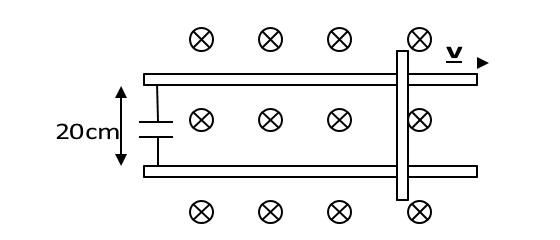
a) Calculate the magnitude and direction of the emf in the circuit. Indicate the direction of the emf by drawing and labeling an arrow on the diagram.
b) Calculate charge on the capacitor after the rod has been moving for a long time.
c) Calculate the force on the rod caused by the current passing through it after the rod has been moving for a long time.
Homework Answers


Add Answer to:
Problem 3
In the figure below, a conducting
rod rests on frictionless conducting parallel rails. There...
The figure shows a 11-cm-long metal rod pulled along twofrictionless, conducting rails at a constant...
 The figure shows a 11-cm-long metal rod pulled along two
frictionless, conducting rails at a constant speed of 3.9 m/s. The
rails have negligible resistance, but the rod has a resistance of
0.65 Ω . (Figure 1)FigureThe figure shows a vertical rod sliding along a pair of
horizontal rails to the left at speed v. The rails are connected at
their left ends. Magnetic field B of 1.4 teslas is directed into
the page in the whole region.Part AWhat is...
The figure shows a 11-cm-long metal rod pulled along two
frictionless, conducting rails at a constant speed of 3.9 m/s. The
rails have negligible resistance, but the rod has a resistance of
0.65 Ω . (Figure 1)FigureThe figure shows a vertical rod sliding along a pair of
horizontal rails to the left at speed v. The rails are connected at
their left ends. Magnetic field B of 1.4 teslas is directed into
the page in the whole region.Part AWhat is...
The conducting rod shown in the accompanying figure moves along parallel metal rails that are 25-cm apart.
 The conducting rod shown in the accompanying figure moves along parallel metal rails that are 25-cm apart. The system is in a uniform magnetic field of strength 0.75 T, which is directed into the page. The resistances of the rod and the rails are negligible, but the section PQ has a resistance of 0.25 Ω. (a) What is the emf induced in the rod when it is moving to the right with a speed of 5.0 m/s? (b) What force is required to...
A conducting rod is pulled horizontally with constant force F-4.40 N along a set of rails...
 A conducting rod is pulled horizontally with constant force F-4.40 N along a set of rails separated by d= 0.340 m. A uniform magnetic field B=0.500 T is directed into the page. There is no friction between the rod and the rails, and therod moves with constant velocity v= 3.60 m/s Using Faraday's Law, calculate the induced emf around the loop in the figure that is caused by the changing flux. Assign clockwise to be the positive direction for emf...
Two parallel conducting rails with negligible resistance are connected at one end by a resistor of...
 Two parallel conducting rails with negligible resistance are connected at one end by a resistor of resistance R, as shown in the figure. The rails are placed in a magnetic field Bext, which is perpendicular to the plane of the rails. This magnetic field is uniform and time independent. The distance between the rails is f. A conducting rod slides without friction on top of the two rails at constant velocity v . Three-dimensional view ext ind Top view Bext...
A conducting rod is pulled horizontally with constant force F=3.20 N along a set of rails...
 A conducting rod is pulled horizontally with constant force F=3.20 N along a set of rails separated by d-0.240 m. A uniform magnetic field B= 0.600 T is directed into the page. There is no friction between the rod and the rails, and the rod moves with constant velocity v= 4.50 m Using Faraday's Law, calculate the induced emf around the loop in the figure that is caused by the changing flux. Assign clockwise to be the positive direction for...
A copper rod is sliding on two conducting rails that make an angle of 16° with...
 A copper rod is sliding on two conducting rails that make an
angle of 16° with respect to each other, as in the drawing. The rod
is moving to the right with a constant speed of 0.70 m/s. A 0.32-T
uniform magnetic field is perpendicular to the plane of the paper.
Determine the magnitude of the average emf induced in the triangle
ABC during the 6.30-s period after the rod has passed point A
Ans : ___________ V
A copper rod is sliding on two conducting rails that make an
angle of 16° with respect to each other, as in the drawing. The rod
is moving to the right with a constant speed of 0.70 m/s. A 0.32-T
uniform magnetic field is perpendicular to the plane of the paper.
Determine the magnitude of the average emf induced in the triangle
ABC during the 6.30-s period after the rod has passed point A
Ans : ___________ V
Question 7 The conducting rod shown in the figure has length L and is being pulled along horlizontal, frictionless, conducting rails at a constant metal strip. A uniform magnetic field, directed...
 Question 7 The conducting rod shown in the figure has length L and is being pulled along horlizontal, frictionless, conducting rails at a constant metal strip. A uniform magnetic field, directed of the magnetic fieid is 8-1.0 T. (a) What is the magnitude Assume that L15 cm, the speed of the rod is v -5.9 m/s, and the magnitude of emf induced in voits in the rod? (b) What is the current in amperes in the conducting loop? Assume that...
A copper rod is sliding on two conducting rails that make an angle of 20° with...
 A copper rod is sliding on two conducting rails that make an
angle of 20° with respect to each other, as in the drawing. The rod
is moving to the right with a constant speed of 0.72 m/s. A 0.28-T
uniform magnetic field is perpendicular to the plane of the paper.
Determine the magnitude of the average emf induced in the triangle
ABC during the 5.40-s period after the rod has passed point A.
B (into paper) 90°
A copper rod is sliding on two conducting rails that make an
angle of 20° with respect to each other, as in the drawing. The rod
is moving to the right with a constant speed of 0.72 m/s. A 0.28-T
uniform magnetic field is perpendicular to the plane of the paper.
Determine the magnitude of the average emf induced in the triangle
ABC during the 5.40-s period after the rod has passed point A.
B (into paper) 90°
3. A rod of mass 0.720 kg and radius 6.00 cm rests on two parallel rails...
 3. A rod of mass 0.720 kg and radius 6.00 cm rests on two parallel rails that are d = 12.0cm apart and L = 45.0cm long. The rod carries a current of 1 = 48.0 A in the direction shown and rolls along the rails without slipping. A uniform magnetic field of magnitude 0.240 T is 2 Page directed perpendicular to the rod and the rails. If it starts from rest, what is the speed of the rod as...
A pair of conducting, parallel, frictionless rails is mounted on an insulating platform. The distance between...
 A pair of conducting, parallel, frictionless rails is mounted on an insulating platform. The distance between the rails is L = 0.20 m. The rails are connected on one end by a R = 10.12 resistor. A conducting bar of mass 1.2 kg can slide on the rails without friction. When the conducting bar is at x = 0, the enclosed area of the loop is 0.03 m2. There is zero resistance in the conducting bar or rails. A uniform...
 The figure shows a 11-cm-long metal rod pulled along two
frictionless, conducting rails at a constant speed of 3.9 m/s. The
rails have negligible resistance, but the rod has a resistance of
0.65 Ω . (Figure 1)FigureThe figure shows a vertical rod sliding along a pair of
horizontal rails to the left at speed v. The rails are connected at
their left ends. Magnetic field B of 1.4 teslas is directed into
the page in the whole region.Part AWhat is...
The figure shows a 11-cm-long metal rod pulled along two
frictionless, conducting rails at a constant speed of 3.9 m/s. The
rails have negligible resistance, but the rod has a resistance of
0.65 Ω . (Figure 1)FigureThe figure shows a vertical rod sliding along a pair of
horizontal rails to the left at speed v. The rails are connected at
their left ends. Magnetic field B of 1.4 teslas is directed into
the page in the whole region.Part AWhat is...
 A conducting rod is pulled horizontally with constant force F-4.40 N along a set of rails separated by d= 0.340 m. A uniform magnetic field B=0.500 T is directed into the page. There is no friction between the rod and the rails, and therod moves with constant velocity v= 3.60 m/s Using Faraday's Law, calculate the induced emf around the loop in the figure that is caused by the changing flux. Assign clockwise to be the positive direction for emf...
 Two parallel conducting rails with negligible resistance are connected at one end by a resistor of resistance R, as shown in the figure. The rails are placed in a magnetic field Bext, which is perpendicular to the plane of the rails. This magnetic field is uniform and time independent. The distance between the rails is f. A conducting rod slides without friction on top of the two rails at constant velocity v . Three-dimensional view ext ind Top view Bext...
 A conducting rod is pulled horizontally with constant force F=3.20 N along a set of rails separated by d-0.240 m. A uniform magnetic field B= 0.600 T is directed into the page. There is no friction between the rod and the rails, and the rod moves with constant velocity v= 4.50 m Using Faraday's Law, calculate the induced emf around the loop in the figure that is caused by the changing flux. Assign clockwise to be the positive direction for...
 A copper rod is sliding on two conducting rails that make an
angle of 16° with respect to each other, as in the drawing. The rod
is moving to the right with a constant speed of 0.70 m/s. A 0.32-T
uniform magnetic field is perpendicular to the plane of the paper.
Determine the magnitude of the average emf induced in the triangle
ABC during the 6.30-s period after the rod has passed point A
Ans : ___________ V
A copper rod is sliding on two conducting rails that make an
angle of 16° with respect to each other, as in the drawing. The rod
is moving to the right with a constant speed of 0.70 m/s. A 0.32-T
uniform magnetic field is perpendicular to the plane of the paper.
Determine the magnitude of the average emf induced in the triangle
ABC during the 6.30-s period after the rod has passed point A
Ans : ___________ V
 Question 7 The conducting rod shown in the figure has length L and is being pulled along horlizontal, frictionless, conducting rails at a constant metal strip. A uniform magnetic field, directed of the magnetic fieid is 8-1.0 T. (a) What is the magnitude Assume that L15 cm, the speed of the rod is v -5.9 m/s, and the magnitude of emf induced in voits in the rod? (b) What is the current in amperes in the conducting loop? Assume that...
 A copper rod is sliding on two conducting rails that make an
angle of 20° with respect to each other, as in the drawing. The rod
is moving to the right with a constant speed of 0.72 m/s. A 0.28-T
uniform magnetic field is perpendicular to the plane of the paper.
Determine the magnitude of the average emf induced in the triangle
ABC during the 5.40-s period after the rod has passed point A.
B (into paper) 90°
A copper rod is sliding on two conducting rails that make an
angle of 20° with respect to each other, as in the drawing. The rod
is moving to the right with a constant speed of 0.72 m/s. A 0.28-T
uniform magnetic field is perpendicular to the plane of the paper.
Determine the magnitude of the average emf induced in the triangle
ABC during the 5.40-s period after the rod has passed point A.
B (into paper) 90°
 3. A rod of mass 0.720 kg and radius 6.00 cm rests on two parallel rails that are d = 12.0cm apart and L = 45.0cm long. The rod carries a current of 1 = 48.0 A in the direction shown and rolls along the rails without slipping. A uniform magnetic field of magnitude 0.240 T is 2 Page directed perpendicular to the rod and the rails. If it starts from rest, what is the speed of the rod as...
 A pair of conducting, parallel, frictionless rails is mounted on an insulating platform. The distance between the rails is L = 0.20 m. The rails are connected on one end by a R = 10.12 resistor. A conducting bar of mass 1.2 kg can slide on the rails without friction. When the conducting bar is at x = 0, the enclosed area of the loop is 0.03 m2. There is zero resistance in the conducting bar or rails. A uniform...
Most questions answered within 3 hours.
-
Where is the error in this code sequence?
String s1 = "Hello";
String s2 = "ello";...
asked 10 months ago -
Financial data for Joel de Paris, Inc., for last year
follow:
Joel de Paris, Inc.
Balance...
asked 10 months ago -
Consider this reaction:
Al2(SO4)3 (aq)+ BaCl3
(aq) Al2Cl6 (aq)- +
3BaSO4(s) . What is the...
asked 10 months ago -
Suppose that Savneet is considering increasing her
recent random sample from 20 car rentals to 40...
asked 10 months ago -
Trucks arrive at an unloading terminal at an average rate of 120
per hour.
Trucks arrive...
asked 10 months ago -
Why are methanol and ethanol completely soluble in water while
octanol is not very little soluble....
asked 10 months ago -
A facilities manager at a university reads in a research report
that the mean amount of...
asked 10 months ago -
When the CuSO4 is rehydrated by adding water to the anhydrous
compound, is this an endothermic...
asked 10 months ago -
A ray of sunlight is passing from diamond into crown glass; the
angle of incidence is...
asked 10 months ago -
A block of mass 0.249 kg is placed on top of a light, vertical
spring of...
asked 10 months ago -
how do the kidneys compensate in the presences of acidosis
a) trigger hyperventilate
b) reserve acid...
asked 10 months ago -
Question 501 pts
The rental rate of capital to the firm increases. Which of the
following...
asked 10 months ago