
Homework Answers
Add Answer to:
8. (10 points) Use Stokes' Theorem to evaluate where (..) - (awy, 3) and C is...
is the Use Stokes' theorem to evaluate ſc(1+y)z dx + (1+z)x dy+(1 + x)y dz, where...
 is the Use Stokes' theorem to evaluate ſc(1+y)z dx + (1+z)x dy+(1 + x)y dz, where counterclockwise-oriented triangle with vertices (1,0,0), (0,1,0), and (0,0,1).
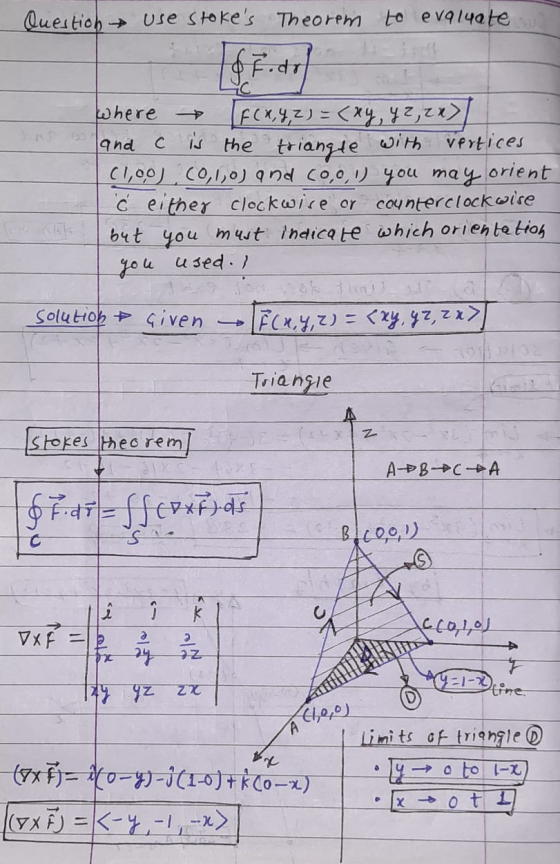
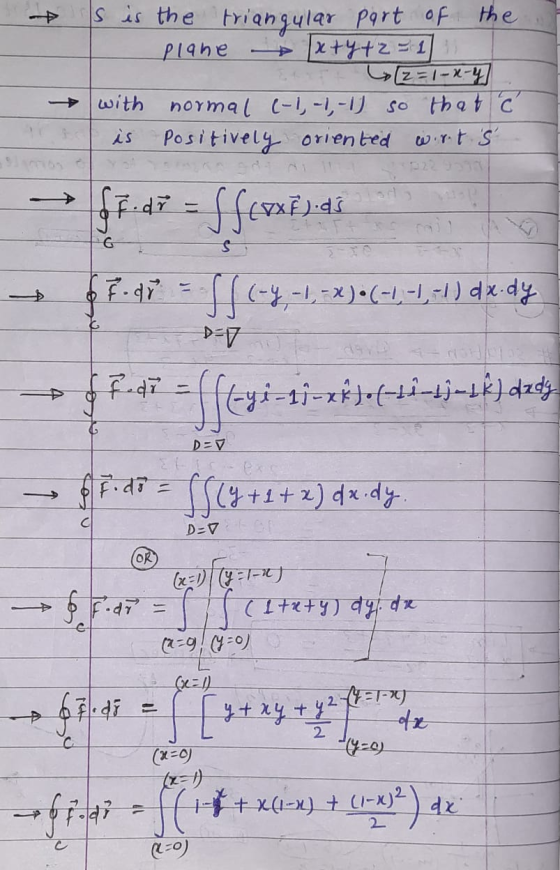
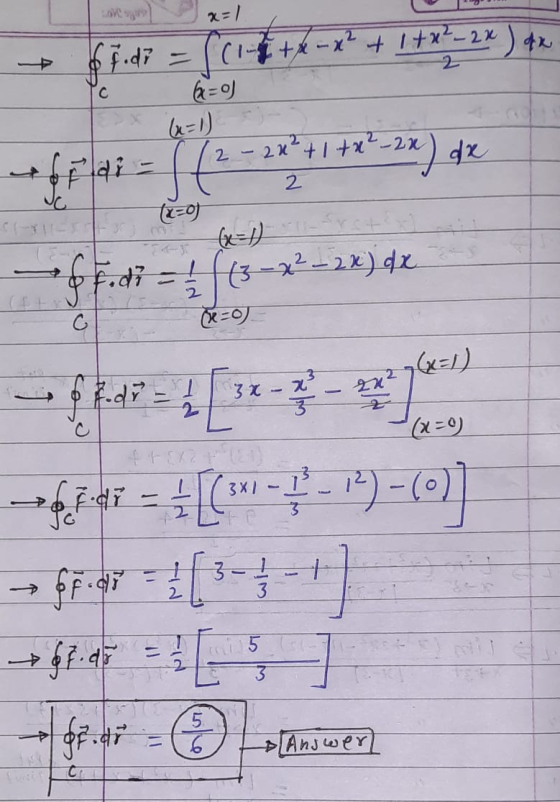
Let Ě = < 2x + y², 8y + z2, 6z + x2 >. Use Stokes'...
 Let Ě = < 2x + y², 8y + z2, 6z + x2 >. Use Stokes' Theorem to evaluate so F. dri where C is the triangle with vertices (1,0,0), (0,1,0), and (0,0,1), oriented counterclockwise as viewed from above.
4. Use Stokes' Theorem to evaluate F dr. F(x,y,z)-(3z,4x, 2y); C is the circle x2 +...
 4. Use Stokes' Theorem to evaluate F dr. F(x,y,z)-(3z,4x, 2y); C is the circle x2 + y2 4 in the xy-plane with a counterclockwise orientation looking down the positive z-axis. az az F dr-JI, (curl F) n ds and VGy, 1) Hint: use ax' dy
4. Use Stokes' Theorem to evaluate Fodr where F =x' i -4:+ xy k and Cis...
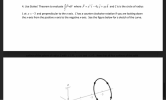 4. Use Stokes' Theorem to evaluate Fodr where F =x' i -4:+ xy k and Cis is the circle of radius 1 at x = -3 and perpendicular to the x-axis. Chas a counter clockwise rotation if you are looking down the x-axis from the positive x-axis to the negative x-axis. See the figure below for a sketch of the curve.
Use Stokes' Theorem to evaluate les F. dr where C is oriented counterclockwise as viewed from...
 Use Stokes' Theorem to evaluate les F. dr where C is oriented counterclockwise as viewed from above. F(x, y, z) = (x + y2)i + (y + z2)j + (z + x2)k, C is the triangle with vertices (3, 0, 0), (0, 3,0), and (0, 0, 3). Need Help? Read it Watch It Master It Talk to a Tutor
please solve this question. answer is 15pi/ √2. please don't make mistakes. I am sending you guys correct answers , but still you are making mistakes and getting other answers. 28. Use Stokes...
 please solve this question. answer is 15pi/ √2. please
don't make mistakes. I am sending you guys correct answers , but
still you are making mistakes and getting other answers.
28. Use Stokes Theorem to evaluateF dr. where C is the circle22 in the ry-plane with counterclockwise orientation looking down the positive z-axis.
28. Use Stokes Theorem to evaluateF dr. where C is the circle22 in the ry-plane with counterclockwise orientation looking down the positive z-axis.
please solve this question. answer is 15pi/ √2. please
don't make mistakes. I am sending you guys correct answers , but
still you are making mistakes and getting other answers.
28. Use Stokes Theorem to evaluateF dr. where C is the circle22 in the ry-plane with counterclockwise orientation looking down the positive z-axis.
28. Use Stokes Theorem to evaluateF dr. where C is the circle22 in the ry-plane with counterclockwise orientation looking down the positive z-axis.
14. (10 pts) Use Stokes' Theorem to compute F dr where F , y,) 32,5x, -2yand the curve C is given by the triangle with vertices (0,2,0), (3,0,0), and (0,0, 1) with positive orientation 14...
 14. (10 pts) Use Stokes' Theorem to compute F dr where F , y,) 32,5x, -2yand the curve C is given by the triangle with vertices (0,2,0), (3,0,0), and (0,0, 1) with positive orientation
14. (10 pts) Use Stokes' Theorem to compute F dr where F , y,) 32,5x, -2yand the curve C is given by the triangle with vertices (0,2,0), (3,0,0), and (0,0, 1) with positive orientation
14. (10 pts) Use Stokes' Theorem to compute F dr where F , y,) 32,5x, -2yand the curve C is given by the triangle with vertices (0,2,0), (3,0,0), and (0,0, 1) with positive orientation
Use Stokes' Theorem to evaluate fe(x+y)dx + (2x – 3)dy +(y +z)dz over the boundary of...
 Use Stokes' Theorem to evaluate fe(x+y)dx + (2x – 3)dy +(y +z)dz over the boundary of the triangle with vertices (2,0,0), (0,3,0), (0,0,6) traversed in the counter clockwise direction.
3) Given vector field F(x,y,z)=<y, xz,x? >. Find N dr where T is the path around...
 3) Given vector field F(x,y,z)=<y, xz,x? >. Find N dr where T is the path around the triangle with vertices (1,0,0),(0,1,0) and (0,0,1) traced counterclockwise (when viewed from above.)
Use Stokes' Theorem to evaluate the line integral $cF.dr, where F(x, y, z) = xyzi +...
 Use Stokes' Theorem to evaluate the line integral $cF.dr, where F(x, y, z) = xyzi + yj + zk, Sis the surface 3x + 4y + 2z = 12 in the first octant, and is the boundary of S with counterclockwise orientation (from above).
 is the Use Stokes' theorem to evaluate ſc(1+y)z dx + (1+z)x dy+(1 + x)y dz, where counterclockwise-oriented triangle with vertices (1,0,0), (0,1,0), and (0,0,1).
 Let Ě = < 2x + y², 8y + z2, 6z + x2 >. Use Stokes' Theorem to evaluate so F. dri where C is the triangle with vertices (1,0,0), (0,1,0), and (0,0,1), oriented counterclockwise as viewed from above.
 4. Use Stokes' Theorem to evaluate F dr. F(x,y,z)-(3z,4x, 2y); C is the circle x2 + y2 4 in the xy-plane with a counterclockwise orientation looking down the positive z-axis. az az F dr-JI, (curl F) n ds and VGy, 1) Hint: use ax' dy
 4. Use Stokes' Theorem to evaluate Fodr where F =x' i -4:+ xy k and Cis is the circle of radius 1 at x = -3 and perpendicular to the x-axis. Chas a counter clockwise rotation if you are looking down the x-axis from the positive x-axis to the negative x-axis. See the figure below for a sketch of the curve.
 Use Stokes' Theorem to evaluate les F. dr where C is oriented counterclockwise as viewed from above. F(x, y, z) = (x + y2)i + (y + z2)j + (z + x2)k, C is the triangle with vertices (3, 0, 0), (0, 3,0), and (0, 0, 3). Need Help? Read it Watch It Master It Talk to a Tutor
 please solve this question. answer is 15pi/ √2. please
don't make mistakes. I am sending you guys correct answers , but
still you are making mistakes and getting other answers.
28. Use Stokes Theorem to evaluateF dr. where C is the circle22 in the ry-plane with counterclockwise orientation looking down the positive z-axis.
28. Use Stokes Theorem to evaluateF dr. where C is the circle22 in the ry-plane with counterclockwise orientation looking down the positive z-axis.
please solve this question. answer is 15pi/ √2. please
don't make mistakes. I am sending you guys correct answers , but
still you are making mistakes and getting other answers.
28. Use Stokes Theorem to evaluateF dr. where C is the circle22 in the ry-plane with counterclockwise orientation looking down the positive z-axis.
28. Use Stokes Theorem to evaluateF dr. where C is the circle22 in the ry-plane with counterclockwise orientation looking down the positive z-axis.
 14. (10 pts) Use Stokes' Theorem to compute F dr where F , y,) 32,5x, -2yand the curve C is given by the triangle with vertices (0,2,0), (3,0,0), and (0,0, 1) with positive orientation
14. (10 pts) Use Stokes' Theorem to compute F dr where F , y,) 32,5x, -2yand the curve C is given by the triangle with vertices (0,2,0), (3,0,0), and (0,0, 1) with positive orientation
14. (10 pts) Use Stokes' Theorem to compute F dr where F , y,) 32,5x, -2yand the curve C is given by the triangle with vertices (0,2,0), (3,0,0), and (0,0, 1) with positive orientation
 Use Stokes' Theorem to evaluate fe(x+y)dx + (2x – 3)dy +(y +z)dz over the boundary of the triangle with vertices (2,0,0), (0,3,0), (0,0,6) traversed in the counter clockwise direction.
 3) Given vector field F(x,y,z)=<y, xz,x? >. Find N dr where T is the path around the triangle with vertices (1,0,0),(0,1,0) and (0,0,1) traced counterclockwise (when viewed from above.)
 Use Stokes' Theorem to evaluate the line integral $cF.dr, where F(x, y, z) = xyzi + yj + zk, Sis the surface 3x + 4y + 2z = 12 in the first octant, and is the boundary of S with counterclockwise orientation (from above).
Most questions answered within 3 hours.
-
Where is the error in this code sequence?
String s1 = "Hello";
String s2 = "ello";...
asked 10 months ago -
Financial data for Joel de Paris, Inc., for last year
follow:
Joel de Paris, Inc.
Balance...
asked 10 months ago -
Consider this reaction:
Al2(SO4)3 (aq)+ BaCl3
(aq) Al2Cl6 (aq)- +
3BaSO4(s) . What is the...
asked 10 months ago -
Suppose that Savneet is considering increasing her
recent random sample from 20 car rentals to 40...
asked 10 months ago -
Trucks arrive at an unloading terminal at an average rate of 120
per hour.
Trucks arrive...
asked 10 months ago -
Why are methanol and ethanol completely soluble in water while
octanol is not very little soluble....
asked 10 months ago -
A facilities manager at a university reads in a research report
that the mean amount of...
asked 10 months ago -
When the CuSO4 is rehydrated by adding water to the anhydrous
compound, is this an endothermic...
asked 10 months ago -
A ray of sunlight is passing from diamond into crown glass; the
angle of incidence is...
asked 10 months ago -
A block of mass 0.249 kg is placed on top of a light, vertical
spring of...
asked 10 months ago -
how do the kidneys compensate in the presences of acidosis
a) trigger hyperventilate
b) reserve acid...
asked 10 months ago -
Question 501 pts
The rental rate of capital to the firm increases. Which of the
following...
asked 10 months ago