
Homework Answers
Add Answer to:
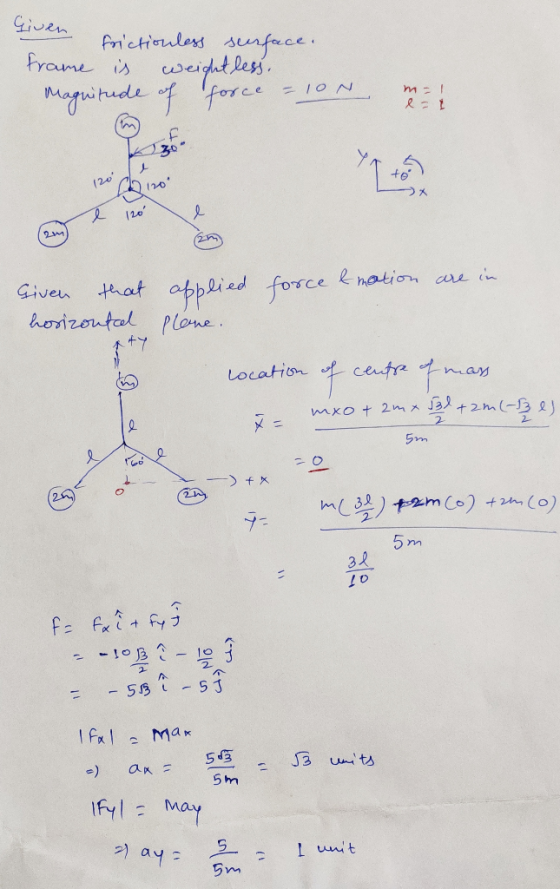
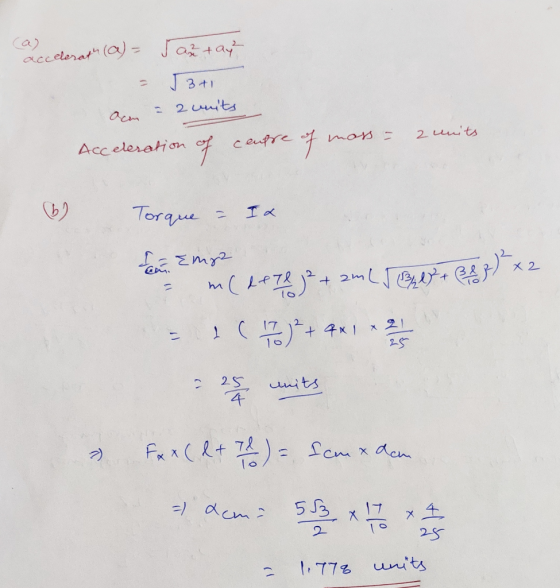
3. Three point masses are attached to a rigid and weightless frame. When the force with...
A rigid, massless rod has three particles with equal masses attached to it as shown in Figure P8.59.
 A rigid, massless rod has three particles with equal masses attached to it as shown in Figure P8.59. The rod is free to rotate in a vertical plane about a friction-less axle perpendicular to the rod through the point Pand is released from rest in the horizontal position at t - 0. Assuming m and d are known, find (a) the moment of inertia of the system (rod plus particles) about the pivot, (b) the torque acting on the system...
Three masses are connected by rigid massless rods, as shown. The 200-g mass (B) is located...
 Three masses are connected by rigid massless rods, as shown. The 200-g mass (B) is located at the origin (0, 0). (a) Find the x- and y-coordinates of the center of mass. (b) Find the moment of inertia of this system of three connected masses when rotated about the r-axis that passes through mass B? (c) If this system is rotated about the r-axis, from rest to an angular speed of 6 rad/s in time t = 3 s, what...
4. (a) Three point masses are attached to a massless rigid rod. Mass m,-1.0 kg is...
 4. (a) Three point masses are attached to a massless rigid rod. Mass m,-1.0 kg is located at x = 1.0 cm, mass m2-2.0 kg at x = 2.0 cm and mass m,-3.0 kg at x-3.0 m. Find the center of mass of the system. (b) Find the center of mass of the four masses as below. mi 2.0 kg at point (1,2) cm; m 3.0 kg at point (2,-3) cm; m -4.0 kg at point (3,-4) cm and m...
Please help thank you! Three masses are attached to a uniform meter stick, as shown in...
 Please help thank you!
Three masses are attached to a uniform meter stick, as shown in the figure. The mass of the meter stick is 0.5 kg and the masses to the left of the fulcrum are m = 4.4 kg and m2 = 4.8 kg. Find the mass my need to be attached to the right end of the stick to balance the system - 30 cm 40 cm - 30 cm A wheel rotates without friction about a...
Please help thank you!
Three masses are attached to a uniform meter stick, as shown in the figure. The mass of the meter stick is 0.5 kg and the masses to the left of the fulcrum are m = 4.4 kg and m2 = 4.8 kg. Find the mass my need to be attached to the right end of the stick to balance the system - 30 cm 40 cm - 30 cm A wheel rotates without friction about a...
3. Three masses are connected by thin rigid rods as shown below, and are initially at rest on the top of a horizontal table. A circular blob of clay (velocity shown immediately before the collisi...
 3. Three masses are connected by thin rigid rods as shown below, and are initially at rest on the top of a horizontal table. A circular blob of clay (velocity shown immediately before the collision) hits and sticks to one of the masses as shown. The mass of the rod can be neglected and the object is NOT pinned down to the table 3 m 20 m/s i 40 2 kg Calculate the linear velocity of the center of mass,...
An object with mass m is dragged along a horizontal plane by a force acting along a rope attached to the object as shown below mass horizontal plane If the rope makes an angle θ with the plane, then...
 An object with mass m is dragged along a horizontal plane by a force acting along a rope attached to the object as shown below mass horizontal plane If the rope makes an angle θ with the plane, then the magnitude of the force required to overcome friction is where g is the acceleration due to gravity and μ is a positive constant called the coefficient of riction, and we assume θ [0, π/2) Use the second derivative t tan...
A rigid system is made of three rods fastened together in the form of letter H (see figure). Two ...
 A rigid system is made of three rods fastened together in the form of letter H (see figure). Two rods (A and B) are identical with length hA, radius rA and mass mA. The central rod (C) has length hc radius rc and mass mc The system is free to rotate in the horizontal xy plane around the vertical z axis passing through the centre of the system. Identify the moment of inertia of the rigid system 12 mc, Consider...
01. Answer both parts of this question. Part-1 2D Rigid Body Dynamics The machine shown in...
 01. Answer both parts of this question. Part-1 2D Rigid Body Dynamics The machine shown in Figure Q1a comprises an arm AB attached to a rotating joint at point A, which can also be elevated by a hydraulic ram. The arm has mass 100 kg and moment of inertia IG = 10 kgm about mass centre G. A fixed x-y frame is shown with its origin at point A. At the instant shown, the arm is in the horizontal position...
Which are true 1. a rigid body undergoing planar motion is pinned at the center of...
Which are true 1. a rigid body undergoing planar motion is pinned at the center of mass in the plane of motion; all non-CM points on the rigid body have the same angular velocity. 2. When a rigid body undergoes planar motion the body center of mass remains in a singular plane. 3. The normal force is never perpendicular to the surfaces that applies the normal force. 4. Mass moment of inertia of a rigid body indicates the magnitude of...
1. Three masses are arranged as shown to the right. The ropes connecting the masses are...
 1. Three masses are arranged as shown to the right. The ropes connecting the masses are massless and the pulley is massless and frictionless. A force, F, is applied to m1 up the incline on the left. All three blocks are released from rest and the values of the masses are 25.0 kg, 15.0 kg and 10.0 kg for mi, m2 and m3 respectively. There is no friction. 71 2 m3 60° 300 (a) First assume that the magnitude of...
 4. (a) Three point masses are attached to a massless rigid rod. Mass m,-1.0 kg is located at x = 1.0 cm, mass m2-2.0 kg at x = 2.0 cm and mass m,-3.0 kg at x-3.0 m. Find the center of mass of the system. (b) Find the center of mass of the four masses as below. mi 2.0 kg at point (1,2) cm; m 3.0 kg at point (2,-3) cm; m -4.0 kg at point (3,-4) cm and m...
 Please help thank you!
Three masses are attached to a uniform meter stick, as shown in the figure. The mass of the meter stick is 0.5 kg and the masses to the left of the fulcrum are m = 4.4 kg and m2 = 4.8 kg. Find the mass my need to be attached to the right end of the stick to balance the system - 30 cm 40 cm - 30 cm A wheel rotates without friction about a...
Please help thank you!
Three masses are attached to a uniform meter stick, as shown in the figure. The mass of the meter stick is 0.5 kg and the masses to the left of the fulcrum are m = 4.4 kg and m2 = 4.8 kg. Find the mass my need to be attached to the right end of the stick to balance the system - 30 cm 40 cm - 30 cm A wheel rotates without friction about a...
 3. Three masses are connected by thin rigid rods as shown below, and are initially at rest on the top of a horizontal table. A circular blob of clay (velocity shown immediately before the collision) hits and sticks to one of the masses as shown. The mass of the rod can be neglected and the object is NOT pinned down to the table 3 m 20 m/s i 40 2 kg Calculate the linear velocity of the center of mass,...
 An object with mass m is dragged along a horizontal plane by a force acting along a rope attached to the object as shown below mass horizontal plane If the rope makes an angle θ with the plane, then the magnitude of the force required to overcome friction is where g is the acceleration due to gravity and μ is a positive constant called the coefficient of riction, and we assume θ [0, π/2) Use the second derivative t tan...
 A rigid system is made of three rods fastened together in the form of letter H (see figure). Two rods (A and B) are identical with length hA, radius rA and mass mA. The central rod (C) has length hc radius rc and mass mc The system is free to rotate in the horizontal xy plane around the vertical z axis passing through the centre of the system. Identify the moment of inertia of the rigid system 12 mc, Consider...
 01. Answer both parts of this question. Part-1 2D Rigid Body Dynamics The machine shown in Figure Q1a comprises an arm AB attached to a rotating joint at point A, which can also be elevated by a hydraulic ram. The arm has mass 100 kg and moment of inertia IG = 10 kgm about mass centre G. A fixed x-y frame is shown with its origin at point A. At the instant shown, the arm is in the horizontal position...
 1. Three masses are arranged as shown to the right. The ropes connecting the masses are massless and the pulley is massless and frictionless. A force, F, is applied to m1 up the incline on the left. All three blocks are released from rest and the values of the masses are 25.0 kg, 15.0 kg and 10.0 kg for mi, m2 and m3 respectively. There is no friction. 71 2 m3 60° 300 (a) First assume that the magnitude of...
Most questions answered within 3 hours.
-
Where is the error in this code sequence?
String s1 = "Hello";
String s2 = "ello";...
asked 10 months ago -
Financial data for Joel de Paris, Inc., for last year
follow:
Joel de Paris, Inc.
Balance...
asked 10 months ago -
Consider this reaction:
Al2(SO4)3 (aq)+ BaCl3
(aq) Al2Cl6 (aq)- +
3BaSO4(s) . What is the...
asked 10 months ago -
Suppose that Savneet is considering increasing her
recent random sample from 20 car rentals to 40...
asked 10 months ago -
Trucks arrive at an unloading terminal at an average rate of 120
per hour.
Trucks arrive...
asked 10 months ago -
Why are methanol and ethanol completely soluble in water while
octanol is not very little soluble....
asked 10 months ago -
A facilities manager at a university reads in a research report
that the mean amount of...
asked 10 months ago -
When the CuSO4 is rehydrated by adding water to the anhydrous
compound, is this an endothermic...
asked 10 months ago -
A ray of sunlight is passing from diamond into crown glass; the
angle of incidence is...
asked 10 months ago -
A block of mass 0.249 kg is placed on top of a light, vertical
spring of...
asked 10 months ago -
how do the kidneys compensate in the presences of acidosis
a) trigger hyperventilate
b) reserve acid...
asked 10 months ago -
Question 501 pts
The rental rate of capital to the firm increases. Which of the
following...
asked 10 months ago