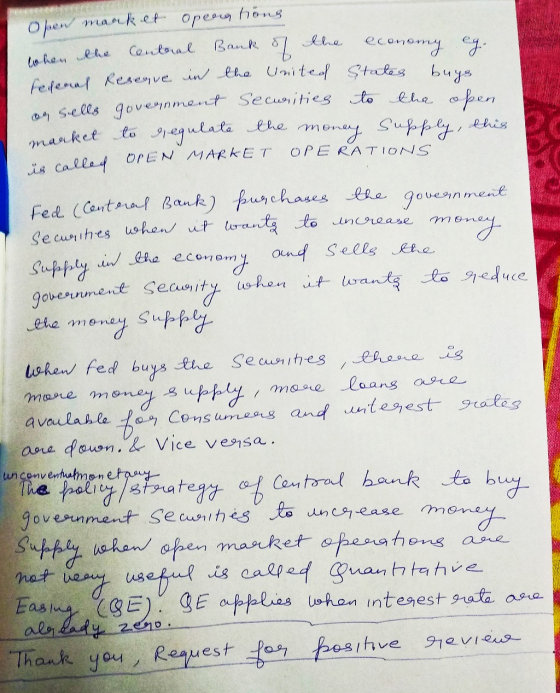
What are open market operations and how do they impact the money supply, outstanding treasury notes,...
What are open market operations and how do they impact the money supply, outstanding treasury notes, and bond values? What is quantitative easing?What are open market operations and how do they impact the money supply, outstanding treasury notes, and bond values? What is quantitative easing?
Homework Answers
Add Answer to:
What are open market operations and how do they impact the money
supply, outstanding treasury notes,...
Identify each of the items as being primarily associated with open market operations, quantitative easing, or...
 Identify each of the items as being primarily associated with open market operations, quantitative easing, or forward guidance. Reduces concern that the Fed may suddenly change policies Deliberate lack of details of planned bond purchases Bond purchases intended to depreciate the dollar Answer Bank Quantitative easing Open market operations Bond sales intended to raise interest rates Forward guidance
____ 65. Open market operations generally involve the purchase and sales of a. government securities. b....
____ 65. Open market operations generally involve the purchase and sales of a. government securities. b. stocks and bonds. c. coins and currency. d. Federal Reserve notes. ____ 66. The Fed relies on open market operations, which work a. with the Treasury in creating money to finance bonds. b. through major stock exchanges to influence bond prices. c. directly through the nonbank public to change their assets. d. through the banking system by affecting their reserves. ____ 68. If the...
8. The reserve requirement, open market operations, and the money supply Assume that banks do not...
 8. The reserve requirement, open market operations, and the money supply Assume that banks do not hold excess reserves and that households do not hold currency, so the only form of money is demand deposits. To simplify the analysis, suppose the banking system has total reserves of $500. Determine the money multiplier and the money supply for each reserve requirement listed in the following table. Reserve Requirement (Percent) Money Supply (Dollars) Simple Money Multiplier A lower reserve requirement is associated...
Fed uses open market operations to influence the money supply. Explain both an open market purchase...
Fed uses open market operations to influence the money supply. Explain both an open market purchase and an open market sale.
a) How does the open market operations increase the number of dollars in circulation? b) How...
a) How does the open market operations increase the number of dollars in circulation? b) How does the reserve ratio influence the money supply? c) What do you think happens to the money multiplier (M) in a financial crisis and what is the likely impact of change in M to the economy?
Which of the following is a difference between "quantitative easing and ordinary open-market operations? Multiple Choice...
 Which of the following is a difference between "quantitative easing and ordinary open-market operations? Multiple Choice There is no difference between the two policy tools Open-market operations are focused exclusively on US govemnment bonds,quantitative easing also includes the buying and selling of debt issued by govemment agencies and government-sponsored entities Quantitetive essing is done in order to lower interest rates open-market operations are merely intended to increase bank reserves Open-market operations involve forwerd commitment quantnative easing i s intentionally vegue...
Below, you will examine how different open market operations affect the monetary base. You will also...
 Below, you will examine how different open market operations affect the monetary base. You will also use information regarding the value of the money multiplier to identify how these different open market operations affect the money supply. Part 1: Complete the statement below. An open market sale leads the monetary base to (grow, contract), because the Federal Reserve is replacing (money, non-money assets) with (money, non-money assets) in the economy. Part 2: Suppose that the reserve requirement is 8%, and...
8.The reserve requirement, open market operations, and the money supply
Assume that banks do not hold excess reserves and that households do not hold currency, so the only form of money is demand deposits. To simplify the analysis, suppose the banking system has total reserves of $500. Determine the money multiplier and the money supply for each reserve requirement listed in the following table.Reserve RequirementSimple Money MultiplierMoney Supply(Percent)(Dollars)25 10 A higher reserve requirement is associated with a money supply.Suppose the Federal Reserve wants to increase the money supply...
Question 6 of 6 3 Points What is Open Market Operations? How to increase (or decrease)...
 Question 6 of 6 3 Points What is Open Market Operations? How to increase (or decrease) money supply by Open Market Operations? Use the U.S. Fed as an example.
2) Explain how the Fed carries out open market operations. How does this change the money...
2) Explain how the Fed carries out open market operations. How does this change the money supply? How is the Fed Funds rate an indicator of this action?
 Identify each of the items as being primarily associated with open market operations, quantitative easing, or forward guidance. Reduces concern that the Fed may suddenly change policies Deliberate lack of details of planned bond purchases Bond purchases intended to depreciate the dollar Answer Bank Quantitative easing Open market operations Bond sales intended to raise interest rates Forward guidance
 8. The reserve requirement, open market operations, and the money supply Assume that banks do not hold excess reserves and that households do not hold currency, so the only form of money is demand deposits. To simplify the analysis, suppose the banking system has total reserves of $500. Determine the money multiplier and the money supply for each reserve requirement listed in the following table. Reserve Requirement (Percent) Money Supply (Dollars) Simple Money Multiplier A lower reserve requirement is associated...
 Which of the following is a difference between "quantitative easing and ordinary open-market operations? Multiple Choice There is no difference between the two policy tools Open-market operations are focused exclusively on US govemnment bonds,quantitative easing also includes the buying and selling of debt issued by govemment agencies and government-sponsored entities Quantitetive essing is done in order to lower interest rates open-market operations are merely intended to increase bank reserves Open-market operations involve forwerd commitment quantnative easing i s intentionally vegue...
 Below, you will examine how different open market operations affect the monetary base. You will also use information regarding the value of the money multiplier to identify how these different open market operations affect the money supply. Part 1: Complete the statement below. An open market sale leads the monetary base to (grow, contract), because the Federal Reserve is replacing (money, non-money assets) with (money, non-money assets) in the economy. Part 2: Suppose that the reserve requirement is 8%, and...
 Question 6 of 6 3 Points What is Open Market Operations? How to increase (or decrease) money supply by Open Market Operations? Use the U.S. Fed as an example.
Most questions answered within 3 hours.
-
Where is the error in this code sequence?
String s1 = "Hello";
String s2 = "ello";...
asked 10 months ago -
Financial data for Joel de Paris, Inc., for last year
follow:
Joel de Paris, Inc.
Balance...
asked 10 months ago -
Consider this reaction:
Al2(SO4)3 (aq)+ BaCl3
(aq) Al2Cl6 (aq)- +
3BaSO4(s) . What is the...
asked 10 months ago -
Suppose that Savneet is considering increasing her
recent random sample from 20 car rentals to 40...
asked 10 months ago -
Trucks arrive at an unloading terminal at an average rate of 120
per hour.
Trucks arrive...
asked 10 months ago -
Why are methanol and ethanol completely soluble in water while
octanol is not very little soluble....
asked 10 months ago -
A facilities manager at a university reads in a research report
that the mean amount of...
asked 10 months ago -
When the CuSO4 is rehydrated by adding water to the anhydrous
compound, is this an endothermic...
asked 10 months ago -
A ray of sunlight is passing from diamond into crown glass; the
angle of incidence is...
asked 10 months ago -
A block of mass 0.249 kg is placed on top of a light, vertical
spring of...
asked 10 months ago -
how do the kidneys compensate in the presences of acidosis
a) trigger hyperventilate
b) reserve acid...
asked 10 months ago -
Question 501 pts
The rental rate of capital to the firm increases. Which of the
following...
asked 10 months ago