

Homework Answers
Add Answer to:
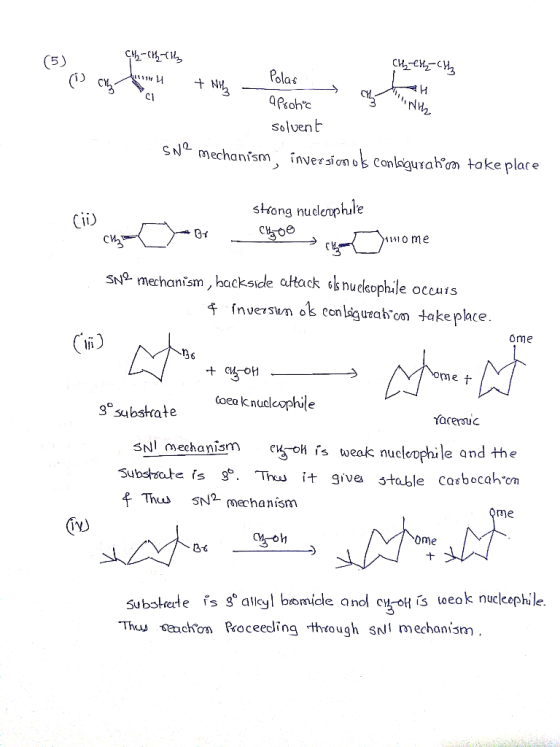
5. (4 points) Draw the configuration(s) of the substitution product(s) that will be formed from the...
Sul B Sx2 Either Syl or S2 None of these D) 103) What substitution reaction mechanism...
 Sul B Sx2 Either Syl or S2 None of these D) 103) What substitution reaction mechanism is most likely for the following conversion? A) SI SN2 Either Snl or S2 None of these 105) Which of the following is a strong nucleophile? OH H0 A) B) C) D) E) CH OH ΝΗ, All of these 108) Which of the following is a weakest nucleophile in a polar protic solvent? A) F B) CH Br D) E) All of these 111)...
major products formed by substitution (Sn1and Sn2) Answer all 4 questions for a total of 100 points. An additional...
 major products formed by substitution (Sn1and Sn2)
Answer all 4 questions for a total of 100 points. An additional 8 points is given to the bonus question. 1a) Give the major product formed by the following substitution reactions: (3 points) by Give the major product formed by the following $2 substitution reaction and the mechanism for it formation: (6 points) Н. c) Give the major product formed by the following S1 substitution reactions and the mechanism for its formation: (16...
major products formed by substitution (Sn1and Sn2)
Answer all 4 questions for a total of 100 points. An additional 8 points is given to the bonus question. 1a) Give the major product formed by the following substitution reactions: (3 points) by Give the major product formed by the following $2 substitution reaction and the mechanism for it formation: (6 points) Н. c) Give the major product formed by the following S1 substitution reactions and the mechanism for its formation: (16...
I need help with 1-4 please Question 1: Find a table that compares the relative reaction...
 I need help with 1-4 please
Question 1: Find a table that compares the relative reaction rates (Su2) for alkyi fluorides, chlorides, bromides and iodides (Section 9.2 in the textbook). Which halide is the best leaving group? How much faster is it than the slowest halide leaving group? Question 2: The nature of the solvent plays a big role in determining the type of substitution or elimination mechanism that takes place (SH1, SN2, E1 or E2). Draw structures for 2...
I need help with 1-4 please
Question 1: Find a table that compares the relative reaction rates (Su2) for alkyi fluorides, chlorides, bromides and iodides (Section 9.2 in the textbook). Which halide is the best leaving group? How much faster is it than the slowest halide leaving group? Question 2: The nature of the solvent plays a big role in determining the type of substitution or elimination mechanism that takes place (SH1, SN2, E1 or E2). Draw structures for 2...
Draw a detailed mechanism for the following transformation 1. Br. Br HBr HO 2. What are the major product (s) formed in...
 Draw a detailed mechanism for the following transformation 1. Br. Br HBr HO 2. What are the major product (s) formed in the following substitution reaction? Draw as Fisher projections CH;CH2ОH CH-CHз Нас— вr CH2CH2CH3 Draw the mechanism for the following reaction. 3. HO Br Draw the major organic product(s) produced in the following reaction as Fischer projection. 4. CHз ОСHЗ Н NaN3 Н. -CH3 Н- Br DMSO CH3 Draw the mechanism for the following reaction to demonstrate how the...
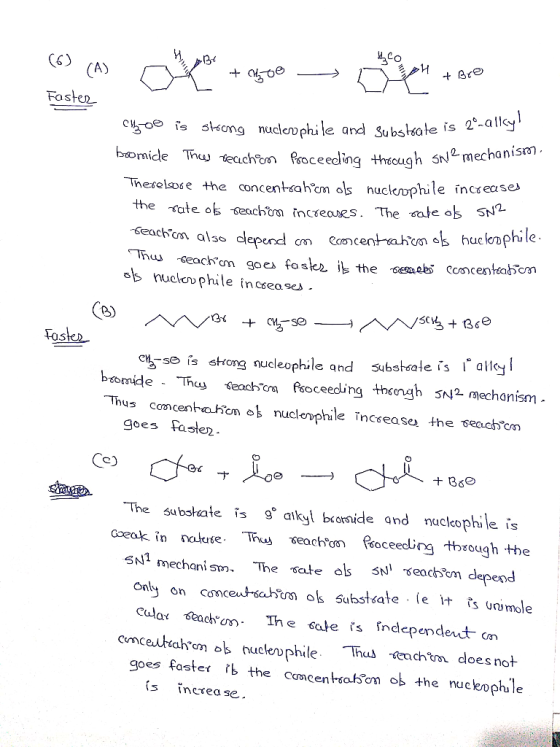
For the following substitution reactions, choose whether reaction A or B will proceed more quickly. If...
 For the following substitution reactions, choose whether reaction A or B will proceed more quickly. If they will proceed at the same rate, put an equal sign,"=", in the box. Reaction Pair Faster? SN1 or SN2? A: CH3Br + CH30-→ CH3OCH3 + Br- B: CH3Br + CH3OH → CH3OCH3 + Br- + H+ Cl + NH3 NH + Cl + H+ B: Ya + Ho — you +C+++11+ OH + Cl + H+ I + NH3 NH2 +I+H+ SN2 ci...
Substitution Problems I. In each of the problems below, label the alkyl halide as primary, secondary, or tertiary. Labe...
 Substitution Problems I. In each of the problems below, label the alkyl halide as primary, secondary, or tertiary. Label the nucleophile as strong or weak. Decide whether an SN2 or an Sy1 reaction occurs. After, show the mechanism and product or products. Indicate stereochemistry where appropriate. a. Reaction of 1-bromopropane and sodium methoxide in methanol CH3 Na CH,Oн Br b. Reaction of 2-bromopropane in ethanol CH3CH2OH Br c. Reaction of (R) 3-chloro-3-methyl heptane in acetic acid Ci Cн CH,COOH но...
41.109 pts. Give the substitution product/s for the following reactions, Show stereochemistry. CN NaCN ^ y...
 41.109 pts. Give the substitution product/s for the following reactions, Show stereochemistry. CN NaCN ^ y en SN2 thabri OH CH, OH SNI 643 C. CHE NaSCH, Br- H CH.CH SN2 ist + Nasrl E H₂ CH3
HWS 5: Due 10/30/2019 15 points total SN1, SN2, Elimination pt 1 1. (10 pts) For...
 HWS 5: Due 10/30/2019 15 points total SN1, SN2, Elimination pt 1 1. (10 pts) For the following reactions: a. Label the Nucleophile (Nu) and whether it is strong or weak b. Label the Electrophile (E) and whether it is primary, secondary, or tertiary and circle the leaving group C. Label the Solvent and whether it is polar protic or polar aprotic d. Categorize each as preferring SN1, Preferring SN2, or could do either e. Draw the product of the...
b) Give the major product formed by the following S1 substitution reactions: (8 points) Me NH...
 b) Give the major product formed by the following S1 substitution reactions: (8 points) Me NH H Da HO e heat OH c) Give the major product formed by the following Syl substitution reaction and the mechanism for its formation: (9 points) te chot CH₂OH,
8. [18 pts) Provide the expected organic product(s) from each of the reactions below. Ignore the...
 8. [18 pts) Provide the expected organic product(s) from each of the reactions below. Ignore the stereochemistry. No mechanism required! (3 points for each organic product, switching the major and minor will be penalized) a. Major: NaOCH; E2 Br b. Major Minor OH E2 Br 3 products in total CH,OH ΕΙ 6. 19 pts] For each of the following reactions, give the organic product(s), and include the stereochemistry when applicable. No mechanism required! (3 points for each organic product) a....
 Sul B Sx2 Either Syl or S2 None of these D) 103) What substitution reaction mechanism is most likely for the following conversion? A) SI SN2 Either Snl or S2 None of these 105) Which of the following is a strong nucleophile? OH H0 A) B) C) D) E) CH OH ΝΗ, All of these 108) Which of the following is a weakest nucleophile in a polar protic solvent? A) F B) CH Br D) E) All of these 111)...
 major products formed by substitution (Sn1and Sn2)
Answer all 4 questions for a total of 100 points. An additional 8 points is given to the bonus question. 1a) Give the major product formed by the following substitution reactions: (3 points) by Give the major product formed by the following $2 substitution reaction and the mechanism for it formation: (6 points) Н. c) Give the major product formed by the following S1 substitution reactions and the mechanism for its formation: (16...
major products formed by substitution (Sn1and Sn2)
Answer all 4 questions for a total of 100 points. An additional 8 points is given to the bonus question. 1a) Give the major product formed by the following substitution reactions: (3 points) by Give the major product formed by the following $2 substitution reaction and the mechanism for it formation: (6 points) Н. c) Give the major product formed by the following S1 substitution reactions and the mechanism for its formation: (16...
 I need help with 1-4 please
Question 1: Find a table that compares the relative reaction rates (Su2) for alkyi fluorides, chlorides, bromides and iodides (Section 9.2 in the textbook). Which halide is the best leaving group? How much faster is it than the slowest halide leaving group? Question 2: The nature of the solvent plays a big role in determining the type of substitution or elimination mechanism that takes place (SH1, SN2, E1 or E2). Draw structures for 2...
I need help with 1-4 please
Question 1: Find a table that compares the relative reaction rates (Su2) for alkyi fluorides, chlorides, bromides and iodides (Section 9.2 in the textbook). Which halide is the best leaving group? How much faster is it than the slowest halide leaving group? Question 2: The nature of the solvent plays a big role in determining the type of substitution or elimination mechanism that takes place (SH1, SN2, E1 or E2). Draw structures for 2...
 Draw a detailed mechanism for the following transformation 1. Br. Br HBr HO 2. What are the major product (s) formed in the following substitution reaction? Draw as Fisher projections CH;CH2ОH CH-CHз Нас— вr CH2CH2CH3 Draw the mechanism for the following reaction. 3. HO Br Draw the major organic product(s) produced in the following reaction as Fischer projection. 4. CHз ОСHЗ Н NaN3 Н. -CH3 Н- Br DMSO CH3 Draw the mechanism for the following reaction to demonstrate how the...
 For the following substitution reactions, choose whether reaction A or B will proceed more quickly. If they will proceed at the same rate, put an equal sign,"=", in the box. Reaction Pair Faster? SN1 or SN2? A: CH3Br + CH30-→ CH3OCH3 + Br- B: CH3Br + CH3OH → CH3OCH3 + Br- + H+ Cl + NH3 NH + Cl + H+ B: Ya + Ho — you +C+++11+ OH + Cl + H+ I + NH3 NH2 +I+H+ SN2 ci...
 Substitution Problems I. In each of the problems below, label the alkyl halide as primary, secondary, or tertiary. Label the nucleophile as strong or weak. Decide whether an SN2 or an Sy1 reaction occurs. After, show the mechanism and product or products. Indicate stereochemistry where appropriate. a. Reaction of 1-bromopropane and sodium methoxide in methanol CH3 Na CH,Oн Br b. Reaction of 2-bromopropane in ethanol CH3CH2OH Br c. Reaction of (R) 3-chloro-3-methyl heptane in acetic acid Ci Cн CH,COOH но...
 41.109 pts. Give the substitution product/s for the following reactions, Show stereochemistry. CN NaCN ^ y en SN2 thabri OH CH, OH SNI 643 C. CHE NaSCH, Br- H CH.CH SN2 ist + Nasrl E H₂ CH3
 HWS 5: Due 10/30/2019 15 points total SN1, SN2, Elimination pt 1 1. (10 pts) For the following reactions: a. Label the Nucleophile (Nu) and whether it is strong or weak b. Label the Electrophile (E) and whether it is primary, secondary, or tertiary and circle the leaving group C. Label the Solvent and whether it is polar protic or polar aprotic d. Categorize each as preferring SN1, Preferring SN2, or could do either e. Draw the product of the...
 b) Give the major product formed by the following S1 substitution reactions: (8 points) Me NH H Da HO e heat OH c) Give the major product formed by the following Syl substitution reaction and the mechanism for its formation: (9 points) te chot CH₂OH,
 8. [18 pts) Provide the expected organic product(s) from each of the reactions below. Ignore the stereochemistry. No mechanism required! (3 points for each organic product, switching the major and minor will be penalized) a. Major: NaOCH; E2 Br b. Major Minor OH E2 Br 3 products in total CH,OH ΕΙ 6. 19 pts] For each of the following reactions, give the organic product(s), and include the stereochemistry when applicable. No mechanism required! (3 points for each organic product) a....
Most questions answered within 3 hours.
-
Where is the error in this code sequence?
String s1 = "Hello";
String s2 = "ello";...
asked 11 months ago -
Financial data for Joel de Paris, Inc., for last year
follow:
Joel de Paris, Inc.
Balance...
asked 11 months ago -
Consider this reaction:
Al2(SO4)3 (aq)+ BaCl3
(aq) Al2Cl6 (aq)- +
3BaSO4(s) . What is the...
asked 11 months ago -
Suppose that Savneet is considering increasing her
recent random sample from 20 car rentals to 40...
asked 11 months ago -
Trucks arrive at an unloading terminal at an average rate of 120
per hour.
Trucks arrive...
asked 11 months ago -
Why are methanol and ethanol completely soluble in water while
octanol is not very little soluble....
asked 11 months ago -
A facilities manager at a university reads in a research report
that the mean amount of...
asked 11 months ago -
When the CuSO4 is rehydrated by adding water to the anhydrous
compound, is this an endothermic...
asked 11 months ago -
A ray of sunlight is passing from diamond into crown glass; the
angle of incidence is...
asked 11 months ago -
A block of mass 0.249 kg is placed on top of a light, vertical
spring of...
asked 11 months ago -
how do the kidneys compensate in the presences of acidosis
a) trigger hyperventilate
b) reserve acid...
asked 11 months ago -
Question 501 pts
The rental rate of capital to the firm increases. Which of the
following...
asked 11 months ago