A single conservative force F with arrow = (7.0x − 12)i hat N where x is in meters, acts on a particle moving along an x axis. The potential energy U associated with this force is assigned a value of 29 J at x = 0.
Homework Answers

Add Answer to:
A single conservative force F with arrow = (7.0x − 12)i hat N
where x is...
A single conservative force F = 6.0x - 12) N where x is in meters, acts...
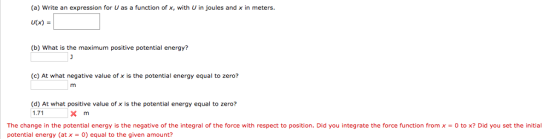
 A single conservative force F = 6.0x - 12) N where x is in meters, acts on a particle moving along an x axis. The potential energy U associated with this force is assigned a value of 30 J at x = 0. (a) Write an expression for U as a function of x, with U in joules and x in meters. U(X) = (b) What is the maximum positive potential energy? (c) At what negative value of x is...
A single conservative force F = (8.0x - 12) N where x is in meters, acts...
 A single conservative force F = (8.0x - 12) N where x is in meters, acts on a particle moving along an x axis. The potential energy U associated with this force is assigned a value of 23 ) at x = 0. (a) Write an expression for U as a function of x, with U in joules and x in meters. U(X) = (b) What is the maximum positive potential energy? (c) At what negative value of x is...
A single conservative force F = (5.0x - 11)i N, where x is in meters, acts...
A single conservative force F = (5.0x - 11)i N, where x is in meters, acts on a particle moving along an x axis. The potential energy U associated with this force is assigned a value of 25 J at x = 0. (a) What is the maximum positive potential energy? At what (b) negative value and (c) positive value of x is the potential energy equal to zero?
A single conservative force F = (5.0x - 11)î N, where x is in meters, acts...
A single conservative force F = (5.0x - 11)î N, where x is in meters, acts on a particle moving along an x axis. The potential energy U associated with this force is assigned a value of 24 J at x = 0. (a) What is the maximum positive potential energy? At what (b) negative value and (c) positive value of x is the potential energy equal to zero? with s.i units
1a. 1b. 1c. A single conservative force = (AX - B) N, where x is in...
 1a.
1b. 1c.
A single conservative force = (AX - B) N, where x is in meters, and A and B are positive constants, acts on a particle moving along an x axis. The potential energy U associated with this force is assigned a value of 0 at x = 0. (a) Write an expression for the potential energy associated with this force. (b) What is the maximum positive value of the potential energy? In the figure, a block of...
1a.
1b. 1c.
A single conservative force = (AX - B) N, where x is in meters, and A and B are positive constants, acts on a particle moving along an x axis. The potential energy U associated with this force is assigned a value of 0 at x = 0. (a) Write an expression for the potential energy associated with this force. (b) What is the maximum positive value of the potential energy? In the figure, a block of...
A single conservative force F(x) acts on a 1.9 kg particle that moves along an x...
A single conservative force F(x) acts on a 1.9 kg particle that moves along an x axis. The potential energy U(x) associated with F(x) is given by U(x) = -4xe-x/6 where U is in Joules and x is in meters. At x = 2 m the particle has a kinetic energy of 7.4 J. (a) What is the mechanical energy of the system? (b) What is the maximum kinetic energy of the particle and (c) the value of x at...
so I know the answer to a) is U(x) = 4e(-2x) + 1 b) and the force is conservative, but how can I prove the force is con...
 so I know the answer to a) is U(x) = 4e(-2x) + 1
b) and the force is conservative, but how can I prove the force
is conservative
Given that The potential energy at x=0 is U=5.0 The force on the particle is given by F(x) = 8 a) The potential energy function is U=-F(x) dx +C U= 8e-*dx+C U= 4(4)+c Atx = 0 U=5.0J 5=4+C C=1 The potential energy of the system as a function of the particle position...
so I know the answer to a) is U(x) = 4e(-2x) + 1
b) and the force is conservative, but how can I prove the force
is conservative
Given that The potential energy at x=0 is U=5.0 The force on the particle is given by F(x) = 8 a) The potential energy function is U=-F(x) dx +C U= 8e-*dx+C U= 4(4)+c Atx = 0 U=5.0J 5=4+C C=1 The potential energy of the system as a function of the particle position...
A force F(x) = (−4.0x2 + 6.0x) N acts on a particle. Picking a convenient reference...
A force F(x) = (−4.0x2 + 6.0x) N acts on a particle. Picking a convenient reference point of the potential energy to be zero at x = 0, find the potential energy for this force. (Use the following as necessary: x. Assume U(x) is in joules and x is in meters. Do not include units in your answer.) The answer I get is (-4/3x^3) + 3x^2, but webassign says its wrong.
Can you help me solve for d and f!! A conservative force F(y) acts on a...
 Can you help me solve for d and f!!
A conservative force F(y) acts on a 0.400 kilogram object that moves along the y-axis. This is the only force on the object [do not assume that this force is the gravity force]. The potential energy U(y) associated with the conservative force F(y) is graphed below as a function of height y. Note that between the points A and B the potential energy U(y) is a straight line, and between the...
Can you help me solve for d and f!!
A conservative force F(y) acts on a 0.400 kilogram object that moves along the y-axis. This is the only force on the object [do not assume that this force is the gravity force]. The potential energy U(y) associated with the conservative force F(y) is graphed below as a function of height y. Note that between the points A and B the potential energy U(y) is a straight line, and between the...
A one-dimensional conservative force is given by the function F(x) = (2.00 N/m) x +(1.00 N/mº)...
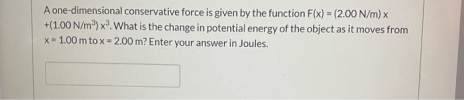 A one-dimensional conservative force is given by the function F(x) = (2.00 N/m) x +(1.00 N/mº) x. What is the change in potential energy of the object as it moves from x = 1.00 m to x = 2.00 m? Enter your answer in Joules.
 A single conservative force F = 6.0x - 12) N where x is in meters, acts on a particle moving along an x axis. The potential energy U associated with this force is assigned a value of 30 J at x = 0. (a) Write an expression for U as a function of x, with U in joules and x in meters. U(X) = (b) What is the maximum positive potential energy? (c) At what negative value of x is...
 A single conservative force F = (8.0x - 12) N where x is in meters, acts on a particle moving along an x axis. The potential energy U associated with this force is assigned a value of 23 ) at x = 0. (a) Write an expression for U as a function of x, with U in joules and x in meters. U(X) = (b) What is the maximum positive potential energy? (c) At what negative value of x is...
 1a.
1b. 1c.
A single conservative force = (AX - B) N, where x is in meters, and A and B are positive constants, acts on a particle moving along an x axis. The potential energy U associated with this force is assigned a value of 0 at x = 0. (a) Write an expression for the potential energy associated with this force. (b) What is the maximum positive value of the potential energy? In the figure, a block of...
1a.
1b. 1c.
A single conservative force = (AX - B) N, where x is in meters, and A and B are positive constants, acts on a particle moving along an x axis. The potential energy U associated with this force is assigned a value of 0 at x = 0. (a) Write an expression for the potential energy associated with this force. (b) What is the maximum positive value of the potential energy? In the figure, a block of...
 so I know the answer to a) is U(x) = 4e(-2x) + 1
b) and the force is conservative, but how can I prove the force
is conservative
Given that The potential energy at x=0 is U=5.0 The force on the particle is given by F(x) = 8 a) The potential energy function is U=-F(x) dx +C U= 8e-*dx+C U= 4(4)+c Atx = 0 U=5.0J 5=4+C C=1 The potential energy of the system as a function of the particle position...
so I know the answer to a) is U(x) = 4e(-2x) + 1
b) and the force is conservative, but how can I prove the force
is conservative
Given that The potential energy at x=0 is U=5.0 The force on the particle is given by F(x) = 8 a) The potential energy function is U=-F(x) dx +C U= 8e-*dx+C U= 4(4)+c Atx = 0 U=5.0J 5=4+C C=1 The potential energy of the system as a function of the particle position...
 Can you help me solve for d and f!!
A conservative force F(y) acts on a 0.400 kilogram object that moves along the y-axis. This is the only force on the object [do not assume that this force is the gravity force]. The potential energy U(y) associated with the conservative force F(y) is graphed below as a function of height y. Note that between the points A and B the potential energy U(y) is a straight line, and between the...
Can you help me solve for d and f!!
A conservative force F(y) acts on a 0.400 kilogram object that moves along the y-axis. This is the only force on the object [do not assume that this force is the gravity force]. The potential energy U(y) associated with the conservative force F(y) is graphed below as a function of height y. Note that between the points A and B the potential energy U(y) is a straight line, and between the...
 A one-dimensional conservative force is given by the function F(x) = (2.00 N/m) x +(1.00 N/mº) x. What is the change in potential energy of the object as it moves from x = 1.00 m to x = 2.00 m? Enter your answer in Joules.
Most questions answered within 3 hours.
-
Where is the error in this code sequence?
String s1 = "Hello";
String s2 = "ello";...
asked 10 months ago -
Financial data for Joel de Paris, Inc., for last year
follow:
Joel de Paris, Inc.
Balance...
asked 10 months ago -
Consider this reaction:
Al2(SO4)3 (aq)+ BaCl3
(aq) Al2Cl6 (aq)- +
3BaSO4(s) . What is the...
asked 10 months ago -
Suppose that Savneet is considering increasing her
recent random sample from 20 car rentals to 40...
asked 10 months ago -
Trucks arrive at an unloading terminal at an average rate of 120
per hour.
Trucks arrive...
asked 10 months ago -
Why are methanol and ethanol completely soluble in water while
octanol is not very little soluble....
asked 10 months ago -
A facilities manager at a university reads in a research report
that the mean amount of...
asked 10 months ago -
When the CuSO4 is rehydrated by adding water to the anhydrous
compound, is this an endothermic...
asked 10 months ago -
A ray of sunlight is passing from diamond into crown glass; the
angle of incidence is...
asked 10 months ago -
A block of mass 0.249 kg is placed on top of a light, vertical
spring of...
asked 10 months ago -
how do the kidneys compensate in the presences of acidosis
a) trigger hyperventilate
b) reserve acid...
asked 10 months ago -
Question 501 pts
The rental rate of capital to the firm increases. Which of the
following...
asked 10 months ago