x is distributed in U (a, b) M x (t) = E ( e ^ tx)...
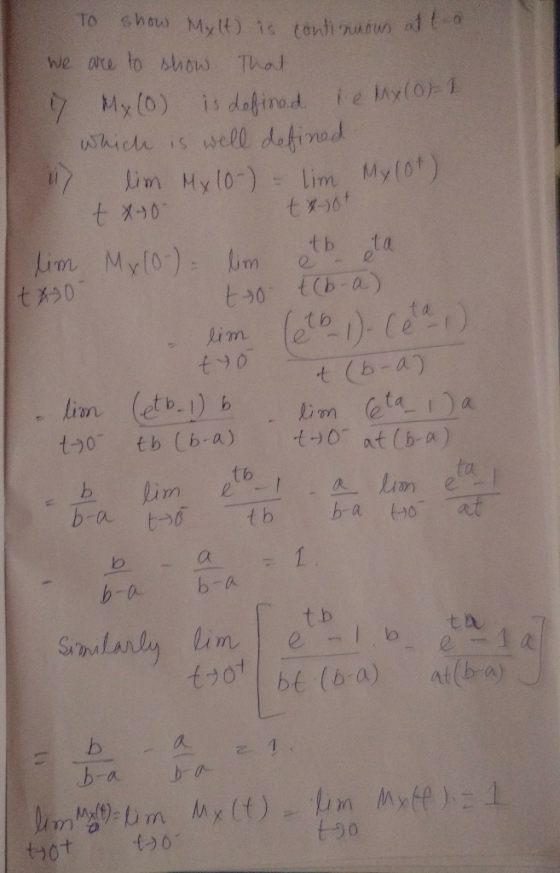
x is distributed in U (a, b) M x (t) = E ( e ^ tx) = a) ( e ^ (tb) - e ^ (ta))/ ( t (b-a)) for t that is not zero b) 1 for t = 0 Show that it is continuous at zero.
Homework Answers
Given v (678) = U (,1;8%)*(x",0)de where U (,t;a") = ( 217 )* <im(8=e")°/2nt and 1...
 Given v (678) = U (,1;8%)*(x",0)de where U (,t;a") = ( 217 )* <im(8=e")°/2nt and 1 V (X",0) = - wie poz' /ħe-x'2/242 (TA)1/4 e’Poz' /H Using Gaussian integrals, show that 1 1/2 -2ħt) 1+ m2 1 6 1410) Lada cara no 15. (24) (-P0t/m)2 Ų (x, t) = eimr/2ht , "ofcas. 771/2 m
3. Let U-Bt- tB be Brownian bridge on [0, 1], where {BiJosesi is a Brownian process (i) Show E(Ut0 (ii) Show Cov(U,, Ut) s(1- t) for 0 s ts1. (ii) Let Xg(t)B Find functions g and h such that X, has t...
 3. Let U-Bt- tB be Brownian bridge on [0, 1], where {BiJosesi is a Brownian process (i) Show E(Ut0 (ii) Show Cov(U,, Ut) s(1- t) for 0 s ts1. (ii) Let Xg(t)B Find functions g and h such that X, has the same covariance as a Brownian bridge.
3. Let U-Bt- tB be Brownian bridge on [0, 1], where {BiJosesi is a Brownian process (i) Show E(Ut0 (ii) Show Cov(U,, Ut) s(1- t) for 0 s ts1. (ii) Let Xg(t)B...
3. Let U-Bt- tB be Brownian bridge on [0, 1], where {BiJosesi is a Brownian process (i) Show E(Ut0 (ii) Show Cov(U,, Ut) s(1- t) for 0 s ts1. (ii) Let Xg(t)B Find functions g and h such that X, has the same covariance as a Brownian bridge.
3. Let U-Bt- tB be Brownian bridge on [0, 1], where {BiJosesi is a Brownian process (i) Show E(Ut0 (ii) Show Cov(U,, Ut) s(1- t) for 0 s ts1. (ii) Let Xg(t)B...
If T is a bounded operator on H with one-dimensional there exist vectors y, z E H such that Tx = ...
 If T is a bounded operator on H with one-dimensional there exist vectors y, z E H such that Tx = (x, z)y for all show the following: sional range, show tha x H. Hence 0 (b) T-AT, λ is a scalar.
If T is a bounded operator on H with one-dimensional there exist vectors y, z E H such that Tx = (x, z)y for all show the following: sional range, show tha x H. Hence 0 (b) T-AT,...
If T is a bounded operator on H with one-dimensional there exist vectors y, z E H such that Tx = (x, z)y for all show the following: sional range, show tha x H. Hence 0 (b) T-AT, λ is a scalar.
If T is a bounded operator on H with one-dimensional there exist vectors y, z E H such that Tx = (x, z)y for all show the following: sional range, show tha x H. Hence 0 (b) T-AT,...
Problem 3: Consider a continuous function x(t), defined for t 0. The Laplace Transform (LT) for...
 Problem 3: Consider a continuous function x(t), defined for t 0. The Laplace Transform (LT) for x(t) is defined as: X(s) - Ix(t)e-st dt. Derive the following properties: a) LT(6(t))-1, the ?(t) is the Dirac-delta function b) LT(u(t))-1/s, where u(t) is the unit-step function c) LT(sin(wt))-u/(s2 + ?2) d) LT(x(t-t)u(t-t)) = e-stx(s), ? > 0. e LT(tx)-4x(s).
() At)x()B(f)u() Consider the following time-varying system y(t) C(f)x(t) where x) R", u(t)E R R 1...
 () At)x()B(f)u() Consider the following time-varying system y(t) C(f)x(t) where x) R", u(t)E R R 1 1) Derive the state transition matrix D(t,r) when A(f) = 0 0 sint 2) Assume that x(to) = x0 is given and u(f) is known in the interval [to, 4] Based on these assumptions, derive the complete solution by using the state transition matrix D(f, r). Also show that the solution is unique in the interval [to, 4]. 3) Let x(1) 0 and u(f)...
Recall that if T: R" R" is a linear transforrmation T(x) = [Tx, where [T is the transformation matrix, then 1....
 Recall that if T: R" R" is a linear transforrmation T(x) = [Tx, where [T is the transformation matrix, then 1. ker(T) null([T] (ker(T) is the kernel of T) 2. T is one-to-one exactly when ker(T) = {0 3. range of T subspace spanned by the columns of [T] col([T) 4. T is onto exactly when T(x) = [Tx = b is consistent for all b in R". 5. Also, T is onto exactly when range of T col([T]) =...
5. Find a solution u(x,t) of the following problem Ute = 2uz, 0< x < 2 u(0, t) u(2, t) = 0 u(x, 0) = 0, u(x,...
 5. Find a solution u(x,t) of the following problem Ute = 2uz, 0< x < 2 u(0, t) u(2, t) = 0 u(x, 0) = 0, u(x, 0) = sin Tx - 2 sin 3ra .
5. Find a solution u(x,t) of the following problem Ute = 2uz, 0
5. Find a solution u(x,t) of the following problem Ute = 2uz, 0< x < 2 u(0, t) u(2, t) = 0 u(x, 0) = 0, u(x, 0) = sin Tx - 2 sin 3ra .
5. Find a solution u(x,t) of the following problem Ute = 2uz, 0
2(a). Compute and plot the convolution of ytryh)x where h(t) t)-u(t-4), x(t)u(t)-u(t-1) and zero else b)....
 2(a). Compute and plot the convolution of ytryh)x where h(t) t)-u(t-4), x(t)u(t)-u(t-1) and zero else b). Compute and plot the convolution y(n) h(n)*x (n) where h(n)-1, for 0Sns4, x(n) 1, n 0, 1 and zero else.
t) (2,t, e') 1. Consider the space curve r and B Tx N (a) Find T...
 t) (2,t, e') 1. Consider the space curve r and B Tx N (a) Find T N= r°T T' (b) Compute the curvature K(t) of r(t)
t) (2,t, e') 1. Consider the space curve r and B Tx N (a) Find T N= r°T T' (b) Compute the curvature K(t) of r(t)
t) (2,t, e') 1. Consider the space curve r and B Tx N (a) Find T N= r°T T' (b) Compute the curvature K(t) of r(t)
3. Let the Laplace transforms of signals (t) and y(t) be X(s) and Y(s) with appropriate...
 3. Let the Laplace transforms of signals (t) and y(t) be X(s) and Y(s) with appropriate regions of convergence, respectively (a) Show that the Laplace transform of x(t) * y(t) is X(s)Y (s). What is the region of convergence? (b) Show that the Laplace transform of tx(t) is -dX(s)/ds with the same region of x(t) convergence as tn-1 1 for Re{sa} > 0. -at e (c) Show that the Laplace transform of 'u(t) is n 1)! (sa)" 1 for Refsa}...
 Given v (678) = U (,1;8%)*(x",0)de where U (,t;a") = ( 217 )* <im(8=e")°/2nt and 1 V (X",0) = - wie poz' /ħe-x'2/242 (TA)1/4 e’Poz' /H Using Gaussian integrals, show that 1 1/2 -2ħt) 1+ m2 1 6 1410) Lada cara no 15. (24) (-P0t/m)2 Ų (x, t) = eimr/2ht , "ofcas. 771/2 m
 3. Let U-Bt- tB be Brownian bridge on [0, 1], where {BiJosesi is a Brownian process (i) Show E(Ut0 (ii) Show Cov(U,, Ut) s(1- t) for 0 s ts1. (ii) Let Xg(t)B Find functions g and h such that X, has the same covariance as a Brownian bridge.
3. Let U-Bt- tB be Brownian bridge on [0, 1], where {BiJosesi is a Brownian process (i) Show E(Ut0 (ii) Show Cov(U,, Ut) s(1- t) for 0 s ts1. (ii) Let Xg(t)B...
3. Let U-Bt- tB be Brownian bridge on [0, 1], where {BiJosesi is a Brownian process (i) Show E(Ut0 (ii) Show Cov(U,, Ut) s(1- t) for 0 s ts1. (ii) Let Xg(t)B Find functions g and h such that X, has the same covariance as a Brownian bridge.
3. Let U-Bt- tB be Brownian bridge on [0, 1], where {BiJosesi is a Brownian process (i) Show E(Ut0 (ii) Show Cov(U,, Ut) s(1- t) for 0 s ts1. (ii) Let Xg(t)B...
 If T is a bounded operator on H with one-dimensional there exist vectors y, z E H such that Tx = (x, z)y for all show the following: sional range, show tha x H. Hence 0 (b) T-AT, λ is a scalar.
If T is a bounded operator on H with one-dimensional there exist vectors y, z E H such that Tx = (x, z)y for all show the following: sional range, show tha x H. Hence 0 (b) T-AT,...
If T is a bounded operator on H with one-dimensional there exist vectors y, z E H such that Tx = (x, z)y for all show the following: sional range, show tha x H. Hence 0 (b) T-AT, λ is a scalar.
If T is a bounded operator on H with one-dimensional there exist vectors y, z E H such that Tx = (x, z)y for all show the following: sional range, show tha x H. Hence 0 (b) T-AT,...
 Problem 3: Consider a continuous function x(t), defined for t 0. The Laplace Transform (LT) for x(t) is defined as: X(s) - Ix(t)e-st dt. Derive the following properties: a) LT(6(t))-1, the ?(t) is the Dirac-delta function b) LT(u(t))-1/s, where u(t) is the unit-step function c) LT(sin(wt))-u/(s2 + ?2) d) LT(x(t-t)u(t-t)) = e-stx(s), ? > 0. e LT(tx)-4x(s).
 () At)x()B(f)u() Consider the following time-varying system y(t) C(f)x(t) where x) R", u(t)E R R 1 1) Derive the state transition matrix D(t,r) when A(f) = 0 0 sint 2) Assume that x(to) = x0 is given and u(f) is known in the interval [to, 4] Based on these assumptions, derive the complete solution by using the state transition matrix D(f, r). Also show that the solution is unique in the interval [to, 4]. 3) Let x(1) 0 and u(f)...
 Recall that if T: R" R" is a linear transforrmation T(x) = [Tx, where [T is the transformation matrix, then 1. ker(T) null([T] (ker(T) is the kernel of T) 2. T is one-to-one exactly when ker(T) = {0 3. range of T subspace spanned by the columns of [T] col([T) 4. T is onto exactly when T(x) = [Tx = b is consistent for all b in R". 5. Also, T is onto exactly when range of T col([T]) =...
 5. Find a solution u(x,t) of the following problem Ute = 2uz, 0< x < 2 u(0, t) u(2, t) = 0 u(x, 0) = 0, u(x, 0) = sin Tx - 2 sin 3ra .
5. Find a solution u(x,t) of the following problem Ute = 2uz, 0
5. Find a solution u(x,t) of the following problem Ute = 2uz, 0< x < 2 u(0, t) u(2, t) = 0 u(x, 0) = 0, u(x, 0) = sin Tx - 2 sin 3ra .
5. Find a solution u(x,t) of the following problem Ute = 2uz, 0
 2(a). Compute and plot the convolution of ytryh)x where h(t) t)-u(t-4), x(t)u(t)-u(t-1) and zero else b). Compute and plot the convolution y(n) h(n)*x (n) where h(n)-1, for 0Sns4, x(n) 1, n 0, 1 and zero else.
 t) (2,t, e') 1. Consider the space curve r and B Tx N (a) Find T N= r°T T' (b) Compute the curvature K(t) of r(t)
t) (2,t, e') 1. Consider the space curve r and B Tx N (a) Find T N= r°T T' (b) Compute the curvature K(t) of r(t)
t) (2,t, e') 1. Consider the space curve r and B Tx N (a) Find T N= r°T T' (b) Compute the curvature K(t) of r(t)
 3. Let the Laplace transforms of signals (t) and y(t) be X(s) and Y(s) with appropriate regions of convergence, respectively (a) Show that the Laplace transform of x(t) * y(t) is X(s)Y (s). What is the region of convergence? (b) Show that the Laplace transform of tx(t) is -dX(s)/ds with the same region of x(t) convergence as tn-1 1 for Re{sa} > 0. -at e (c) Show that the Laplace transform of 'u(t) is n 1)! (sa)" 1 for Refsa}...
Most questions answered within 3 hours.
-
Where is the error in this code sequence?
String s1 = "Hello";
String s2 = "ello";...
asked 10 months ago -
Financial data for Joel de Paris, Inc., for last year
follow:
Joel de Paris, Inc.
Balance...
asked 10 months ago -
Consider this reaction:
Al2(SO4)3 (aq)+ BaCl3
(aq) Al2Cl6 (aq)- +
3BaSO4(s) . What is the...
asked 10 months ago -
Suppose that Savneet is considering increasing her
recent random sample from 20 car rentals to 40...
asked 10 months ago -
Trucks arrive at an unloading terminal at an average rate of 120
per hour.
Trucks arrive...
asked 10 months ago -
Why are methanol and ethanol completely soluble in water while
octanol is not very little soluble....
asked 10 months ago -
A facilities manager at a university reads in a research report
that the mean amount of...
asked 10 months ago -
When the CuSO4 is rehydrated by adding water to the anhydrous
compound, is this an endothermic...
asked 10 months ago -
A ray of sunlight is passing from diamond into crown glass; the
angle of incidence is...
asked 10 months ago -
A block of mass 0.249 kg is placed on top of a light, vertical
spring of...
asked 10 months ago -
how do the kidneys compensate in the presences of acidosis
a) trigger hyperventilate
b) reserve acid...
asked 10 months ago -
Question 501 pts
The rental rate of capital to the firm increases. Which of the
following...
asked 10 months ago