


Homework Answers
Add Answer to:
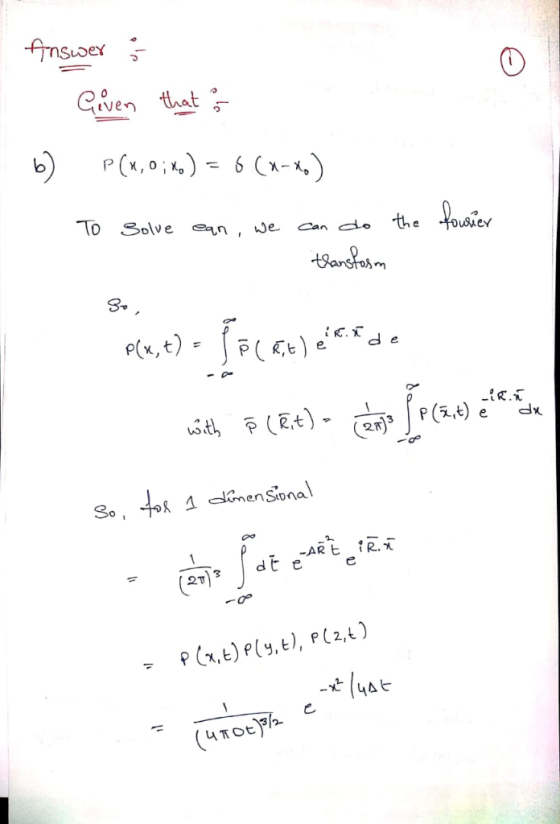
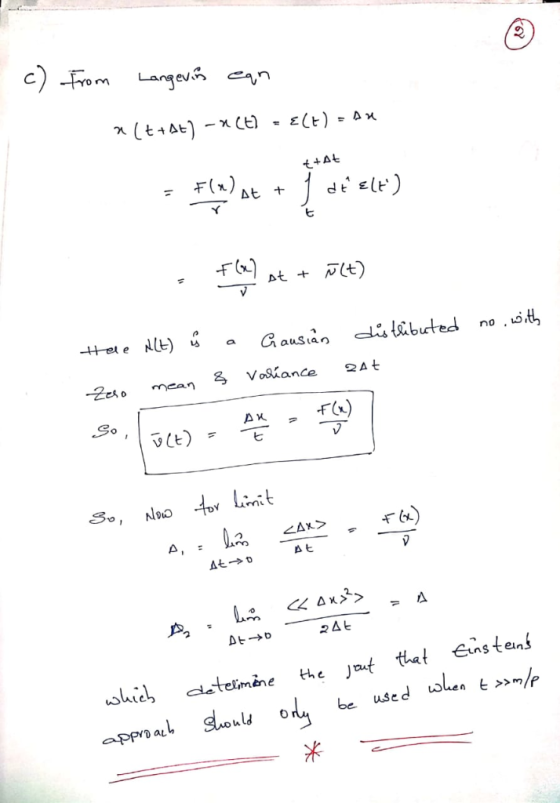
part b and c
In class we derived a Fokker-Planck equation for the velocity distribution P(et)...
Question 2 Consider the differential equation We saw in class that one solution is the Bessel function (a) Suppose we h...
 Question 2 Consider the differential equation We saw in class that one solution is the Bessel function (a) Suppose we have a solution to this ODE in the form y-Σχ0CnXntr where cn 0. By considering the first term of this series show that r must satisfy r2-4-0 (and hence that r = 2 or r =-2) (b) Show that any solution of the form y-ca:0G,2n-2 must satisfy C0 (c) From the theory about singular solutions we know that a linearly...
and part b solve the initial value problem for the system in (a) with initial position q(0)=a and initial momentum p(0)= wb. a and b are real constant. A ρ。'ntc, p by ferce pro portional...
 and part b
solve the initial value problem for the system in (a) with initial
position q(0)=a and initial momentum p(0)= wb. a and b are real
constant.
A ρ。'ntc, p by ferce pro portional to its dis knte fron . If t denotes tre the Punctven) obey s Ne mass m=1 no vesen alae R, at tracted to the origine Where w iss Posit i ue constant ,This ,s know, as the Mumon.lOulleh'F.q order EA. Wrde this Haininic as...
and part b
solve the initial value problem for the system in (a) with initial
position q(0)=a and initial momentum p(0)= wb. a and b are real
constant.
A ρ。'ntc, p by ferce pro portional to its dis knte fron . If t denotes tre the Punctven) obey s Ne mass m=1 no vesen alae R, at tracted to the origine Where w iss Posit i ue constant ,This ,s know, as the Mumon.lOulleh'F.q order EA. Wrde this Haininic as...
please use the equation on the sheet below the question to our tow alds .e woll...
 please use the equation on the sheet below the question
to our tow alds .e woll dbsh TE on muibeeoobuo n o2 bwo St a (0 smor to tnos bot buol s o 2. (20) A disk with a mass of "m" kg and radius of "r" meters (I = 2 mr2) rolls without slipping at "V" m/s. What is its total kinetic energy (in terms of m, r, and v)? maii.ds sunot lant ai l mot 15) A Momentum...
please use the equation on the sheet below the question
to our tow alds .e woll dbsh TE on muibeeoobuo n o2 bwo St a (0 smor to tnos bot buol s o 2. (20) A disk with a mass of "m" kg and radius of "r" meters (I = 2 mr2) rolls without slipping at "V" m/s. What is its total kinetic energy (in terms of m, r, and v)? maii.ds sunot lant ai l mot 15) A Momentum...
P (a) (b) +29 ( c) + -Q (d) FIGURE 21-34 Electric field lines for four...
 P (a) (b) +29 ( c) + -Q (d) FIGURE 21-34 Electric field lines for four arrangements of charges. E P R do EXAMPLE 21-12 Uniformly charged disk. Charge is distributed uniformly over a thin circular disk of radius R. The charge per unit area (C/m²) is o. Calculate the electric field at a point P on the axis of the disk, a distance z above its center, Fig. 21-30. APPROACH We can think of the disk as a set...
(1 point) Solve the wave equation with fixed endpoints and the given initial displacement and velocity. a2 ,0<x<L, t > 0 a(0. t) = 0, u(L, t) = 0, t > 0 Ou Ot ηπα t) + B,, sin (m Now we c...
 (1 point) Solve the wave equation with fixed endpoints and the given initial displacement and velocity. a2 ,0<x<L, t > 0 a(0. t) = 0, u(L, t) = 0, t > 0 Ou Ot ηπα t) + B,, sin (m Now we can solve the PDE using the series solution u(r,t)-> An C computed many times: An example: t) ) sin (-1 ). The coefficients .An and i, are Fourier coefficients we have , cos n-1 sin(n pix/ L) dr...
1. In class, we examined in detail case "C" of table 3.4 on page 150 of...
 1. In class, we examined in detail case "C" of table 3.4 on page 150 of your text. Prove the expressions provided in the table for cases A, B, and D. Specifically, start from the general equation 3.67, and apply at x-L the boundary condition on the second column of Table 3.4 for each of the cases. Then, solve the differential equation and acquire the information on the third and the fourth column. Hint In some cases, you will need...
PART A PART B PART C PART D (1 point) A mass m = 4 kg...
 PART A
PART B
PART C
PART D
(1 point) A mass m = 4 kg is attached to both a spring with spring constant k = 197 N/m and a dash-pot with damping constant c=4N s/m. The mass is started in motion with initial position to 3 m and initial velocity vo = 6 m/s. Determine the position function r(t) in meters. x(1) Note that, in this problem, the motion of the spring is underdamped, therefore the solution can...
PART A
PART B
PART C
PART D
(1 point) A mass m = 4 kg is attached to both a spring with spring constant k = 197 N/m and a dash-pot with damping constant c=4N s/m. The mass is started in motion with initial position to 3 m and initial velocity vo = 6 m/s. Determine the position function r(t) in meters. x(1) Note that, in this problem, the motion of the spring is underdamped, therefore the solution can...
Only solve part (d) please. The formula derived in part (b) is 1 Dimensional Analysis 34 1.4. The luminosity of certa...
 Only solve part (d) please. The formula derived in part (b) is
1 Dimensional Analysis 34 1.4. The luminosity of certain giant and supergiant stars varies in a periodic manner. It is hypothesized that the period p depends upon the star's average radius r, its lllass ข, alul i.he nravii.aiional cousiałí. G. (a) Newton's law of gravitation asserts that the attractive force between two bodies is proportional to the product of their masses divided by the square of the distance...
Only solve part (d) please. The formula derived in part (b) is
1 Dimensional Analysis 34 1.4. The luminosity of certain giant and supergiant stars varies in a periodic manner. It is hypothesized that the period p depends upon the star's average radius r, its lllass ข, alul i.he nravii.aiional cousiałí. G. (a) Newton's law of gravitation asserts that the attractive force between two bodies is proportional to the product of their masses divided by the square of the distance...
the first pictures equation is 4/(t^3 +1) CB 2 x c 0 College Board AP Classroom...
 the
first pictures equation is 4/(t^3 +1)
CB 2 x c 0 College Board AP Classroom 8.2 PARTICLE MOTION Mala Nou - 6 0 -6-0-0-0-0-0 Question 1 A particle moves along the x-axis. The velocity of the particle at time is given by v(t) 42 If the position of the particle is z - I when t-2, what is the position of the particle when (A) 0.617 B) 0.647 1.353 D ) 5.712 CB x C 0 B . College...
the
first pictures equation is 4/(t^3 +1)
CB 2 x c 0 College Board AP Classroom 8.2 PARTICLE MOTION Mala Nou - 6 0 -6-0-0-0-0-0 Question 1 A particle moves along the x-axis. The velocity of the particle at time is given by v(t) 42 If the position of the particle is z - I when t-2, what is the position of the particle when (A) 0.617 B) 0.647 1.353 D ) 5.712 CB x C 0 B . College...
solve 2.40 a,b,c, e using Fourier series. 2.40 part a,b,c,e 2.40 Consider the continuous-time signals depicted in Fig. P2.40. Evaluate the following convolution integrals: (a) m(t) x(t) y(t) (...
 solve 2.40 a,b,c, e using Fourier series.
2.40 part a,b,c,e 2.40 Consider the continuous-time signals depicted in Fig. P2.40. Evaluate the following convolution integrals: (a) m(t) x(t) y(t) (b) m(t)x(t)z(t) (c) m(t) x(t) ft) (d) m(t) x(t) a(t) (e) m(t)y(t) z(t) (f) m(t) -y(t) w(t) (g) m(t) y(t)g(t) (h) m(t)y(t) c(t) (i) m(t) z(t) f(t) (j) m(t) z(t) g(t) (k) m(t) z(t)b(t) (1) m(t) w(t) g(t) (m) m(t) w(t) a(t) (n) m(t) f(t) g(t (o) m(t) fo) . do) (p)...
solve 2.40 a,b,c, e using Fourier series.
2.40 part a,b,c,e 2.40 Consider the continuous-time signals depicted in Fig. P2.40. Evaluate the following convolution integrals: (a) m(t) x(t) y(t) (b) m(t)x(t)z(t) (c) m(t) x(t) ft) (d) m(t) x(t) a(t) (e) m(t)y(t) z(t) (f) m(t) -y(t) w(t) (g) m(t) y(t)g(t) (h) m(t)y(t) c(t) (i) m(t) z(t) f(t) (j) m(t) z(t) g(t) (k) m(t) z(t)b(t) (1) m(t) w(t) g(t) (m) m(t) w(t) a(t) (n) m(t) f(t) g(t (o) m(t) fo) . do) (p)...
 Question 2 Consider the differential equation We saw in class that one solution is the Bessel function (a) Suppose we have a solution to this ODE in the form y-Σχ0CnXntr where cn 0. By considering the first term of this series show that r must satisfy r2-4-0 (and hence that r = 2 or r =-2) (b) Show that any solution of the form y-ca:0G,2n-2 must satisfy C0 (c) From the theory about singular solutions we know that a linearly...
 and part b
solve the initial value problem for the system in (a) with initial
position q(0)=a and initial momentum p(0)= wb. a and b are real
constant.
A ρ。'ntc, p by ferce pro portional to its dis knte fron . If t denotes tre the Punctven) obey s Ne mass m=1 no vesen alae R, at tracted to the origine Where w iss Posit i ue constant ,This ,s know, as the Mumon.lOulleh'F.q order EA. Wrde this Haininic as...
and part b
solve the initial value problem for the system in (a) with initial
position q(0)=a and initial momentum p(0)= wb. a and b are real
constant.
A ρ。'ntc, p by ferce pro portional to its dis knte fron . If t denotes tre the Punctven) obey s Ne mass m=1 no vesen alae R, at tracted to the origine Where w iss Posit i ue constant ,This ,s know, as the Mumon.lOulleh'F.q order EA. Wrde this Haininic as...
 please use the equation on the sheet below the question
to our tow alds .e woll dbsh TE on muibeeoobuo n o2 bwo St a (0 smor to tnos bot buol s o 2. (20) A disk with a mass of "m" kg and radius of "r" meters (I = 2 mr2) rolls without slipping at "V" m/s. What is its total kinetic energy (in terms of m, r, and v)? maii.ds sunot lant ai l mot 15) A Momentum...
please use the equation on the sheet below the question
to our tow alds .e woll dbsh TE on muibeeoobuo n o2 bwo St a (0 smor to tnos bot buol s o 2. (20) A disk with a mass of "m" kg and radius of "r" meters (I = 2 mr2) rolls without slipping at "V" m/s. What is its total kinetic energy (in terms of m, r, and v)? maii.ds sunot lant ai l mot 15) A Momentum...
 P (a) (b) +29 ( c) + -Q (d) FIGURE 21-34 Electric field lines for four arrangements of charges. E P R do EXAMPLE 21-12 Uniformly charged disk. Charge is distributed uniformly over a thin circular disk of radius R. The charge per unit area (C/m²) is o. Calculate the electric field at a point P on the axis of the disk, a distance z above its center, Fig. 21-30. APPROACH We can think of the disk as a set...
 (1 point) Solve the wave equation with fixed endpoints and the given initial displacement and velocity. a2 ,0<x<L, t > 0 a(0. t) = 0, u(L, t) = 0, t > 0 Ou Ot ηπα t) + B,, sin (m Now we can solve the PDE using the series solution u(r,t)-> An C computed many times: An example: t) ) sin (-1 ). The coefficients .An and i, are Fourier coefficients we have , cos n-1 sin(n pix/ L) dr...
 1. In class, we examined in detail case "C" of table 3.4 on page 150 of your text. Prove the expressions provided in the table for cases A, B, and D. Specifically, start from the general equation 3.67, and apply at x-L the boundary condition on the second column of Table 3.4 for each of the cases. Then, solve the differential equation and acquire the information on the third and the fourth column. Hint In some cases, you will need...
 PART A
PART B
PART C
PART D
(1 point) A mass m = 4 kg is attached to both a spring with spring constant k = 197 N/m and a dash-pot with damping constant c=4N s/m. The mass is started in motion with initial position to 3 m and initial velocity vo = 6 m/s. Determine the position function r(t) in meters. x(1) Note that, in this problem, the motion of the spring is underdamped, therefore the solution can...
PART A
PART B
PART C
PART D
(1 point) A mass m = 4 kg is attached to both a spring with spring constant k = 197 N/m and a dash-pot with damping constant c=4N s/m. The mass is started in motion with initial position to 3 m and initial velocity vo = 6 m/s. Determine the position function r(t) in meters. x(1) Note that, in this problem, the motion of the spring is underdamped, therefore the solution can...
 Only solve part (d) please. The formula derived in part (b) is
1 Dimensional Analysis 34 1.4. The luminosity of certain giant and supergiant stars varies in a periodic manner. It is hypothesized that the period p depends upon the star's average radius r, its lllass ข, alul i.he nravii.aiional cousiałí. G. (a) Newton's law of gravitation asserts that the attractive force between two bodies is proportional to the product of their masses divided by the square of the distance...
Only solve part (d) please. The formula derived in part (b) is
1 Dimensional Analysis 34 1.4. The luminosity of certain giant and supergiant stars varies in a periodic manner. It is hypothesized that the period p depends upon the star's average radius r, its lllass ข, alul i.he nravii.aiional cousiałí. G. (a) Newton's law of gravitation asserts that the attractive force between two bodies is proportional to the product of their masses divided by the square of the distance...
 the
first pictures equation is 4/(t^3 +1)
CB 2 x c 0 College Board AP Classroom 8.2 PARTICLE MOTION Mala Nou - 6 0 -6-0-0-0-0-0 Question 1 A particle moves along the x-axis. The velocity of the particle at time is given by v(t) 42 If the position of the particle is z - I when t-2, what is the position of the particle when (A) 0.617 B) 0.647 1.353 D ) 5.712 CB x C 0 B . College...
the
first pictures equation is 4/(t^3 +1)
CB 2 x c 0 College Board AP Classroom 8.2 PARTICLE MOTION Mala Nou - 6 0 -6-0-0-0-0-0 Question 1 A particle moves along the x-axis. The velocity of the particle at time is given by v(t) 42 If the position of the particle is z - I when t-2, what is the position of the particle when (A) 0.617 B) 0.647 1.353 D ) 5.712 CB x C 0 B . College...
 solve 2.40 a,b,c, e using Fourier series.
2.40 part a,b,c,e 2.40 Consider the continuous-time signals depicted in Fig. P2.40. Evaluate the following convolution integrals: (a) m(t) x(t) y(t) (b) m(t)x(t)z(t) (c) m(t) x(t) ft) (d) m(t) x(t) a(t) (e) m(t)y(t) z(t) (f) m(t) -y(t) w(t) (g) m(t) y(t)g(t) (h) m(t)y(t) c(t) (i) m(t) z(t) f(t) (j) m(t) z(t) g(t) (k) m(t) z(t)b(t) (1) m(t) w(t) g(t) (m) m(t) w(t) a(t) (n) m(t) f(t) g(t (o) m(t) fo) . do) (p)...
solve 2.40 a,b,c, e using Fourier series.
2.40 part a,b,c,e 2.40 Consider the continuous-time signals depicted in Fig. P2.40. Evaluate the following convolution integrals: (a) m(t) x(t) y(t) (b) m(t)x(t)z(t) (c) m(t) x(t) ft) (d) m(t) x(t) a(t) (e) m(t)y(t) z(t) (f) m(t) -y(t) w(t) (g) m(t) y(t)g(t) (h) m(t)y(t) c(t) (i) m(t) z(t) f(t) (j) m(t) z(t) g(t) (k) m(t) z(t)b(t) (1) m(t) w(t) g(t) (m) m(t) w(t) a(t) (n) m(t) f(t) g(t (o) m(t) fo) . do) (p)...
Most questions answered within 3 hours.
-
Where is the error in this code sequence?
String s1 = "Hello";
String s2 = "ello";...
asked 11 months ago -
Financial data for Joel de Paris, Inc., for last year
follow:
Joel de Paris, Inc.
Balance...
asked 11 months ago -
Consider this reaction:
Al2(SO4)3 (aq)+ BaCl3
(aq) Al2Cl6 (aq)- +
3BaSO4(s) . What is the...
asked 11 months ago -
Suppose that Savneet is considering increasing her
recent random sample from 20 car rentals to 40...
asked 11 months ago -
Trucks arrive at an unloading terminal at an average rate of 120
per hour.
Trucks arrive...
asked 11 months ago -
Why are methanol and ethanol completely soluble in water while
octanol is not very little soluble....
asked 11 months ago -
A facilities manager at a university reads in a research report
that the mean amount of...
asked 11 months ago -
When the CuSO4 is rehydrated by adding water to the anhydrous
compound, is this an endothermic...
asked 11 months ago -
A ray of sunlight is passing from diamond into crown glass; the
angle of incidence is...
asked 11 months ago -
A block of mass 0.249 kg is placed on top of a light, vertical
spring of...
asked 11 months ago -
how do the kidneys compensate in the presences of acidosis
a) trigger hyperventilate
b) reserve acid...
asked 11 months ago -
Question 501 pts
The rental rate of capital to the firm increases. Which of the
following...
asked 11 months ago