
Homework Answers
Phenylephrine nasal spray is used to relieve nasal discomfort caused by colds, allergies, and hay fever. It is also used to relieve sinus congestion and pressure.
How should this medicine be used?
Use phenylephrine nasal spray more often or for longer than the recommended period of time, your congestion may get worse or may improve but then return.
Do not use phenylephrine nasal spray for longer than 3 days. If your symptoms do not get better after 3 days of treatment, stop using phenylephrine and call your doctor.
To use the nose spray:
- Blow your nose gently. With the head upright, spray the medicine into each nostril. Sniff briskly while squeezing the bottle quickly and firmly. For best results, spray once or twice into each nostril and wait 3 to 5 minutes to allow the medicine to work. Then, blow your nose gently and thoroughly. Repeat until the complete dose is used.
- Rinse the tip of the spray bottle with hot water, taking care not to suck water into the bottle, and dry with a clean tissue. Replace the cap right after use.
- To avoid spreading the infection, do not use the container for more than one person.
To use the nose spray
- Blow your nose until your nostrils are clear.
- Wash your hands with soap and water.
- Shake the bottle gently before each use and remove the cap.
- Hold one nostril closed with your finger.
- Tilt your head slightly forward and place the tip of the bottle towards the back of your open nostril.
- Squeeze the bottle quickly and firmly 2 to 3 times while gently breathing in the medication.
- Repeat steps 4 to 6 for the other nostril.
- Wipe the tip of the bottle and replace the bottle cap.
- Blow your nose gently. With the head upright, spray the medicine into each nostril. Sniff briskly while squeezing the bottle quickly and firmly. For best results, spray once or twice into each nostril and wait 3 to 5 minutes to allow the medicine to work. Then, blow your nose gently and thoroughly. Repeat until the complete dose is used.
- Rinse the tip of the spray bottle with hot water, taking care not to suck water into the bottle, and dry with a clean tissue. Replace the cap right after use.
- To avoid spreading the infection, do not use the container for more than one person.
Before using phenylephrine nasal spray:-
- tell your doctor and pharmacist if you are allergic to phenylephrine, any other medications, or any of the ingredients in phenylephrine nasal spray. Ask your pharmacist or check the product labeling for a list of the ingredients.
- tell your doctor if you have or have ever had high blood pressure, diabetes, difficulty urinating due to an enlarged prostate gland, or thyroid or heart disease.
- tell your doctor if you are pregnant, plan to become pregnant, or are breastfeeding. If you become pregnant while using phenylephrine nasal spray, call your doctor.
Phenylephrine nasal may cause side effects:-burning, stinging, sneezing, increased nasal discharge, nervousness, dizziness, difficulty falling asleep or staying asleep.
Assessment & Drug Effects:-
- Monitor pulse, BP, and central venous pressure (q2–5min) during IV administration.
- Control flow rate and dosage to prevent excessive dosage. IV overdoses can induce ventricular dysrhythmias.
- Observe for congestion or rebound miosis after topical administration to eye.
Patient Education
- Be aware that instillation of 2.5–10% strength ophthalmic solution can cause burning and stinging.
- Do not exceed recommended dosage regardless of formulation.
- Inform the physician if no relief is experienced from preparation in 5 d.
- Be aware that systemic absorption from nasal and conjunctival membranes can occur, though infrequently. Discontinue drug and report to the physician if adverse effects occur.
- Wear sunglasses in bright light because after instillation of ophthalmic drops, pupils will be large and eyes may be more sensitive to light than usual. Stop medication and notify physician if sensitivity persists beyond 12 h after drug has been discontinued.
- Be aware that some ophthalmic solutions may stain contact lenses.
- Do not breast feed while taking this drug.
Assessment Prior to administration:
- Monitor cardiac output, central venous pressure, pulmonary artery wedge pressure, standard vital signs and urinary output.
- Monitor vital signs and observe the nasal mucosa for changes such as excoriation or bleeding.
- Obtain complete health history including cardiac, visual, pulmonary, GI, urinary disorders including blood studies: CBC, electrolytes, cardiac enzymes, BUN, creatinine. May include EKG, pulmonary functions, and x-rays of the chest or nasal sinuses.
- Obtain patient’s drug history to determine possible drug interactions and allergies.
Planning: Patient Goals
The patient will:
- Demonstrate understanding of the drug's action.
- Return demonstrate proper nasal medication instillation technique.
- Demonstrate effective nasal airway clearance.
- Maintain vital signs within normal range.
- Maintain effective tissue perfusion.
Patient Education
Inform patients:
- to immediately report shortness of breath, palpitations, dizziness, chest/arm pain or pressure or other "angina-like" symptoms.
- to consult their health care provider before attempting to use phenylephrine to treat nasal stuffiness or eye irritation.
- to monitor blood pressure, pulse and temperature ensuring proper use of home equipment
Instruct patient:
- to report change in heart rate and rhythm, or chest pain.
- to report elevated temperature, increased heart rate, and behavioral changes to the health care provider
- to immediately report any difficulty breathing.
- with a history of asthma to consult their health care provider before attempting to use phenylephrine to treat nasal stuffiness.
- Instruct patients to report all drug side effects, especially headache, weakness or changes in sensorium like dizziness or altered level of consciousness.
- to observe the nasal cavity for signs of excoriation or bleeding before instilling nasal spray or drops.
- on the procedure for safe instillation of nasal sprays or drops.
- to limit "over-the-counter" usage of phenylephrine; inform the patient about rebound nasal congestion.
Add Answer to:
10. The nurse is reinforcing teaching regarding nasal spray phenylephrine. Explain important points for the nurse...
2 points 7. A nurse is reinforcing medication teaching with a client who has psoriasis and...
 2 points 7. A nurse is reinforcing medication teaching with a client who has psoriasis and a new prescription for triamcinolone cream. Which of the following statements should the nurse include in the teaching? *
A nurse is reinforcing teaching with a client who has a new prescription for spironolactone. Which...
A nurse is reinforcing teaching with a client who has a new prescription for spironolactone. Which of the following foods should the nurse instruct the client to avoid? a. Popcorn b. Whole grain pasta c. Cooked carrots d. Dried apricots A nurse is caring for a client who reports diarrhea for the past 48 hours. Which of the following findings indicates the client is experiencing dehydration? a. Weight gain b. Hematocrit 56% c. Temperature 37.2 C (99.1 F) d. Firm...
A nurse is reinforcing teaching with a client who has diabetes mellitus about using a glucometer...
A nurse is reinforcing teaching with a client who has diabetes mellitus about using a glucometer to monitor her blood glucose. Whic following actions should the nurse identify as an indication that the client understands the instructions?
A nurse is reinforcing teaching with a client who has a new prescription for verapamil. Which...
A nurse is reinforcing teaching with a client who has a new prescription for verapamil. Which of the following instructions should the nurse include in the teaching? a. Expect palpitations for 2 days. b. Withhold the medication if dizziness occurs. c. Change positions slowly d. Take the medication on an empty stomach
129. a nurse is reinforcing teaching with a client who is postoperative following a laparoscopic cholecystectomy....
 129. a nurse is reinforcing teaching with a client who is postoperative following a laparoscopic cholecystectomy. Which of the following statements by the client indicates an understanding of teaching? I should expect to have diarrhea until my diet changes. I should eat a high-fat diet for several weeks. I should expect to have nausea for several days I should leave my steri-strips on until they fall off.
132. a nurse is reinforcing teaching with a client who has primary open-angle glaucoma and a...
 132. a nurse is reinforcing teaching with a client who has primary open-angle glaucoma and a new prescription for timolol eye drops. Which of the following statements by the client indicates an understanding of the teaching? I should check my heart rate while taking this medication I should take a zinc supplement while taking this medication This medication will darken the color of my eyes This medication will date my eyes
163. a nurse is reinforcing teaching with a client who is about to undergo surgery. Which...
 163. a nurse is reinforcing teaching with a client who is about to undergo surgery. Which of the following statement about information consent should the nurse include in the teaching? A family member must witness your signature on the informed consent form We require informed consent for all routine treatment We can accept verbal consent unless the surgical procedure is an emergency You can sign the informed consent form after the provider explains the pros and cons of the procedure
Question 1 10 pts A patient reports to the nurse that initially, their nasal congestion improved...
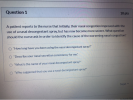 Question 1 10 pts A patient reports to the nurse that initially, their nasal congestion improved with the use of a nasal decongestant spray, but has now become more severe. What question should the nurse ask in order to identify the cause of the worsening nasal congestion? O "How long have you been using the nasal decongestant spray?" O "Describe your nasal secretion consistency for me." O "What is the name of your nasal decongestant spray?" O "Who suggested that...
7 A nurse is reinforcing teaching about circumcision care with a Parent of an infant who...
 7 A nurse is reinforcing teaching about circumcision care with a Parent of an infant who Underwent a plastibile circumcision. Which of the following statement by the parent indicate an understanding of the teaching? I will apply pressure with the girls if I see bleeding I will apply antibiotic ointment to my babies penis I will wipe away yellow crust the form around incision I will make sure that my babies diaper is applied snuggly 8. A nurse is reinforcing...
A nurse is reinforcing dietary teaching with an adolescent client who has chronic kidney failure and...
A nurse is reinforcing dietary teaching with an adolescent client who has chronic kidney failure and peripheral edema. Which of the following statements should the nurse include in the teaching? a. You should eat foods high in potassium throughout the day. b. You should drink 1 to 2 cups of milk per meal. c. You will need to decrease your daily water intake. d. You can eat pretzels as a healthy snack option.
 2 points 7. A nurse is reinforcing medication teaching with a client who has psoriasis and a new prescription for triamcinolone cream. Which of the following statements should the nurse include in the teaching? *
 129. a nurse is reinforcing teaching with a client who is postoperative following a laparoscopic cholecystectomy. Which of the following statements by the client indicates an understanding of teaching? I should expect to have diarrhea until my diet changes. I should eat a high-fat diet for several weeks. I should expect to have nausea for several days I should leave my steri-strips on until they fall off.
 132. a nurse is reinforcing teaching with a client who has primary open-angle glaucoma and a new prescription for timolol eye drops. Which of the following statements by the client indicates an understanding of the teaching? I should check my heart rate while taking this medication I should take a zinc supplement while taking this medication This medication will darken the color of my eyes This medication will date my eyes
 163. a nurse is reinforcing teaching with a client who is about to undergo surgery. Which of the following statement about information consent should the nurse include in the teaching? A family member must witness your signature on the informed consent form We require informed consent for all routine treatment We can accept verbal consent unless the surgical procedure is an emergency You can sign the informed consent form after the provider explains the pros and cons of the procedure
 Question 1 10 pts A patient reports to the nurse that initially, their nasal congestion improved with the use of a nasal decongestant spray, but has now become more severe. What question should the nurse ask in order to identify the cause of the worsening nasal congestion? O "How long have you been using the nasal decongestant spray?" O "Describe your nasal secretion consistency for me." O "What is the name of your nasal decongestant spray?" O "Who suggested that...
 7 A nurse is reinforcing teaching about circumcision care with a Parent of an infant who Underwent a plastibile circumcision. Which of the following statement by the parent indicate an understanding of the teaching? I will apply pressure with the girls if I see bleeding I will apply antibiotic ointment to my babies penis I will wipe away yellow crust the form around incision I will make sure that my babies diaper is applied snuggly 8. A nurse is reinforcing...
Most questions answered within 3 hours.
-
Where is the error in this code sequence?
String s1 = "Hello";
String s2 = "ello";...
asked 10 months ago -
Financial data for Joel de Paris, Inc., for last year
follow:
Joel de Paris, Inc.
Balance...
asked 10 months ago -
Consider this reaction:
Al2(SO4)3 (aq)+ BaCl3
(aq) Al2Cl6 (aq)- +
3BaSO4(s) . What is the...
asked 10 months ago -
Suppose that Savneet is considering increasing her
recent random sample from 20 car rentals to 40...
asked 10 months ago -
Trucks arrive at an unloading terminal at an average rate of 120
per hour.
Trucks arrive...
asked 10 months ago -
Why are methanol and ethanol completely soluble in water while
octanol is not very little soluble....
asked 10 months ago -
A facilities manager at a university reads in a research report
that the mean amount of...
asked 10 months ago -
When the CuSO4 is rehydrated by adding water to the anhydrous
compound, is this an endothermic...
asked 10 months ago -
A ray of sunlight is passing from diamond into crown glass; the
angle of incidence is...
asked 10 months ago -
A block of mass 0.249 kg is placed on top of a light, vertical
spring of...
asked 10 months ago -
how do the kidneys compensate in the presences of acidosis
a) trigger hyperventilate
b) reserve acid...
asked 10 months ago -
Question 501 pts
The rental rate of capital to the firm increases. Which of the
following...
asked 10 months ago