In reference to: (Polymerization; Nylon-6,6 Organic Chemistry Lab) 1. Why do you add hydroxide to your...
In reference to: (Polymerization; Nylon-6,6 Organic Chemistry Lab)
1. Why do you add hydroxide to your hexanediamine solution? What would occur if you did not add it?
Homework Answers

Add Answer to:
In reference to: (Polymerization; Nylon-6,6 Organic Chemistry
Lab)
1. Why do you add hydroxide to your...
Radical Polymerization: Organic chemistry 2, lab 1 5) Stirring this reaction will result in little to...
Radical Polymerization: Organic chemistry 2, lab 1 5) Stirring this reaction will result in little to no polymer formation. Why do you think this is?
Can you answer these questions based on the Synthesis of Nylon-6,6 using adipoyl chloride and 1,6-hexanediamine...
Can you answer these questions based on the Synthesis of Nylon-6,6 using adipoyl chloride and 1,6-hexanediamine Discuss the polycondensation reaction. Why would water interfere with it? In case experiment failed-explanation is expected. Why it failed? What could be improved. Explain molecular structure vs signal relationship . In your discussion consider the following concepts: polycondensation, functional groups, fibril formation and stabilization (interchain molecular itneractions) , reaction yield and the role of NaOH solution used in the reaction
In Organic Chemistry for the Preparation and Properties of Polymers Lab (using toluene, styrene, benzoyl peroxide,...
In Organic Chemistry for the Preparation and Properties of Polymers Lab (using toluene, styrene, benzoyl peroxide, methanol, adipoyl chloride, cyclohexane, hexanediamine, sodium hydroxide, phthalic anhydride, sodium acetate, and ethylene glycol), please help answer the following question; 1. The observation between the two heated polyesters were different. What structural features account for the differences observed? (test tube 1 contained phthalic anhydride, sodium acetate and ethylene glycol and the second test tube contained phthalic anhydride, sodium acetate and glycerol.)
chemistry 1. Your boss asks you to prepare and then standardize a sodium hydroxide solution, which...
 chemistry
1. Your boss asks you to prepare and then standardize a sodium hydroxide solution, which you do as you did in this lab. The average concentration is 0.1063M. He then hands you a solution of nitric acid and asks you to titrate it with your NaOH solution. It requires 27.33mL of your tandardized NaOH solution to titrate 24.79mL of the nitric acid solution. Write a chemical quation for the neutralization reaction and then calculate the molarity of the nitric...
chemistry
1. Your boss asks you to prepare and then standardize a sodium hydroxide solution, which you do as you did in this lab. The average concentration is 0.1063M. He then hands you a solution of nitric acid and asks you to titrate it with your NaOH solution. It requires 27.33mL of your tandardized NaOH solution to titrate 24.79mL of the nitric acid solution. Write a chemical quation for the neutralization reaction and then calculate the molarity of the nitric...
127- Anwer the following question after attending your organic chemistry lab : Explain why/how a brown...
127- Anwer the following question after attending your organic chemistry lab : Explain why/how a brown solution of Br2 in methylene chloride would react or not react with the starting reactant methyl oleate and with the product methyl stearate.
organic chemistry lab ISOLATION OF NATURAL PRODUCTS: EUGENOL ( organic chemistry lab ) Questions Explain why...
 organic chemistry lab
ISOLATION OF NATURAL PRODUCTS: EUGENOL ( organic chemistry lab
)
Questions Explain why the distillate from the distillation was turbid. (0.5 marks) Why anhydrous magnesium sulphate was used in this experiment? (0.5 marks) Discuss two other methods (other than distillation and solvent extraction] that could be used of extraction of essential oils. (0.5 marks) Do not answer briefly, make sure you provide enough details to score the full mark Questions Explain why the distillate from the distillation...
organic chemistry lab
ISOLATION OF NATURAL PRODUCTS: EUGENOL ( organic chemistry lab
)
Questions Explain why the distillate from the distillation was turbid. (0.5 marks) Why anhydrous magnesium sulphate was used in this experiment? (0.5 marks) Discuss two other methods (other than distillation and solvent extraction] that could be used of extraction of essential oils. (0.5 marks) Do not answer briefly, make sure you provide enough details to score the full mark Questions Explain why the distillate from the distillation...
Pre-Lab Preparation es preparing your lab report as outlined in the Laboratory Information section, famil- iarize yours...
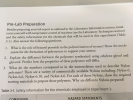 Pre-Lab Preparation es preparing your lab report as outlined in the Laboratory Information section, famil- iarize yourself with temperature control of reactions (see the Laboratory Techni and the safety 3-1). Also answer the following questions: information for the chemicals that will be used in this experiment (Table hat is the role of benzoyl peroxide in the polymerization of styrene? Show the mech- anism for the formation of polystyrene to support your answer Explain the difference between the polyesters synthesized using...
how to do the percent yield in organic chemistry lab and how do you find the...
how to do the percent yield in organic chemistry lab and how do you find the theoretical yield? Also how to do the percent recovery?
combinatorial chemistry; ester synthesis Fundamentals of Organic Chemistry Lab Post-Lab Questions 1. If you were doing...
 combinatorial chemistry; ester synthesis
Fundamentals of Organic Chemistry Lab Post-Lab Questions 1. If you were doing these experiments on a larger scale, describe two ways that you could improve the yield of the target ester What is the point of adding sulfuric acid to the reaction? How about the heat? 2. Pick your favorite of the esters you made, and write the mechanism for its formation. 3.
combinatorial chemistry; ester synthesis
Fundamentals of Organic Chemistry Lab Post-Lab Questions 1. If you were doing these experiments on a larger scale, describe two ways that you could improve the yield of the target ester What is the point of adding sulfuric acid to the reaction? How about the heat? 2. Pick your favorite of the esters you made, and write the mechanism for its formation. 3.
Discuss the polycondensation reaction. Why would water interfere with it? In case experiment failed-explanation is expected....
Discuss the polycondensation reaction. Why would water interfere with it? In case experiment failed-explanation is expected. Why it failed? What could be improved. Explain molecular structure vs signal relationship . In your discussion consider the following concepts: polycondensation, functional groups, fibril formation and stabilization (interchain molecular itneractions) , reaction yield and the role of NaOH solution used in the reaction Can you answer these questions based on the Synthesis of Nylon-6,6 using adipoyl chloride and 1,6-hexanediamine
 chemistry
1. Your boss asks you to prepare and then standardize a sodium hydroxide solution, which you do as you did in this lab. The average concentration is 0.1063M. He then hands you a solution of nitric acid and asks you to titrate it with your NaOH solution. It requires 27.33mL of your tandardized NaOH solution to titrate 24.79mL of the nitric acid solution. Write a chemical quation for the neutralization reaction and then calculate the molarity of the nitric...
chemistry
1. Your boss asks you to prepare and then standardize a sodium hydroxide solution, which you do as you did in this lab. The average concentration is 0.1063M. He then hands you a solution of nitric acid and asks you to titrate it with your NaOH solution. It requires 27.33mL of your tandardized NaOH solution to titrate 24.79mL of the nitric acid solution. Write a chemical quation for the neutralization reaction and then calculate the molarity of the nitric...
 organic chemistry lab
ISOLATION OF NATURAL PRODUCTS: EUGENOL ( organic chemistry lab
)
Questions Explain why the distillate from the distillation was turbid. (0.5 marks) Why anhydrous magnesium sulphate was used in this experiment? (0.5 marks) Discuss two other methods (other than distillation and solvent extraction] that could be used of extraction of essential oils. (0.5 marks) Do not answer briefly, make sure you provide enough details to score the full mark Questions Explain why the distillate from the distillation...
organic chemistry lab
ISOLATION OF NATURAL PRODUCTS: EUGENOL ( organic chemistry lab
)
Questions Explain why the distillate from the distillation was turbid. (0.5 marks) Why anhydrous magnesium sulphate was used in this experiment? (0.5 marks) Discuss two other methods (other than distillation and solvent extraction] that could be used of extraction of essential oils. (0.5 marks) Do not answer briefly, make sure you provide enough details to score the full mark Questions Explain why the distillate from the distillation...
 Pre-Lab Preparation es preparing your lab report as outlined in the Laboratory Information section, famil- iarize yourself with temperature control of reactions (see the Laboratory Techni and the safety 3-1). Also answer the following questions: information for the chemicals that will be used in this experiment (Table hat is the role of benzoyl peroxide in the polymerization of styrene? Show the mech- anism for the formation of polystyrene to support your answer Explain the difference between the polyesters synthesized using...
 combinatorial chemistry; ester synthesis
Fundamentals of Organic Chemistry Lab Post-Lab Questions 1. If you were doing these experiments on a larger scale, describe two ways that you could improve the yield of the target ester What is the point of adding sulfuric acid to the reaction? How about the heat? 2. Pick your favorite of the esters you made, and write the mechanism for its formation. 3.
combinatorial chemistry; ester synthesis
Fundamentals of Organic Chemistry Lab Post-Lab Questions 1. If you were doing these experiments on a larger scale, describe two ways that you could improve the yield of the target ester What is the point of adding sulfuric acid to the reaction? How about the heat? 2. Pick your favorite of the esters you made, and write the mechanism for its formation. 3.
Most questions answered within 3 hours.
-
Where is the error in this code sequence?
String s1 = "Hello";
String s2 = "ello";...
asked 11 months ago -
Financial data for Joel de Paris, Inc., for last year
follow:
Joel de Paris, Inc.
Balance...
asked 11 months ago -
Consider this reaction:
Al2(SO4)3 (aq)+ BaCl3
(aq) Al2Cl6 (aq)- +
3BaSO4(s) . What is the...
asked 11 months ago -
Suppose that Savneet is considering increasing her
recent random sample from 20 car rentals to 40...
asked 11 months ago -
Trucks arrive at an unloading terminal at an average rate of 120
per hour.
Trucks arrive...
asked 11 months ago -
Why are methanol and ethanol completely soluble in water while
octanol is not very little soluble....
asked 11 months ago -
A facilities manager at a university reads in a research report
that the mean amount of...
asked 11 months ago -
When the CuSO4 is rehydrated by adding water to the anhydrous
compound, is this an endothermic...
asked 11 months ago -
A ray of sunlight is passing from diamond into crown glass; the
angle of incidence is...
asked 11 months ago -
A block of mass 0.249 kg is placed on top of a light, vertical
spring of...
asked 11 months ago -
how do the kidneys compensate in the presences of acidosis
a) trigger hyperventilate
b) reserve acid...
asked 11 months ago -
Question 501 pts
The rental rate of capital to the firm increases. Which of the
following...
asked 11 months ago