
Homework Answers

Add Answer to:
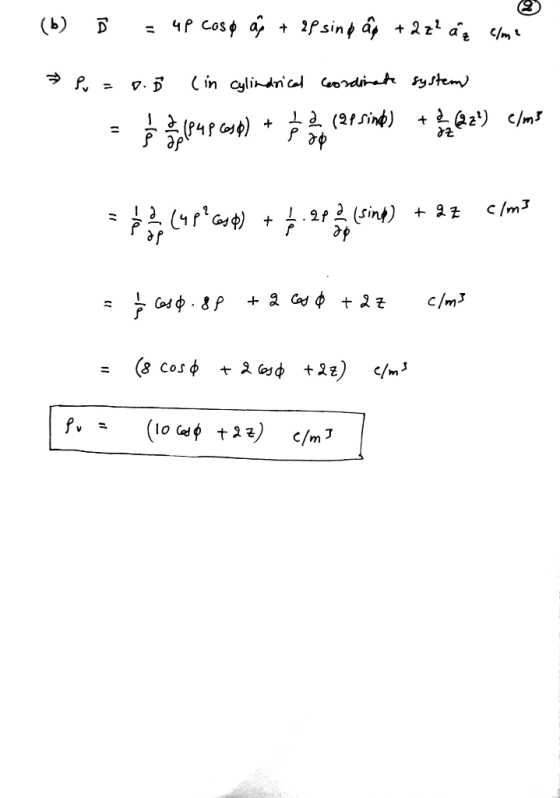
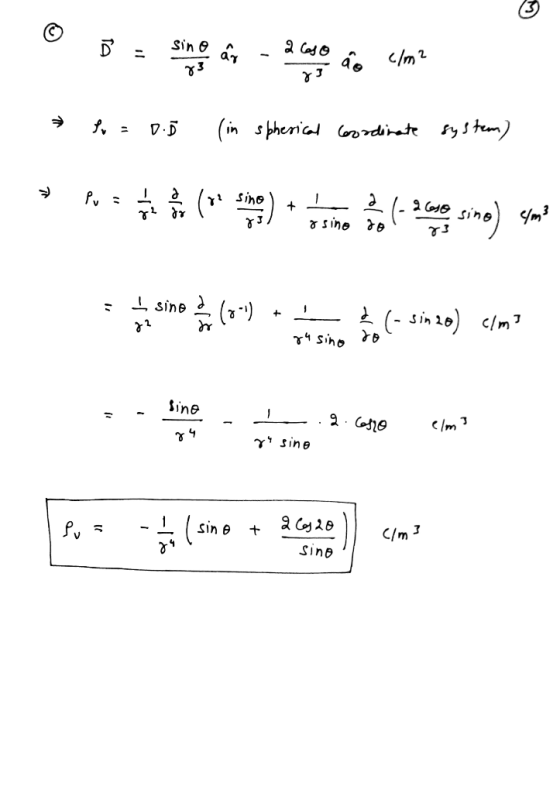
Determine the charge density due to each of the following electric flux densities: TI.
The electric flux density produced inside a parallel plate capacitor with a 3 cm diameter and...
 The electric flux density produced inside a parallel plate capacitor with a 3 cm diameter and plate separation of 60mm is)--4.5 cos(20π×103t) az c. Use Ampere's Law in point form to determine the following a. The curl of the magnetic field intensity due to displacement current produced in the capacitor. Plot the magnitude of the curl of the magnetic field intensity versus the magnitude of the electric flux density produced b. in the capacitor for S ts 10 msec.
determine the electric flux passing through a spherical shell surrounding a 5nC charge
determine the electric flux passing through a spherical shell surrounding a 5nC charge
State Gauss law? Explain how to find electric flux (D) due to a point charge inside...
 State Gauss law? Explain how to find electric flux (D) due to a point charge inside spherical and non-spherical surfaces separately with necessary figures? 4. Problem-4: What is the electric flux (D)produced through a disk of radius 100 cm which is oriented at 20° to the uniform electric field (E) of 1.0 x 10⁴ N/Coul.
P7. Two large sheets of charge have equal but opposite surface charge densities. (a) Determine the...
 P7. Two large sheets of charge have equal but opposite surface charge densities. (a) Determine the electric field between these sheets. (b) Determine the electric field outside of these sheets
The spherical surface r = 1 m, 2 m and 3 m carry surface charge densities...
 The spherical surface r = 1 m, 2 m and 3 m carry surface charge densities of 20, -9 and 17. 2 nC/m2 respectively Calculate the electric flux leaving through the surface r 5 m а. Find electric flux density at P (1, -1, 2) b. Four charges are located at the vertices of a rectangular plane shown in Fig. Find the magnitude and direction of resultant force on Qı. The width of the plane is 5 cm and the...
Find the potential due to the electric charge volume density , where are constants, filling the...
Find the potential due to the electric charge volume density , where are constants, filling the whole space.
Find the electric field due to a circular ring with charge density A and radius R...
 Find the electric field due to a circular ring with charge density A and radius R Find the field here
Determine whether each statement below about flux is true or false. O The electric flux is...
 Determine whether each statement below about flux is true or false. O The electric flux is calculated as a dot product. The total electric flux for three point charges with +2Q, +3Q, and -6Q has a negative value. O The total electric flux through a closed surface depends on charges outside the surface. Tries 0/2 Submit Answer
Part A Constants What is the electric flux through the cylinder due to this infinite line...
 Part A Constants What is the electric flux through the cylinder due to this infinite line of charge? It was shown in Example 21.11 (Section 21.5) in the textbook that the electric field due to an infinite line of charge is perpendicular to the line and has magnitude E-N2τε07. Consider an Imaginary cylinder with a radlus of r 0.245 and a length of 0.465 m that has an infinite line of positive charge running along its axis. The charge per...
Problem A.1 - Calculate electric flux f5) The electric field due to an infinite line of...
 Problem A.1 - Calculate electric flux f5) The electric field due to an infinite line of charge is perpendicular to the line and has magnitude E . Consider an imaginary cylinder with radius e-25 cm and length L = 40 cm that has an infinite line of positive charge running along its axis. The charge per unit length is 3 HC/m. Do not use Gauss's Law, but actually calculate the flux! a) What is the electric flux through the cylinder...
 The electric flux density produced inside a parallel plate capacitor with a 3 cm diameter and plate separation of 60mm is)--4.5 cos(20π×103t) az c. Use Ampere's Law in point form to determine the following a. The curl of the magnetic field intensity due to displacement current produced in the capacitor. Plot the magnitude of the curl of the magnetic field intensity versus the magnitude of the electric flux density produced b. in the capacitor for S ts 10 msec.
 State Gauss law? Explain how to find electric flux (D) due to a point charge inside spherical and non-spherical surfaces separately with necessary figures? 4. Problem-4: What is the electric flux (D)produced through a disk of radius 100 cm which is oriented at 20° to the uniform electric field (E) of 1.0 x 10⁴ N/Coul.
 P7. Two large sheets of charge have equal but opposite surface charge densities. (a) Determine the electric field between these sheets. (b) Determine the electric field outside of these sheets
 The spherical surface r = 1 m, 2 m and 3 m carry surface charge densities of 20, -9 and 17. 2 nC/m2 respectively Calculate the electric flux leaving through the surface r 5 m а. Find electric flux density at P (1, -1, 2) b. Four charges are located at the vertices of a rectangular plane shown in Fig. Find the magnitude and direction of resultant force on Qı. The width of the plane is 5 cm and the...
 Find the electric field due to a circular ring with charge density A and radius R Find the field here
 Determine whether each statement below about flux is true or false. O The electric flux is calculated as a dot product. The total electric flux for three point charges with +2Q, +3Q, and -6Q has a negative value. O The total electric flux through a closed surface depends on charges outside the surface. Tries 0/2 Submit Answer
 Part A Constants What is the electric flux through the cylinder due to this infinite line of charge? It was shown in Example 21.11 (Section 21.5) in the textbook that the electric field due to an infinite line of charge is perpendicular to the line and has magnitude E-N2τε07. Consider an Imaginary cylinder with a radlus of r 0.245 and a length of 0.465 m that has an infinite line of positive charge running along its axis. The charge per...
 Problem A.1 - Calculate electric flux f5) The electric field due to an infinite line of charge is perpendicular to the line and has magnitude E . Consider an imaginary cylinder with radius e-25 cm and length L = 40 cm that has an infinite line of positive charge running along its axis. The charge per unit length is 3 HC/m. Do not use Gauss's Law, but actually calculate the flux! a) What is the electric flux through the cylinder...
Most questions answered within 3 hours.
-
Where is the error in this code sequence?
String s1 = "Hello";
String s2 = "ello";...
asked 10 months ago -
Financial data for Joel de Paris, Inc., for last year
follow:
Joel de Paris, Inc.
Balance...
asked 10 months ago -
Consider this reaction:
Al2(SO4)3 (aq)+ BaCl3
(aq) Al2Cl6 (aq)- +
3BaSO4(s) . What is the...
asked 10 months ago -
Suppose that Savneet is considering increasing her
recent random sample from 20 car rentals to 40...
asked 10 months ago -
Trucks arrive at an unloading terminal at an average rate of 120
per hour.
Trucks arrive...
asked 10 months ago -
Why are methanol and ethanol completely soluble in water while
octanol is not very little soluble....
asked 10 months ago -
A facilities manager at a university reads in a research report
that the mean amount of...
asked 10 months ago -
When the CuSO4 is rehydrated by adding water to the anhydrous
compound, is this an endothermic...
asked 10 months ago -
A ray of sunlight is passing from diamond into crown glass; the
angle of incidence is...
asked 10 months ago -
A block of mass 0.249 kg is placed on top of a light, vertical
spring of...
asked 10 months ago -
how do the kidneys compensate in the presences of acidosis
a) trigger hyperventilate
b) reserve acid...
asked 10 months ago -
Question 501 pts
The rental rate of capital to the firm increases. Which of the
following...
asked 10 months ago