
Homework Answers

Add Answer to:
A particle in an infinite square well has the initial wave function: (x,0)- A sin(x/a) (0...
1. A particle in an infinite square well has an initial wave function Alsin sin 4 0 < x < L other...
 help on all a), b), and c) please!!
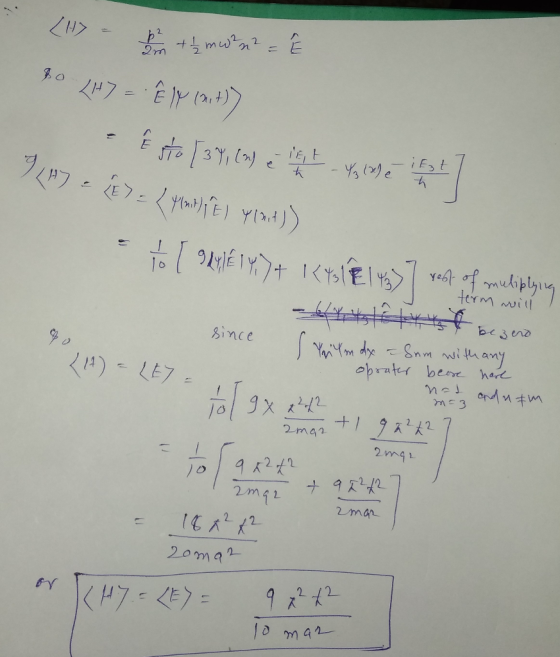
1. A particle in an infinite square well has an initial wave function Alsin sin 4 0 < x < L otherwise s(x, t = 0) 0 (a) Find A so that the wavefunction is normalized. (b) Find '(z,t). (c) Find the expectation value(E) of the energy of ψ(x,t = 0). You may use the result mx n 2 0
1. A particle in an infinite square well has an initial wave...
help on all a), b), and c) please!!
1. A particle in an infinite square well has an initial wave function Alsin sin 4 0 < x < L otherwise s(x, t = 0) 0 (a) Find A so that the wavefunction is normalized. (b) Find '(z,t). (c) Find the expectation value(E) of the energy of ψ(x,t = 0). You may use the result mx n 2 0
1. A particle in an infinite square well has an initial wave...
A particle in the infinite square well has as its initial wave function an even mixture...
 A particle in the infinite square well has as its initial wave function an even mixture of the first two stationary states: psi(x, 0) = A[psi_1 (x) + psi_2(x)]. Normalize psi(x, 0) (that is, find A). Find psi (x) and |psi (x, )|^2. Express the latter as a sinusoidal function of time. To simplify the result, let omega = pi^2 h/2ma^2. Compute < x >? Compute < p >? If you measured the energy of this particle, what values might...
2. A particle of mass m in the infinite square well of width a (located at...
 2. A particle of mass m in the infinite square well of width a (located at 0 SSa) has as its initial wave function a mixture of two stationary states: v(x,0)Avi(x) +2s (x). (a) Find the probability density of finding the particle at the center of the well, as a function of time. (b) Find the average momentum of the particle at time t.
4) A particle in an infinite square well 0 for 0
 4) A particle in an infinite square well 0 for 0
5) A particle of mass m is in the ground state of the infinite square well...
 5) A particle of mass m is in the ground state of the infinite square well 0 < x < a At t-0 the right hand wall suddenly moves to x = 2a, doubling the size of the well. Assume that this expansion happens on a time scale so fast that the initial wave function (at t0+) is the same as just before the expansion (at t-0-) (This is called the "sudden" approximation.) a) What is the probability that a...
please explain all, thanks! 4. (60 pts) A particle in an infinite square well of width...
 please explain all, thanks!
4. (60 pts) A particle in an infinite square well of width L has an initial wave function (x,t = 0) = Ax(L - x)2, OSX SL a) Find y(x, t) fort > 0. You first have to normalize the wave function. Hint: this is best expressed an infinite series: show that the wave function coefficients are on = * 31% (12 – n?)(1-(-1)") → (n = 87315 (12 - nºre?); n odd. b) Which energy...
please explain all, thanks!
4. (60 pts) A particle in an infinite square well of width L has an initial wave function (x,t = 0) = Ax(L - x)2, OSX SL a) Find y(x, t) fort > 0. You first have to normalize the wave function. Hint: this is best expressed an infinite series: show that the wave function coefficients are on = * 31% (12 – n?)(1-(-1)") → (n = 87315 (12 - nºre?); n odd. b) Which energy...
2. A particle of mass m in the infinite square well of width a at time...
 2. A particle of mass m in the infinite square well of width a at time 1 - 0 has wave function that is an equal weight mixture of the two lowest n= 1,2 energy stationary states: (x,0) - C[4,(x)+42(x)] (a) Normalize the wave function. Hints: 1. Exploit the orthonormality of W, 2. Recall that if a wave function is normalized at t = 0, it stays normalized. (b) Find '(x, t) and (x,1)1at a later time 1>0. Express Y*...
3. For a particle moving in an infinite, one-dimensional, symmetric square well of width 2a, show...
 3. For a particle moving in an infinite, one-dimensional, symmetric square well of width 2a, show that the (normalized) wave functions are of the form ?-kx).va. cos?x): "-1. 3.5 ,.. COS ? -?? r")(x)=?sin n-r | ; n-2, 4, 6 Express the state ?(x)=N sin,(rx/a) as a linear superposition eigenstates, and find its normalization constant N. of the above HINT sin39-3sin ?-4sin'?
please show work 1. (5 points) The wave function for a particle in an infinite square...
 please show work
1. (5 points) The wave function for a particle in an infinite square well (0<xca) at t-o is given by: (x,0)-Finm). Which one of the following is the wave function at time t? (Clearly circle your choice.) 2 . 3x 2 . 3m (a) (x.1)-Vasin( )cos(Ey/A) 2 . 3tx sies-E/n) (c) Both (a) and (b) above are correct. (d) None of the above.
please show work
1. (5 points) The wave function for a particle in an infinite square well (0<xca) at t-o is given by: (x,0)-Finm). Which one of the following is the wave function at time t? (Clearly circle your choice.) 2 . 3x 2 . 3m (a) (x.1)-Vasin( )cos(Ey/A) 2 . 3tx sies-E/n) (c) Both (a) and (b) above are correct. (d) None of the above.
a) Set up the Schrodinger equation for a particle in an infinite square well where: V...
a) Set up the Schrodinger equation for a particle in an infinite square well where: V = 0 -a<x<a V= otherwise b) Solve the equation to find E and the wave function
 help on all a), b), and c) please!!
1. A particle in an infinite square well has an initial wave function Alsin sin 4 0 < x < L otherwise s(x, t = 0) 0 (a) Find A so that the wavefunction is normalized. (b) Find '(z,t). (c) Find the expectation value(E) of the energy of ψ(x,t = 0). You may use the result mx n 2 0
1. A particle in an infinite square well has an initial wave...
help on all a), b), and c) please!!
1. A particle in an infinite square well has an initial wave function Alsin sin 4 0 < x < L otherwise s(x, t = 0) 0 (a) Find A so that the wavefunction is normalized. (b) Find '(z,t). (c) Find the expectation value(E) of the energy of ψ(x,t = 0). You may use the result mx n 2 0
1. A particle in an infinite square well has an initial wave...
 A particle in the infinite square well has as its initial wave function an even mixture of the first two stationary states: psi(x, 0) = A[psi_1 (x) + psi_2(x)]. Normalize psi(x, 0) (that is, find A). Find psi (x) and |psi (x, )|^2. Express the latter as a sinusoidal function of time. To simplify the result, let omega = pi^2 h/2ma^2. Compute < x >? Compute < p >? If you measured the energy of this particle, what values might...
 2. A particle of mass m in the infinite square well of width a (located at 0 SSa) has as its initial wave function a mixture of two stationary states: v(x,0)Avi(x) +2s (x). (a) Find the probability density of finding the particle at the center of the well, as a function of time. (b) Find the average momentum of the particle at time t.
 4) A particle in an infinite square well 0 for 0
 5) A particle of mass m is in the ground state of the infinite square well 0 < x < a At t-0 the right hand wall suddenly moves to x = 2a, doubling the size of the well. Assume that this expansion happens on a time scale so fast that the initial wave function (at t0+) is the same as just before the expansion (at t-0-) (This is called the "sudden" approximation.) a) What is the probability that a...
 please explain all, thanks!
4. (60 pts) A particle in an infinite square well of width L has an initial wave function (x,t = 0) = Ax(L - x)2, OSX SL a) Find y(x, t) fort > 0. You first have to normalize the wave function. Hint: this is best expressed an infinite series: show that the wave function coefficients are on = * 31% (12 – n?)(1-(-1)") → (n = 87315 (12 - nºre?); n odd. b) Which energy...
please explain all, thanks!
4. (60 pts) A particle in an infinite square well of width L has an initial wave function (x,t = 0) = Ax(L - x)2, OSX SL a) Find y(x, t) fort > 0. You first have to normalize the wave function. Hint: this is best expressed an infinite series: show that the wave function coefficients are on = * 31% (12 – n?)(1-(-1)") → (n = 87315 (12 - nºre?); n odd. b) Which energy...
 2. A particle of mass m in the infinite square well of width a at time 1 - 0 has wave function that is an equal weight mixture of the two lowest n= 1,2 energy stationary states: (x,0) - C[4,(x)+42(x)] (a) Normalize the wave function. Hints: 1. Exploit the orthonormality of W, 2. Recall that if a wave function is normalized at t = 0, it stays normalized. (b) Find '(x, t) and (x,1)1at a later time 1>0. Express Y*...
 3. For a particle moving in an infinite, one-dimensional, symmetric square well of width 2a, show that the (normalized) wave functions are of the form ?-kx).va. cos?x): "-1. 3.5 ,.. COS ? -?? r")(x)=?sin n-r | ; n-2, 4, 6 Express the state ?(x)=N sin,(rx/a) as a linear superposition eigenstates, and find its normalization constant N. of the above HINT sin39-3sin ?-4sin'?
 please show work
1. (5 points) The wave function for a particle in an infinite square well (0<xca) at t-o is given by: (x,0)-Finm). Which one of the following is the wave function at time t? (Clearly circle your choice.) 2 . 3x 2 . 3m (a) (x.1)-Vasin( )cos(Ey/A) 2 . 3tx sies-E/n) (c) Both (a) and (b) above are correct. (d) None of the above.
please show work
1. (5 points) The wave function for a particle in an infinite square well (0<xca) at t-o is given by: (x,0)-Finm). Which one of the following is the wave function at time t? (Clearly circle your choice.) 2 . 3x 2 . 3m (a) (x.1)-Vasin( )cos(Ey/A) 2 . 3tx sies-E/n) (c) Both (a) and (b) above are correct. (d) None of the above.
Most questions answered within 3 hours.
-
Where is the error in this code sequence?
String s1 = "Hello";
String s2 = "ello";...
asked 10 months ago -
Financial data for Joel de Paris, Inc., for last year
follow:
Joel de Paris, Inc.
Balance...
asked 10 months ago -
Consider this reaction:
Al2(SO4)3 (aq)+ BaCl3
(aq) Al2Cl6 (aq)- +
3BaSO4(s) . What is the...
asked 10 months ago -
Suppose that Savneet is considering increasing her
recent random sample from 20 car rentals to 40...
asked 10 months ago -
Trucks arrive at an unloading terminal at an average rate of 120
per hour.
Trucks arrive...
asked 10 months ago -
Why are methanol and ethanol completely soluble in water while
octanol is not very little soluble....
asked 10 months ago -
A facilities manager at a university reads in a research report
that the mean amount of...
asked 10 months ago -
When the CuSO4 is rehydrated by adding water to the anhydrous
compound, is this an endothermic...
asked 10 months ago -
A ray of sunlight is passing from diamond into crown glass; the
angle of incidence is...
asked 10 months ago -
A block of mass 0.249 kg is placed on top of a light, vertical
spring of...
asked 10 months ago -
how do the kidneys compensate in the presences of acidosis
a) trigger hyperventilate
b) reserve acid...
asked 10 months ago -
Question 501 pts
The rental rate of capital to the firm increases. Which of the
following...
asked 10 months ago