Homework Answers
Request Answer!
We need at least 10 more requests to produce the answer.
0 / 10 have requested this problem solution
The more requests, the faster the answer.
Consider the following multi-step synthesis to generate an amine: Consider the following multi-step synthesis to generate...
 Consider the following multi-step synthesis to generate an
amine:
Consider the following multi-step synthesis to generate an amine: Add in the missing curved arrows and complete the mechanism to the key isocyanate intermediate.
Consider the following multi-step synthesis to generate an
amine:
Consider the following multi-step synthesis to generate an amine: Add in the missing curved arrows and complete the mechanism to the key isocyanate intermediate.
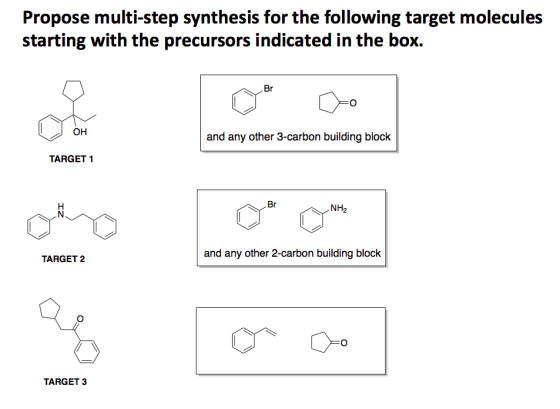
What is the multi-step synthesis for this problem?
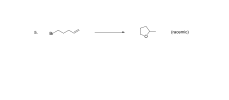 - can be done in 2 steps- please show the all the reagents used
3) For the following multi-step synthesis. Provide the reagents needed for each step of the sequence...
 3) For the following multi-step synthesis. Provide the reagents needed for each step of the sequence and then write a paragraph that explains what has occurred overall synthetically and why this elaborate strategy is needed. HC 5- 0 HAC NMgBr
Provide the steps to successfully complete this multi-step synthesis: 3-gu
 Provide the steps to successfully complete this multi-step synthesis: 3-gu
Provide a multi-step synthesis of the compound on the right. The restriction is that all carbon...
 Provide a multi-step synthesis of the compound on the right. The restriction is that all carbon atoms in this target must originate from molecules of ethanol. All other reagents may be used.
Organic Chemistry: Question 12 One problem with a synthesis that takes several steps (a multi-step synthesis...
 Organic Chemistry:
Question 12 One problem with a synthesis that takes several steps (a multi-step synthesis in the jargon) is that it produces a low overall yield. Imagine each step has a yield of 90%. A 1-step process would have a 90% yield, a 2-step process would yield 0.90 x 0.90 = 81%. What would be the yield of a 6-step process? Show the math.
Organic Chemistry:
Question 12 One problem with a synthesis that takes several steps (a multi-step synthesis in the jargon) is that it produces a low overall yield. Imagine each step has a yield of 90%. A 1-step process would have a 90% yield, a 2-step process would yield 0.90 x 0.90 = 81%. What would be the yield of a 6-step process? Show the math.
The experiment was a multi-step synthesis of p-bromoaniline . Aniline was protected with acetic anhydride ....
 The experiment was a multi-step synthesis of
p-bromoaniline . Aniline was protected with acetic anhydride .
Please help answer the 4 questions posted in
the first picture .
help of your TA. Questions to be discussed in the discussion section (please see your rubrics next page) 1. Explain why we did not synthesize the target molecule p-bromoaniline by direct bromination of aniline. (1 pt) 2. Explain why we did not synthesize acetanilide by refluxing a mixture of aniline and acetic...
The experiment was a multi-step synthesis of
p-bromoaniline . Aniline was protected with acetic anhydride .
Please help answer the 4 questions posted in
the first picture .
help of your TA. Questions to be discussed in the discussion section (please see your rubrics next page) 1. Explain why we did not synthesize the target molecule p-bromoaniline by direct bromination of aniline. (1 pt) 2. Explain why we did not synthesize acetanilide by refluxing a mixture of aniline and acetic...
Provide reagents to complete this multi step synthesis. ? OH 12pt Paragraph * * * Show...
 Provide reagents to complete this multi step synthesis. ? OH 12pt Paragraph * * *
The use of Grignard reagents in multi-step synthesis is widely employed. For each of the reaction...
 The use of Grignard reagents in
multi-step synthesis is widely employed. For each of the reaction
sequences below, draw the major organic product that would be
present after each reaction of the sequence. No mechanisms, no
explanations, just draw the products (in total, 14 reaction
products A to N are required). You may have to consult your lecture
material and/or the textbook to solve some of these problems
The use of Grignard reagents in multi-step synthesis is widely employed. For...
The use of Grignard reagents in
multi-step synthesis is widely employed. For each of the reaction
sequences below, draw the major organic product that would be
present after each reaction of the sequence. No mechanisms, no
explanations, just draw the products (in total, 14 reaction
products A to N are required). You may have to consult your lecture
material and/or the textbook to solve some of these problems
The use of Grignard reagents in multi-step synthesis is widely employed. For...
A chemist is undertaking a multi-step synthesis of a dye molecule. An intermediate compound contains a...
A chemist is undertaking a multi-step synthesis of a dye molecule. An intermediate compound contains a chloride functional group singly bonded to the aromatic carbon core of the molecule. The IR spectrum of this intermediate shows a strong absorption due to a stretching vibrational mode involving the =C–Cl bond at 726 cm-1. What property of the =C–Cl bond is mostly responsible for the stretching mode of the bond showing the strong signal in the mid-IR at 726 cm-1? Calculate the...
 Consider the following multi-step synthesis to generate an
amine:
Consider the following multi-step synthesis to generate an amine: Add in the missing curved arrows and complete the mechanism to the key isocyanate intermediate.
Consider the following multi-step synthesis to generate an
amine:
Consider the following multi-step synthesis to generate an amine: Add in the missing curved arrows and complete the mechanism to the key isocyanate intermediate.
 3) For the following multi-step synthesis. Provide the reagents needed for each step of the sequence and then write a paragraph that explains what has occurred overall synthetically and why this elaborate strategy is needed. HC 5- 0 HAC NMgBr
 Provide the steps to successfully complete this multi-step synthesis: 3-gu
 Provide a multi-step synthesis of the compound on the right. The restriction is that all carbon atoms in this target must originate from molecules of ethanol. All other reagents may be used.
 Organic Chemistry:
Question 12 One problem with a synthesis that takes several steps (a multi-step synthesis in the jargon) is that it produces a low overall yield. Imagine each step has a yield of 90%. A 1-step process would have a 90% yield, a 2-step process would yield 0.90 x 0.90 = 81%. What would be the yield of a 6-step process? Show the math.
Organic Chemistry:
Question 12 One problem with a synthesis that takes several steps (a multi-step synthesis in the jargon) is that it produces a low overall yield. Imagine each step has a yield of 90%. A 1-step process would have a 90% yield, a 2-step process would yield 0.90 x 0.90 = 81%. What would be the yield of a 6-step process? Show the math.
 The experiment was a multi-step synthesis of
p-bromoaniline . Aniline was protected with acetic anhydride .
Please help answer the 4 questions posted in
the first picture .
help of your TA. Questions to be discussed in the discussion section (please see your rubrics next page) 1. Explain why we did not synthesize the target molecule p-bromoaniline by direct bromination of aniline. (1 pt) 2. Explain why we did not synthesize acetanilide by refluxing a mixture of aniline and acetic...
The experiment was a multi-step synthesis of
p-bromoaniline . Aniline was protected with acetic anhydride .
Please help answer the 4 questions posted in
the first picture .
help of your TA. Questions to be discussed in the discussion section (please see your rubrics next page) 1. Explain why we did not synthesize the target molecule p-bromoaniline by direct bromination of aniline. (1 pt) 2. Explain why we did not synthesize acetanilide by refluxing a mixture of aniline and acetic...
 Provide reagents to complete this multi step synthesis. ? OH 12pt Paragraph * * *
 The use of Grignard reagents in
multi-step synthesis is widely employed. For each of the reaction
sequences below, draw the major organic product that would be
present after each reaction of the sequence. No mechanisms, no
explanations, just draw the products (in total, 14 reaction
products A to N are required). You may have to consult your lecture
material and/or the textbook to solve some of these problems
The use of Grignard reagents in multi-step synthesis is widely employed. For...
The use of Grignard reagents in
multi-step synthesis is widely employed. For each of the reaction
sequences below, draw the major organic product that would be
present after each reaction of the sequence. No mechanisms, no
explanations, just draw the products (in total, 14 reaction
products A to N are required). You may have to consult your lecture
material and/or the textbook to solve some of these problems
The use of Grignard reagents in multi-step synthesis is widely employed. For...
Most questions answered within 3 hours.
-
Where is the error in this code sequence?
String s1 = "Hello";
String s2 = "ello";...
asked 11 months ago -
Financial data for Joel de Paris, Inc., for last year
follow:
Joel de Paris, Inc.
Balance...
asked 11 months ago -
Consider this reaction:
Al2(SO4)3 (aq)+ BaCl3
(aq) Al2Cl6 (aq)- +
3BaSO4(s) . What is the...
asked 11 months ago -
Suppose that Savneet is considering increasing her
recent random sample from 20 car rentals to 40...
asked 11 months ago -
Trucks arrive at an unloading terminal at an average rate of 120
per hour.
Trucks arrive...
asked 11 months ago -
Why are methanol and ethanol completely soluble in water while
octanol is not very little soluble....
asked 11 months ago -
A facilities manager at a university reads in a research report
that the mean amount of...
asked 11 months ago -
When the CuSO4 is rehydrated by adding water to the anhydrous
compound, is this an endothermic...
asked 11 months ago -
A ray of sunlight is passing from diamond into crown glass; the
angle of incidence is...
asked 11 months ago -
A block of mass 0.249 kg is placed on top of a light, vertical
spring of...
asked 11 months ago -
how do the kidneys compensate in the presences of acidosis
a) trigger hyperventilate
b) reserve acid...
asked 11 months ago -
Question 501 pts
The rental rate of capital to the firm increases. Which of the
following...
asked 11 months ago