![An induction motor draws 1.0 kW at 0.8 lagging power factor from a 250 V, 60 Hz source. [38] (a) What value of capacitance mu](http://img.homeworklib.com/questions/446ea380-9674-11eb-9961-71e1911ed6c8.png?x-oss-process=image/resize,w_560)
Homework Answers
Add Answer to:
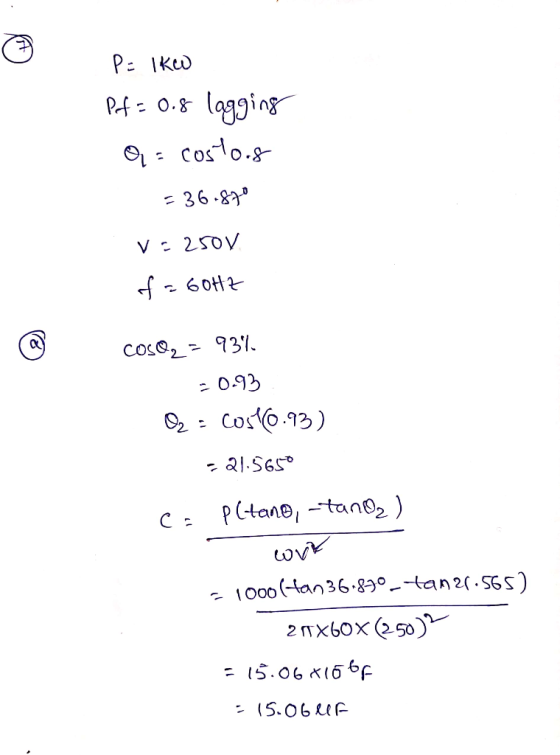
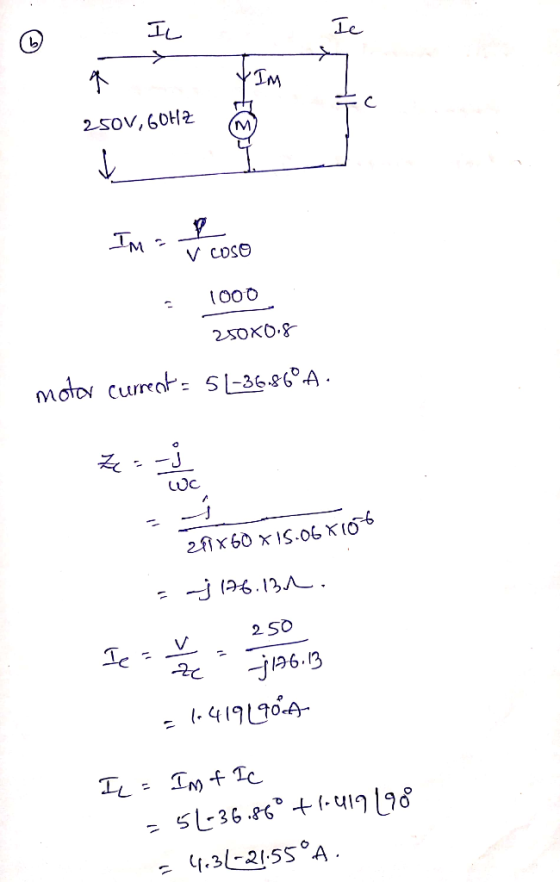
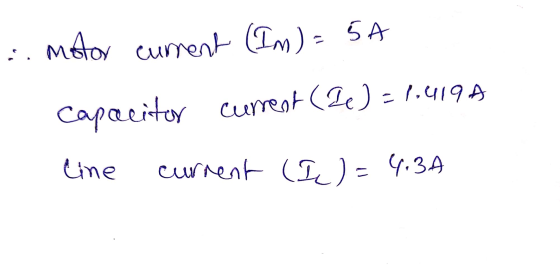
An induction motor draws 1.0 kW at 0.8 lagging power factor from a 250 V, 60...
A 50 kW load operates from a 60 Hz and 10kV line with a power factor...
 A 50 kW load operates from a 60 Hz and 10kV line with a power
factor of 0.6 lagging. Compute the capacitance that must be placed
in parallel with the load to achieve 0.9 lagging power factor.
In-Class #10 Problem A 50 kW load operates from a 60 Hz and 10 kV line with a power factor of 0.6 lagging. Compute the capacitance that must be placed in parallel with the load to achieve 0.9 lagging power factor.
A 50 kW load operates from a 60 Hz and 10kV line with a power
factor of 0.6 lagging. Compute the capacitance that must be placed
in parallel with the load to achieve 0.9 lagging power factor.
In-Class #10 Problem A 50 kW load operates from a 60 Hz and 10 kV line with a power factor of 0.6 lagging. Compute the capacitance that must be placed in parallel with the load to achieve 0.9 lagging power factor.
A 220 kW load having 0.8 lagging power factor is supplied from a 600 V (line...
 A 220 kW load having 0.8 lagging power factor is supplied from a 600 V (line to line) three-phase supply. A bank of power factor capacitors is delta connected. (a) Draw neat schematic diagram showing the connection of the capacitor bank in Delta connection. (b) Determine the KVAR rating of each individual capacitor needed to bring power factor to 0.9. (c) Determine the capacitance of each capacitor in uF.
Problem #1: A 25 KW motor with lagging power factor of 0.75 in a manufacturing plant...
 Problem #1: A 25 KW motor with lagging power factor of 0.75 in a manufacturing plant is running from a 240V, 60 Hz. power line. The utility company is going to impose penalty on their utility bill unless they improve their power factor to 0.9 (lagging). Determine: a) The current reactive power(Q) and the improved Q of the motor b) The size of the capacitor needed for the correction of the power factor.
QUESTION 3 3.1 A single-phase 39 kW, 380 V, 50Hz induction motor operates on full load...
 QUESTION 3 3.1 A single-phase 39 kW, 380 V, 50Hz induction motor operates on full load with an efficiency of 89% and at a power factor of 0.809 lagging. Three identical parallel- connected capacitors are used to raise the power factor to 0.96. 3.1.1 Calculate the kVAr rating of the capacitor bank. (9) 3.1.2 Calculate the capacitance of each capacitor. (6) [15]
A single phase motor draws a current of 30 A from a 240 V, 60 Hz....
A single phase motor draws a current of 30 A from a 240 V, 60 Hz. line. Refer to Problem Description 7.2. A capacitor with a reactance of 31 Ω is then connected in parallel with the motor. A Wattmeter connected to the circuit gives a reading of 5.4 kW. How much reactive power does the capacitor deliver? How much net reactive power remains in the circuit? How much apparent power does the circuit now consume? What is the power...
A 220 kW load having 0.8 lagging power factor is supplied from a 600 V (line to line) three-phase...
A 220 kW load having 0.8 lagging power factor is supplied from a 600 V (line to line) three-phase supply. A bank of power factor capacitors is delta connected Q2. (a) Draw neat schematic diagram showing the connection of the capacitor bank in Delta connection. (b) Determine the kVAR rating of each individual capacitor needed to bring power factor to 0.9 (c) Determine the capacitance of each capacitor in μF.
3 phase, 37.3 Kw, 440 V, 50 Hz induction motor operates at full load with efficiency...
3 phase, 37.3 Kw, 440 V, 50 Hz induction motor operates at full load with efficiency 89% and power factor 0.85 lagging. Calculate: A) The total KVA rating of capacitor required to rise full load power factor to 0.95 lagging. B) What is capacitance per phase if capacitor: 1) Delta connected. 2) Star connected.
A single Phase load draws 10 kW from a 410 V line at a power factor...
A single Phase load draws 10 kW from a 410 V line at a power factor of 0.707 lagging. Determine: (a) The rms current (b) The reactive power required by the load (c) We want to correct the power factor to be 0.9 lagging by adding a capacitor, what will be the new reactive power? (d) draw the power triangle with the old and new reactive powers
A 4 phase, 460 V, 60 Hz, 26.8 hp, 4 pole, Y-connected induction motor draws 25...
 A 4 phase, 460 V, 60 Hz, 26.8 hp, 4 pole, Y-connected
induction motor draws 25 A at a power factor of 0.9 lagging. Core
loss is 900 W, stator copper loss is 1100W, friction and winding
losses are 300 W, and stray loss is neglected. The machine shaft
rotates at 1738 rpm. Calculate the air gap power and output load
torque
- [Induction Motor - 15 points) A three-phase, 460 V, 60 Hz, 26.8 hp, 4-pole, Y-connected induction motor...
A 4 phase, 460 V, 60 Hz, 26.8 hp, 4 pole, Y-connected
induction motor draws 25 A at a power factor of 0.9 lagging. Core
loss is 900 W, stator copper loss is 1100W, friction and winding
losses are 300 W, and stray loss is neglected. The machine shaft
rotates at 1738 rpm. Calculate the air gap power and output load
torque
- [Induction Motor - 15 points) A three-phase, 460 V, 60 Hz, 26.8 hp, 4-pole, Y-connected induction motor...
4.6. A 460-V, 75 kW, 4-pole, delta-connected, 60-Hz, three- phase induction motor has a full-load slip of 5 percent, an efficiency of 92 percent and a power-factor of 0.87 lagging at full-load. At st...
 4.6. A 460-V, 75 kW, 4-pole, delta-connected, 60-Hz, three- phase induction motor has a full-load slip of 5 percent, an efficiency of 92 percent and a power-factor of 0.87 lagging at full-load. At start-up, the motor develops 1.9 times the full load developed torque but draws 7.5 times the rated current at the rated voltage. This motor is to be started with an auto- transformer reduced-voltage starter. Assume the stator resistance and the stator core loss to be negligible. Calculate...
 A 50 kW load operates from a 60 Hz and 10kV line with a power
factor of 0.6 lagging. Compute the capacitance that must be placed
in parallel with the load to achieve 0.9 lagging power factor.
In-Class #10 Problem A 50 kW load operates from a 60 Hz and 10 kV line with a power factor of 0.6 lagging. Compute the capacitance that must be placed in parallel with the load to achieve 0.9 lagging power factor.
A 50 kW load operates from a 60 Hz and 10kV line with a power
factor of 0.6 lagging. Compute the capacitance that must be placed
in parallel with the load to achieve 0.9 lagging power factor.
In-Class #10 Problem A 50 kW load operates from a 60 Hz and 10 kV line with a power factor of 0.6 lagging. Compute the capacitance that must be placed in parallel with the load to achieve 0.9 lagging power factor.
 A 220 kW load having 0.8 lagging power factor is supplied from a 600 V (line to line) three-phase supply. A bank of power factor capacitors is delta connected. (a) Draw neat schematic diagram showing the connection of the capacitor bank in Delta connection. (b) Determine the KVAR rating of each individual capacitor needed to bring power factor to 0.9. (c) Determine the capacitance of each capacitor in uF.
 Problem #1: A 25 KW motor with lagging power factor of 0.75 in a manufacturing plant is running from a 240V, 60 Hz. power line. The utility company is going to impose penalty on their utility bill unless they improve their power factor to 0.9 (lagging). Determine: a) The current reactive power(Q) and the improved Q of the motor b) The size of the capacitor needed for the correction of the power factor.
 QUESTION 3 3.1 A single-phase 39 kW, 380 V, 50Hz induction motor operates on full load with an efficiency of 89% and at a power factor of 0.809 lagging. Three identical parallel- connected capacitors are used to raise the power factor to 0.96. 3.1.1 Calculate the kVAr rating of the capacitor bank. (9) 3.1.2 Calculate the capacitance of each capacitor. (6) [15]
 A 4 phase, 460 V, 60 Hz, 26.8 hp, 4 pole, Y-connected
induction motor draws 25 A at a power factor of 0.9 lagging. Core
loss is 900 W, stator copper loss is 1100W, friction and winding
losses are 300 W, and stray loss is neglected. The machine shaft
rotates at 1738 rpm. Calculate the air gap power and output load
torque
- [Induction Motor - 15 points) A three-phase, 460 V, 60 Hz, 26.8 hp, 4-pole, Y-connected induction motor...
A 4 phase, 460 V, 60 Hz, 26.8 hp, 4 pole, Y-connected
induction motor draws 25 A at a power factor of 0.9 lagging. Core
loss is 900 W, stator copper loss is 1100W, friction and winding
losses are 300 W, and stray loss is neglected. The machine shaft
rotates at 1738 rpm. Calculate the air gap power and output load
torque
- [Induction Motor - 15 points) A three-phase, 460 V, 60 Hz, 26.8 hp, 4-pole, Y-connected induction motor...
 4.6. A 460-V, 75 kW, 4-pole, delta-connected, 60-Hz, three- phase induction motor has a full-load slip of 5 percent, an efficiency of 92 percent and a power-factor of 0.87 lagging at full-load. At start-up, the motor develops 1.9 times the full load developed torque but draws 7.5 times the rated current at the rated voltage. This motor is to be started with an auto- transformer reduced-voltage starter. Assume the stator resistance and the stator core loss to be negligible. Calculate...
Most questions answered within 3 hours.
-
Where is the error in this code sequence?
String s1 = "Hello";
String s2 = "ello";...
asked 10 months ago -
Financial data for Joel de Paris, Inc., for last year
follow:
Joel de Paris, Inc.
Balance...
asked 10 months ago -
Consider this reaction:
Al2(SO4)3 (aq)+ BaCl3
(aq) Al2Cl6 (aq)- +
3BaSO4(s) . What is the...
asked 10 months ago -
Suppose that Savneet is considering increasing her
recent random sample from 20 car rentals to 40...
asked 10 months ago -
Trucks arrive at an unloading terminal at an average rate of 120
per hour.
Trucks arrive...
asked 10 months ago -
Why are methanol and ethanol completely soluble in water while
octanol is not very little soluble....
asked 10 months ago -
A facilities manager at a university reads in a research report
that the mean amount of...
asked 10 months ago -
When the CuSO4 is rehydrated by adding water to the anhydrous
compound, is this an endothermic...
asked 10 months ago -
A ray of sunlight is passing from diamond into crown glass; the
angle of incidence is...
asked 10 months ago -
A block of mass 0.249 kg is placed on top of a light, vertical
spring of...
asked 10 months ago -
how do the kidneys compensate in the presences of acidosis
a) trigger hyperventilate
b) reserve acid...
asked 10 months ago -
Question 501 pts
The rental rate of capital to the firm increases. Which of the
following...
asked 10 months ago