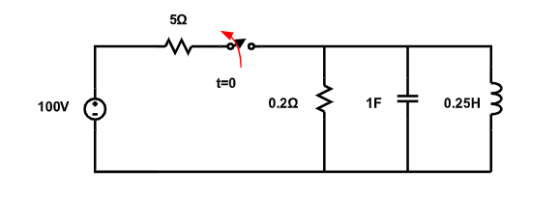
Solve for v(t), t>0.
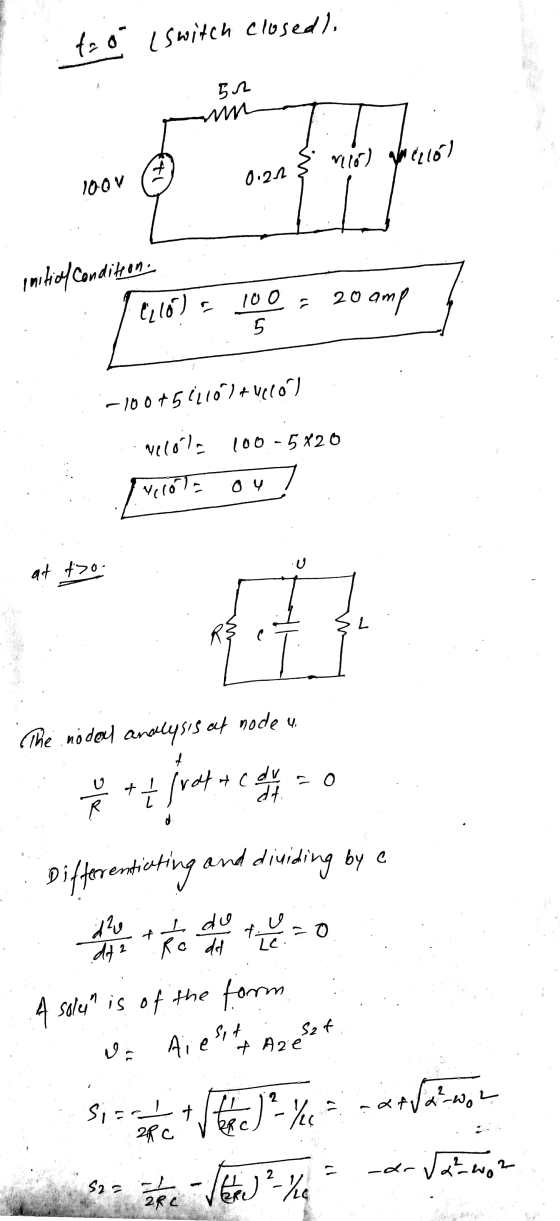
a. Find the initial conditions.
b. Write the differential equation.
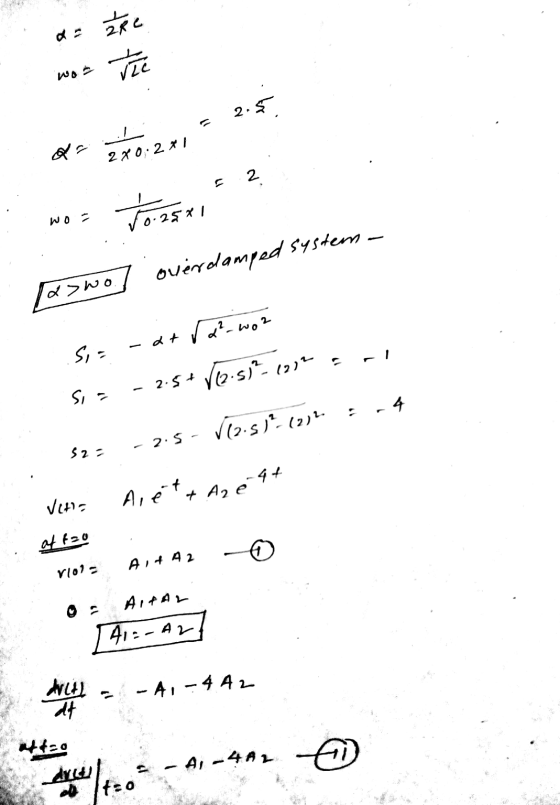
c. Find the general form of the solution.
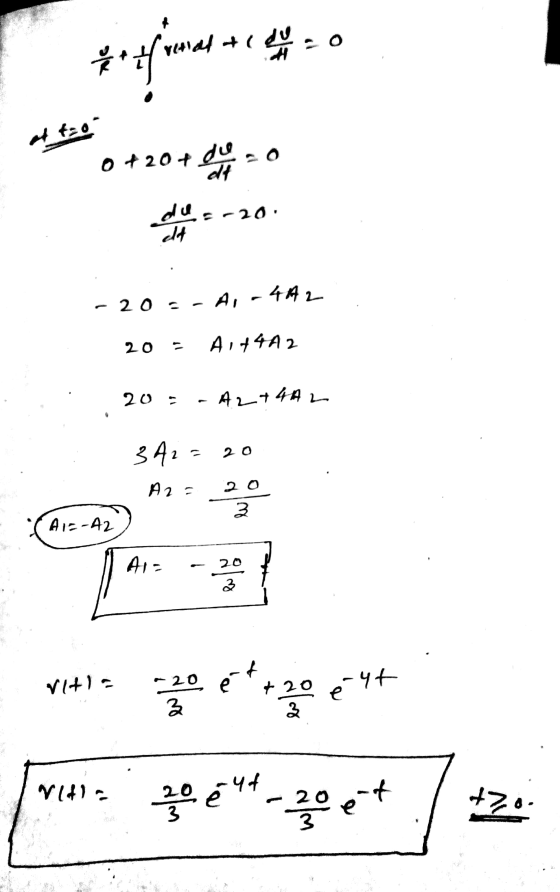
d. Find the coefficients of the solution by matching the initial
conditions.
Homework Answers
Add Answer to:
Solve for v(t), t>0.
a. Find the initial conditions.
b. Write the differential equation.
c. Find...
2. Assume steady-state conditions exist at 0. (a) Find the differential equation for it(t) for t>...
 2. Assume steady-state conditions exist at 0. (a) Find the differential equation for it(t) for t> 0 for the circuit below (b) Find the form of the solution (c) Find the initial conditions (d) Evaluate the coefficients for the solution. 4A 7 A 3. Find the voltage across the capacitor as a function of time. 30Ω 4u(t) A + 5A 3 H 27
3. a) Find the solution y(t) of the ordinary differential equation with the initial conditions: (Solve...
 3. a) Find the solution y(t) of the ordinary differential equation with the initial conditions: (Solve it only by hand and show your complete work. Do not use a calculator or any symbolic calu lations). [8 marks b) ) Recast our third order ODE into a system of irst order ODEs of the form A.v, where v' = dv/dr = f(v) and v = (y,y,,y")" . You should show all working to find the corresponding matrix A. Do not solve...
Problem 3: Insights into Differential Equations a. Consider the differential equation 습 +4 = f(t), where...
 Problem 3: Insights into Differential Equations a. Consider the differential equation 습 +4 = f(t), where f(t) = e-u, 12 0. Please write the forms of the natural and forced solution for this differential equation. You DO NOT need to solve. (7 points) b. Again consider the differential equation f(t), where f(t) is an input and y(t) is the output (response) of interest. Please write the differential equation in state-space form. (10 points) c. The classical method for solving differential...
(1 point) a. Consider the differential equation: d2y 0.16y-0 dt2 with initial conditions dt (0)-3 y(0)--1 and Find the...
 (1 point) a. Consider the differential equation: d2y 0.16y-0 dt2 with initial conditions dt (0)-3 y(0)--1 and Find the solution to this initial value problem b. Assume the same second order differential equation as Part a. However, consider it is subject to the following boundary conditions: y(0)-2 and y(3)-7 Find the solution to this boundary value problem. If there is no solution, then write NO SOLUTION. If there are infinitely many solutions, then use C as your arbitrary constant (e.g....
A. Write down the differential equation describing the circuit for an arbitrary time-dependent voltage V (t),...
 A. Write down the differential equation describing the circuit for an arbitrary time-dependent voltage V (t), in terms of the inductance L, capacitance C and resistance R of the circuit. B. Determine an analytic solution when the voltage is switched off [V(t) = ol. First, express your solution in terms of arbitrary coefficients as appropriate. Then, determine those coefficients for the initial conditions where the current is given by I(に0)-10 and satisfies I'(t = 0) = 0. C. Determine the...
A. Write down the differential equation describing the circuit for an arbitrary time-dependent voltage V (t),...
 A. Write down the differential equation describing the circuit for an arbitrary time-dependent voltage V (t), in terms of the inductance L, capacitance C and resistance R of the circuit. B. Determine an analytic solution when the voltage is switched off [V(t) = ol. First, express your solution in terms of arbitrary coefficients as appropriate. Then, determine those coefficients for the initial conditions where the current is given by I(に0)-10 and satisfies I'(t = 0) = 0. C. Determine the...
solve the PDE +u= at2 on 3 € (0,L), t > 0, with boundary conditions au...
 solve the PDE
+u= at2 on 3 € (0,L), t > 0, with boundary conditions au 2x2 u(0,t) = 0, u(L, t) = 0 au and initial condition u(x,0) = f(x), at (x,0) = g(x) following the steps below. (a) Separate the variables and write differential equations for the functions (x) and h(t); pick the separation constant so that we recover a problem already studied. (b) Find the eigenfunctions and eigenvalues. (c) Write the general solution for this problem. (d)...
solve the PDE
+u= at2 on 3 € (0,L), t > 0, with boundary conditions au 2x2 u(0,t) = 0, u(L, t) = 0 au and initial condition u(x,0) = f(x), at (x,0) = g(x) following the steps below. (a) Separate the variables and write differential equations for the functions (x) and h(t); pick the separation constant so that we recover a problem already studied. (b) Find the eigenfunctions and eigenvalues. (c) Write the general solution for this problem. (d)...
Solve the differential equation below with initial conditions. . Find the recurrence relation and compute the...
 Solve the differential equation below with initial conditions. . Find the recurrence relation and compute the first 6 coefficients (a -a,) (1 3x)y y' 2xy 0 y(0) 1, y'(0)-0
m FE18 Consider the second-ord er inhomogeneous differential equation -10cos(t/3)-10sin(t/3), y"-y ith the initial conditions y(0)...
 m FE18 Consider the second-ord er inhomogeneous differential equation -10cos(t/3)-10sin(t/3), y"-y ith the initial conditions y(0) = 1/2 and y,(0) =-1/2 ) (2 points) Obtain the general solution, yelt), of the corresponding homog ) (6 points) Using the method of undetermined coefficients, obtain a soluti geneous equation, Y (t), and write down the general solution of equation 5
Exercise 3: Solve the following differential equation (with initial conditions) for the three cases below.. Solve...
 Exercise 3: Solve the following differential equation (with
initial conditions) for the three cases below..
Solve the following differential equation (with initial conditions) for the three cases below (by hand!). You may use whatever method you find simplest. You may check your work in MATLAB or Python. 2ä + 3c – 2x = f(t), x(0) = 1, ¿(0) = 3. (a) For f(t) = 0. Note that this is just the homogeneous ODE, 2ä + 3i – 2x = 0....
Exercise 3: Solve the following differential equation (with
initial conditions) for the three cases below..
Solve the following differential equation (with initial conditions) for the three cases below (by hand!). You may use whatever method you find simplest. You may check your work in MATLAB or Python. 2ä + 3c – 2x = f(t), x(0) = 1, ¿(0) = 3. (a) For f(t) = 0. Note that this is just the homogeneous ODE, 2ä + 3i – 2x = 0....
 2. Assume steady-state conditions exist at 0. (a) Find the differential equation for it(t) for t> 0 for the circuit below (b) Find the form of the solution (c) Find the initial conditions (d) Evaluate the coefficients for the solution. 4A 7 A 3. Find the voltage across the capacitor as a function of time. 30Ω 4u(t) A + 5A 3 H 27
 3. a) Find the solution y(t) of the ordinary differential equation with the initial conditions: (Solve it only by hand and show your complete work. Do not use a calculator or any symbolic calu lations). [8 marks b) ) Recast our third order ODE into a system of irst order ODEs of the form A.v, where v' = dv/dr = f(v) and v = (y,y,,y")" . You should show all working to find the corresponding matrix A. Do not solve...
 Problem 3: Insights into Differential Equations a. Consider the differential equation 습 +4 = f(t), where f(t) = e-u, 12 0. Please write the forms of the natural and forced solution for this differential equation. You DO NOT need to solve. (7 points) b. Again consider the differential equation f(t), where f(t) is an input and y(t) is the output (response) of interest. Please write the differential equation in state-space form. (10 points) c. The classical method for solving differential...
 (1 point) a. Consider the differential equation: d2y 0.16y-0 dt2 with initial conditions dt (0)-3 y(0)--1 and Find the solution to this initial value problem b. Assume the same second order differential equation as Part a. However, consider it is subject to the following boundary conditions: y(0)-2 and y(3)-7 Find the solution to this boundary value problem. If there is no solution, then write NO SOLUTION. If there are infinitely many solutions, then use C as your arbitrary constant (e.g....
 A. Write down the differential equation describing the circuit for an arbitrary time-dependent voltage V (t), in terms of the inductance L, capacitance C and resistance R of the circuit. B. Determine an analytic solution when the voltage is switched off [V(t) = ol. First, express your solution in terms of arbitrary coefficients as appropriate. Then, determine those coefficients for the initial conditions where the current is given by I(に0)-10 and satisfies I'(t = 0) = 0. C. Determine the...
 A. Write down the differential equation describing the circuit for an arbitrary time-dependent voltage V (t), in terms of the inductance L, capacitance C and resistance R of the circuit. B. Determine an analytic solution when the voltage is switched off [V(t) = ol. First, express your solution in terms of arbitrary coefficients as appropriate. Then, determine those coefficients for the initial conditions where the current is given by I(に0)-10 and satisfies I'(t = 0) = 0. C. Determine the...
 solve the PDE
+u= at2 on 3 € (0,L), t > 0, with boundary conditions au 2x2 u(0,t) = 0, u(L, t) = 0 au and initial condition u(x,0) = f(x), at (x,0) = g(x) following the steps below. (a) Separate the variables and write differential equations for the functions (x) and h(t); pick the separation constant so that we recover a problem already studied. (b) Find the eigenfunctions and eigenvalues. (c) Write the general solution for this problem. (d)...
solve the PDE
+u= at2 on 3 € (0,L), t > 0, with boundary conditions au 2x2 u(0,t) = 0, u(L, t) = 0 au and initial condition u(x,0) = f(x), at (x,0) = g(x) following the steps below. (a) Separate the variables and write differential equations for the functions (x) and h(t); pick the separation constant so that we recover a problem already studied. (b) Find the eigenfunctions and eigenvalues. (c) Write the general solution for this problem. (d)...
 Solve the differential equation below with initial conditions. . Find the recurrence relation and compute the first 6 coefficients (a -a,) (1 3x)y y' 2xy 0 y(0) 1, y'(0)-0
 m FE18 Consider the second-ord er inhomogeneous differential equation -10cos(t/3)-10sin(t/3), y"-y ith the initial conditions y(0) = 1/2 and y,(0) =-1/2 ) (2 points) Obtain the general solution, yelt), of the corresponding homog ) (6 points) Using the method of undetermined coefficients, obtain a soluti geneous equation, Y (t), and write down the general solution of equation 5
 Exercise 3: Solve the following differential equation (with
initial conditions) for the three cases below..
Solve the following differential equation (with initial conditions) for the three cases below (by hand!). You may use whatever method you find simplest. You may check your work in MATLAB or Python. 2ä + 3c – 2x = f(t), x(0) = 1, ¿(0) = 3. (a) For f(t) = 0. Note that this is just the homogeneous ODE, 2ä + 3i – 2x = 0....
Exercise 3: Solve the following differential equation (with
initial conditions) for the three cases below..
Solve the following differential equation (with initial conditions) for the three cases below (by hand!). You may use whatever method you find simplest. You may check your work in MATLAB or Python. 2ä + 3c – 2x = f(t), x(0) = 1, ¿(0) = 3. (a) For f(t) = 0. Note that this is just the homogeneous ODE, 2ä + 3i – 2x = 0....
Most questions answered within 3 hours.
-
Where is the error in this code sequence?
String s1 = "Hello";
String s2 = "ello";...
asked 11 months ago -
Financial data for Joel de Paris, Inc., for last year
follow:
Joel de Paris, Inc.
Balance...
asked 11 months ago -
Consider this reaction:
Al2(SO4)3 (aq)+ BaCl3
(aq) Al2Cl6 (aq)- +
3BaSO4(s) . What is the...
asked 11 months ago -
Suppose that Savneet is considering increasing her
recent random sample from 20 car rentals to 40...
asked 11 months ago -
Trucks arrive at an unloading terminal at an average rate of 120
per hour.
Trucks arrive...
asked 11 months ago -
Why are methanol and ethanol completely soluble in water while
octanol is not very little soluble....
asked 11 months ago -
A facilities manager at a university reads in a research report
that the mean amount of...
asked 11 months ago -
When the CuSO4 is rehydrated by adding water to the anhydrous
compound, is this an endothermic...
asked 11 months ago -
A ray of sunlight is passing from diamond into crown glass; the
angle of incidence is...
asked 11 months ago -
A block of mass 0.249 kg is placed on top of a light, vertical
spring of...
asked 11 months ago -
how do the kidneys compensate in the presences of acidosis
a) trigger hyperventilate
b) reserve acid...
asked 11 months ago -
Question 501 pts
The rental rate of capital to the firm increases. Which of the
following...
asked 11 months ago