Trigonometry
Let A, B, C, and D be four distinct points in the plane. Suppose that no three of them lie on a line and A, C are on opposite sides of the line BD. The lengths of the line segments AB, BC, CD and DA are 1, 2, 3 and 4 respectively. (a) What is the range of possible values for the length x of the line segment BD?
Homework Answers
Request Answer!
We need at least 10 more requests to produce the answer.
0 / 10 have requested this problem solution
The more requests, the faster the answer.
Let A, B, C, and D be four distinct points in the plane. Suppose that no three of them lie on a l...
Let A, B, C, and D be four distinct points in the plane. Suppose that no three of them lie on a line and A, C are on opposite sides of the line BD. The lengths of the line segments AB, BC, CD and DA are 1, 2, 3 and 4 respectively. (a) What is the range of possible values for the length x of the line segment BD? You should justify your answer carefully! [5 marks] (b) Now suppose...
hint for d): consider a point D such that M is the midpoint of CD. Which...
 hint for d): consider a point D such that M is the
midpoint of CD. Which segments are congruent here? Do you see a
triangle with all three side lengts given.
Could you please write some instructions on the side
so I know how to follow your solution?
5. Given a triangle ABC, let M be the midpoint of the segment AB. The segment CM is called the median of the triangle. Let T be the point on the line...
hint for d): consider a point D such that M is the
midpoint of CD. Which segments are congruent here? Do you see a
triangle with all three side lengts given.
Could you please write some instructions on the side
so I know how to follow your solution?
5. Given a triangle ABC, let M be the midpoint of the segment AB. The segment CM is called the median of the triangle. Let T be the point on the line...
Line segments ab, cd, and da If you were to use the Amperian loop pictured below,...
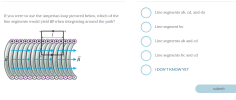 Line segments ab, cd, and da If you were to use the Amperian loop pictured below, which of the line segments would yield Bl when integrating around the path? Line segment bc pooooooo Line segments ab and cd Line segments bc and cd IDON'T KNOWYET submit
Question 1 (1 point) A line segment AD, contains points B & C such that C...
 Question 1 (1 point) A line segment AD, contains points B & C such that C is between A and D, and B is between A and C. If AB- 6, BD- 23, and AB -CD, find the length of segment BC. 17 23 29 Not enough information to solve the problem
(1) Assume the axioms of metric geometry. Let A, B, C, D be distinct collinear points....
 (1) Assume the axioms of metric geometry. Let A, B, C, D be
distinct collinear points. Let f : l → R be a coordinate function
for the line l that crosses all of A, B, C, D. Suppose f(A) <
f(B) < f(C) < f(D). Prove that AD = AB ∪ BC ∪ CD. (2) Assume
the axioms of metric geometry. Let A, B, C, D be distinct collinear
points. Suppose A ∗ B ∗ C and B ∗...
(1) Assume the axioms of metric geometry. Let A, B, C, D be
distinct collinear points. Let f : l → R be a coordinate function
for the line l that crosses all of A, B, C, D. Suppose f(A) <
f(B) < f(C) < f(D). Prove that AD = AB ∪ BC ∪ CD. (2) Assume
the axioms of metric geometry. Let A, B, C, D be distinct collinear
points. Suppose A ∗ B ∗ C and B ∗...
Recall the following definitions Two angles are called supplementary if they share a side and the...
 Recall the following definitions Two angles are called supplementary if they share a side and the other two sides are opposite rays. The segment PR is called the sum of segments AB and CD if there exists a point Q on the segment PR (i.e. on the line PR between P and R) such that segment PQ is congruent to segment AB and segment QR is congruent to segment CD In a similar way, give a definition of: (a) vertical...
Let A-B-C denote B is between A and C. For this problem, use the following three...
 Let A-B-C denote B is between A and C. For this problem, use the following three axioms: A1: Each pair of points is assigned a number, called the distance between A and B. it is denoted by AB. A2: Given any points A and B, then AB 20. Equality holds precisely when A=B. A3: For all points A and B, ABEBA Suppose A, B, C, and D are collinear. Assume that A-B-C means: A, B, and C are distinct, collinear...
Previous ProblemPlUDIelfLis (1 point) You are given the four points in the plane A (1,1), B- (4,-2), C (7,2), and D The graph of the function f(z) consists of the three line segments AB, BC and CD...
 Previous ProblemPlUDIelfLis (1 point) You are given the four points in the plane A (1,1), B- (4,-2), C (7,2), and D The graph of the function f(z) consists of the three line segments AB, BC and CD (11, -2) Find the integralf() dz by interpreting the integral in terms of sums and/or differences of areas of elementary figures f(z) de-
Previous ProblemPlUDIelfLis (1 point) You are given the four points in the plane A (1,1), B- (4,-2), C (7,2), and...
Previous ProblemPlUDIelfLis (1 point) You are given the four points in the plane A (1,1), B- (4,-2), C (7,2), and D The graph of the function f(z) consists of the three line segments AB, BC and CD (11, -2) Find the integralf() dz by interpreting the integral in terms of sums and/or differences of areas of elementary figures f(z) de-
Previous ProblemPlUDIelfLis (1 point) You are given the four points in the plane A (1,1), B- (4,-2), C (7,2), and...
I need help doing a doing two column for these two propositions. Book 1 Proposition 7:...
 I need help doing a doing two column for these two
propositions.
Book 1 Proposition 7:
Given two straight lines constructed from the ends of a straight
line and meeting in a point, there cannot be constructed from the
ends of the same straight line, and on the same side of it, two
other straight lines meeting in another point and equal to the
former two respectively, namely each equal to that from the same
end.
Book 3 Proposition 14:...
I need help doing a doing two column for these two
propositions.
Book 1 Proposition 7:
Given two straight lines constructed from the ends of a straight
line and meeting in a point, there cannot be constructed from the
ends of the same straight line, and on the same side of it, two
other straight lines meeting in another point and equal to the
former two respectively, namely each equal to that from the same
end.
Book 3 Proposition 14:...
 hint for d): consider a point D such that M is the
midpoint of CD. Which segments are congruent here? Do you see a
triangle with all three side lengts given.
Could you please write some instructions on the side
so I know how to follow your solution?
5. Given a triangle ABC, let M be the midpoint of the segment AB. The segment CM is called the median of the triangle. Let T be the point on the line...
hint for d): consider a point D such that M is the
midpoint of CD. Which segments are congruent here? Do you see a
triangle with all three side lengts given.
Could you please write some instructions on the side
so I know how to follow your solution?
5. Given a triangle ABC, let M be the midpoint of the segment AB. The segment CM is called the median of the triangle. Let T be the point on the line...
 Line segments ab, cd, and da If you were to use the Amperian loop pictured below, which of the line segments would yield Bl when integrating around the path? Line segment bc pooooooo Line segments ab and cd Line segments bc and cd IDON'T KNOWYET submit
 Question 1 (1 point) A line segment AD, contains points B & C such that C is between A and D, and B is between A and C. If AB- 6, BD- 23, and AB -CD, find the length of segment BC. 17 23 29 Not enough information to solve the problem
 (1) Assume the axioms of metric geometry. Let A, B, C, D be
distinct collinear points. Let f : l → R be a coordinate function
for the line l that crosses all of A, B, C, D. Suppose f(A) <
f(B) < f(C) < f(D). Prove that AD = AB ∪ BC ∪ CD. (2) Assume
the axioms of metric geometry. Let A, B, C, D be distinct collinear
points. Suppose A ∗ B ∗ C and B ∗...
(1) Assume the axioms of metric geometry. Let A, B, C, D be
distinct collinear points. Let f : l → R be a coordinate function
for the line l that crosses all of A, B, C, D. Suppose f(A) <
f(B) < f(C) < f(D). Prove that AD = AB ∪ BC ∪ CD. (2) Assume
the axioms of metric geometry. Let A, B, C, D be distinct collinear
points. Suppose A ∗ B ∗ C and B ∗...
 Recall the following definitions Two angles are called supplementary if they share a side and the other two sides are opposite rays. The segment PR is called the sum of segments AB and CD if there exists a point Q on the segment PR (i.e. on the line PR between P and R) such that segment PQ is congruent to segment AB and segment QR is congruent to segment CD In a similar way, give a definition of: (a) vertical...
 Let A-B-C denote B is between A and C. For this problem, use the following three axioms: A1: Each pair of points is assigned a number, called the distance between A and B. it is denoted by AB. A2: Given any points A and B, then AB 20. Equality holds precisely when A=B. A3: For all points A and B, ABEBA Suppose A, B, C, and D are collinear. Assume that A-B-C means: A, B, and C are distinct, collinear...
 Previous ProblemPlUDIelfLis (1 point) You are given the four points in the plane A (1,1), B- (4,-2), C (7,2), and D The graph of the function f(z) consists of the three line segments AB, BC and CD (11, -2) Find the integralf() dz by interpreting the integral in terms of sums and/or differences of areas of elementary figures f(z) de-
Previous ProblemPlUDIelfLis (1 point) You are given the four points in the plane A (1,1), B- (4,-2), C (7,2), and...
Previous ProblemPlUDIelfLis (1 point) You are given the four points in the plane A (1,1), B- (4,-2), C (7,2), and D The graph of the function f(z) consists of the three line segments AB, BC and CD (11, -2) Find the integralf() dz by interpreting the integral in terms of sums and/or differences of areas of elementary figures f(z) de-
Previous ProblemPlUDIelfLis (1 point) You are given the four points in the plane A (1,1), B- (4,-2), C (7,2), and...
 I need help doing a doing two column for these two
propositions.
Book 1 Proposition 7:
Given two straight lines constructed from the ends of a straight
line and meeting in a point, there cannot be constructed from the
ends of the same straight line, and on the same side of it, two
other straight lines meeting in another point and equal to the
former two respectively, namely each equal to that from the same
end.
Book 3 Proposition 14:...
I need help doing a doing two column for these two
propositions.
Book 1 Proposition 7:
Given two straight lines constructed from the ends of a straight
line and meeting in a point, there cannot be constructed from the
ends of the same straight line, and on the same side of it, two
other straight lines meeting in another point and equal to the
former two respectively, namely each equal to that from the same
end.
Book 3 Proposition 14:...
Most questions answered within 3 hours.
-
Where is the error in this code sequence?
String s1 = "Hello";
String s2 = "ello";...
asked 10 months ago -
Financial data for Joel de Paris, Inc., for last year
follow:
Joel de Paris, Inc.
Balance...
asked 10 months ago -
Consider this reaction:
Al2(SO4)3 (aq)+ BaCl3
(aq) Al2Cl6 (aq)- +
3BaSO4(s) . What is the...
asked 10 months ago -
Suppose that Savneet is considering increasing her
recent random sample from 20 car rentals to 40...
asked 10 months ago -
Trucks arrive at an unloading terminal at an average rate of 120
per hour.
Trucks arrive...
asked 10 months ago -
Why are methanol and ethanol completely soluble in water while
octanol is not very little soluble....
asked 10 months ago -
A facilities manager at a university reads in a research report
that the mean amount of...
asked 10 months ago -
When the CuSO4 is rehydrated by adding water to the anhydrous
compound, is this an endothermic...
asked 10 months ago -
A ray of sunlight is passing from diamond into crown glass; the
angle of incidence is...
asked 10 months ago -
A block of mass 0.249 kg is placed on top of a light, vertical
spring of...
asked 10 months ago -
how do the kidneys compensate in the presences of acidosis
a) trigger hyperventilate
b) reserve acid...
asked 10 months ago -
Question 501 pts
The rental rate of capital to the firm increases. Which of the
following...
asked 10 months ago