ECON 1150
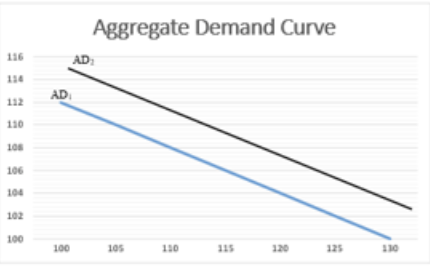
Consider a hypothetical economy in which households spend $0.75 of each additional dollar they earn and save the remaining $0.25. The following graph shows the economy's initial aggregate-demand curve ().
Suppose the government increases its purchases by $3.75 billion.
Use the green line (triangle symbol) on the following graph to show the aggregate-demand curve () after the multiplier effect takes place.
Hint: Be sure the new aggregate-demand curve () is parallel to . You can see the slope of by selecting it on the following graph.
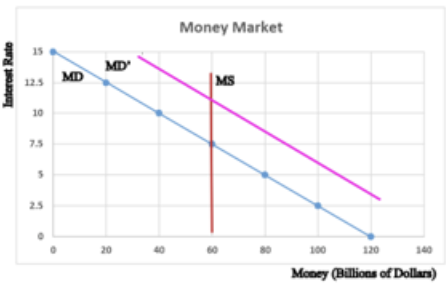
The following graph shows the money market in equilibrium at an interest rate of 7.5% and a quantity of money equal to $60 billion.
Show the impact of the increase in government purchases on the interest rate by shifting one or both of the curves on the following graph.
Suppose that for each one-percentage-point increase in the interest rate, the level of investment spending declines by $0.5 billion. The change in the interest rate (according to the change you made to the money market in the previous scenario) therefore causes the level of investment spending to (fall/rise) by
.(2.5 billions/ 1.25 bil/ 0.62 bil)
After the multiplier effect is accounted for, the change in investment spending will cause the quantity of output demanded to (decrease/increase) by
(5 bil/1.2 bil/2bil)at each price level. The impact of an increase in government purchases on the interest rate and the level of investment spending is known as the
( multiplier/liquidty preference/ automatic stabilizer/ crowding out) effect.
Use the purple line (diamond symbol) on the graph at the beginning of this problem to show the aggregate-demand curve () after accounting for the impact of the increase in government purchases on the interest rate and the level of investment spending.
Hint: Be sure your final aggregate-demand curve () is parallel to and . You can see the slopes of and by selecting them on the graph.
Homework Answers
It is given that the economy has the marginal propensity to consume has \(\$ 0.75\) and marginal propensity to save is \(\$ 0.25\)
Further, the government increases its purchase by \(\$ 3.75\) billion.
Government Multiplier \(=1 / 1-\mathrm{MPC}\) \(\mathrm{MPC}=0.75\)
Therefore, government multiplier \(=1 / 1-0.75=4\)
Increase in output can be calculated using the following formula:
\(\Delta \mathrm{Y}=\) Government Multiplier \(\times\) Increase in government spending \(\Delta \mathrm{Y}=4 \times 3.75\)
\(\Delta \mathrm{Y}=\$ 15\) billion
Hence, the increase in output is \(\$ 15\) billion.
The increase in government spending will have a positive effect on the aggregate demand curve. The demand curve will shift rightwards from \(\mathrm{AD}_{1}\) to \(\mathrm{AD}_{2}\).
In the money market, the equilibrium rate of interest is \(7.5 \%\), and the equilibrium quantity of money is \(\$ 60\) billion. An increase in government spending leads to an increase in output. At a higher level of output, the income level increase with further increases the demand for money. The demand for money will shift rightwards. The money supply curve will remain unaffected.
The demand for money increases from MD to MD'. The new equilibrium rate of interest also increases.
For each point, it is given that for each point increase in the interest rate and leads to a decline in investment spending by \(\$ 0.5\) Billion. The change in interest rate will cause the level of investment spending to fall by \(\$ 1.25\) billion.
After the multiplier effected is taken into consideration, the change in investment spending will cause the quantity of output demanded to decrease by 5 billion at each price level.
$$ \Delta \mathrm{Y}=\left(\frac{1}{1-c}\right) \times \Delta \mathrm{I} $$
\(\Delta \mathrm{Y}=\left(\frac{1}{1-0.75}\right) \times \Delta \mathrm{I}\)
\(\Delta \mathrm{Y}=4 \times 1.25\)
\(\Delta \mathrm{Y}=\$ 5\) billion
The impact of an increase in government purchases on the interest rate and investment spending is known as a crowding-out effect.
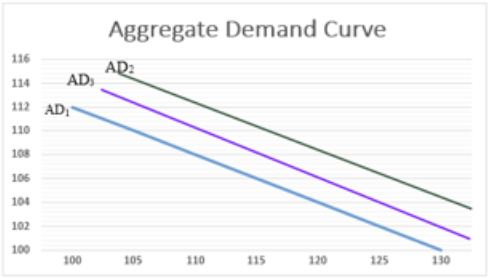
The aggregate demand curve, \(\mathrm{AD}_{3}\) is the final demand curve that accounts for the impact of government spending on the interest rate and the level of spending.
Multiplier = 1/(1-MPC)= 1/(1-0.75)=4
Increase in Government purchases= $3.75 billion
Change in AD= Multiplier * Change in Government purchases
AD increase = 4*$3.75 billion =$15 billion
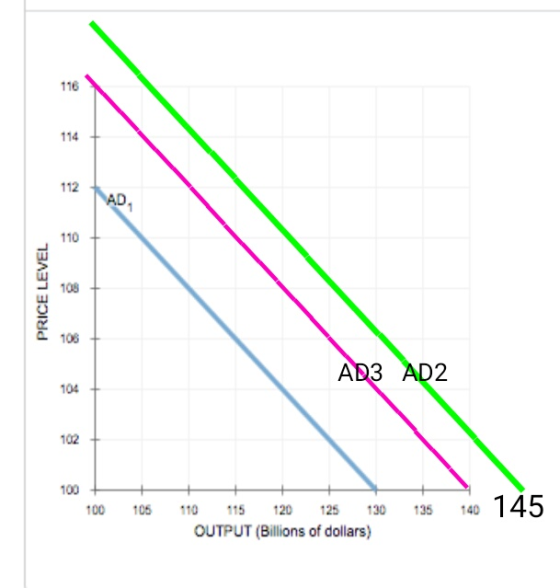
AD 1 shift to AD 2. Output increases from 130 to 145.
Suppose that for each one-percentage-point increase in the interest rate, the level of investment spending declines by $0.5 billion. The change in the interest rate (according to the change you made to the money market in the previous scenario) therefore causes the level of investment spending to __ fall___ by __$1.25 billion___ .
After the multiplier effect is accounted for, the change in investment spending will cause the quantity of output demanded to __decrease__ by __$5 billion__ at each price level. The impact of an increase in government purchases on the interest rate and the level of investment spending is known as the crowding-out effect.
Reason- one percentage point increase in interest rate leads to $0.5 billion decrease. When interest rate rises by 2.5% from 7.5% to 10%. As Money demand curve shifts upwards.
2.5*$.5 billion= $1.25 billion fall in investment
Investment decreases by $1.25 billion
AD fall= multiplier* change in investment= 4*$1.25 billion= $5 billion
AD2 shift to AD 3. Output decreases from 145 to 140.
When increase in government Purchases still leads to fall in output level it is known as crowding out.
If it helps kindly upvote.
Most questions answered within 3 hours.
-
Where is the error in this code sequence?
String s1 = "Hello";
String s2 = "ello";...
asked 10 months ago -
Financial data for Joel de Paris, Inc., for last year
follow:
Joel de Paris, Inc.
Balance...
asked 10 months ago -
Consider this reaction:
Al2(SO4)3 (aq)+ BaCl3
(aq) Al2Cl6 (aq)- +
3BaSO4(s) . What is the...
asked 10 months ago -
Suppose that Savneet is considering increasing her
recent random sample from 20 car rentals to 40...
asked 10 months ago -
Trucks arrive at an unloading terminal at an average rate of 120
per hour.
Trucks arrive...
asked 10 months ago -
Why are methanol and ethanol completely soluble in water while
octanol is not very little soluble....
asked 10 months ago -
A facilities manager at a university reads in a research report
that the mean amount of...
asked 10 months ago -
When the CuSO4 is rehydrated by adding water to the anhydrous
compound, is this an endothermic...
asked 10 months ago -
A ray of sunlight is passing from diamond into crown glass; the
angle of incidence is...
asked 10 months ago -
A block of mass 0.249 kg is placed on top of a light, vertical
spring of...
asked 10 months ago -
how do the kidneys compensate in the presences of acidosis
a) trigger hyperventilate
b) reserve acid...
asked 10 months ago -
Question 501 pts
The rental rate of capital to the firm increases. Which of the
following...
asked 10 months ago