1. Calculate the experimental head loss from the readings taken in the manometer below and compare them with theoretical predictions. NOTE: The table is only provided for inputting the answers. The only given parameters are the temperature of the water, flow rate and manometer reading. Calculate the velocity, Reynolds Number, Darcy Friction Factor, Theoretical Head Loss and Experimental Head Loss.
2. Compare the differences of using a Moody Chart and the Haaland Approximation of the Darcy Friction Factor by calculating the theoretical and experimental head loss (hL) from the conditions above in Q1.
| Temperature (degrees Celsius) | Flow Rate (L/min) | Manometer Reading (mmHg) | Velocity (m/s) | Reynolds Number, Re | Darcy Friction Factor, f | Theoretical Losses, hL (m) | Experimental Losses, hL (m) |
| 24.0 | 8 | 6 | |||||
| 24.0 | 16 | 22 | |||||
| 24.0 | 24 | 46 | |||||
| 24.0 | 32 | 79 | |||||
| 24.0 | 40 | 117 |
HINT: Use the Darcy Equation and Reynolds Number provided below.
 where f = Darcy Friction Factor calculated from
the Haaland Approximation of the Darcy Friction
Factor
where f = Darcy Friction Factor calculated from
the Haaland Approximation of the Darcy Friction
Factor ![\frac{1}{\sqrt{f}} = -1.8 log[\frac{6.9}{Re} +(\frac{\varepsilon /d}{3.7})^{1.11}]](http://img.homeworklib.com/questions/3b5fad80-974c-11eb-b75b-95ffc70c6642.png?x-oss-process=image/resize,w_560) where
where  is the
nominal roughness given as
is the
nominal roughness given as  mm, l = length of the pipe given as 1.22
m, v = mean velocity of flow in the pipe
(m/s) and d = diameter of the pipe given as
0.01384 m.
mm, l = length of the pipe given as 1.22
m, v = mean velocity of flow in the pipe
(m/s) and d = diameter of the pipe given as
0.01384 m.
 where
where  = mass density
of water (kg/m3), v = Mean velocity of
flow in the pipe (m/s), d = diameter of the pipe
given as 0.01384 m and
= mass density
of water (kg/m3), v = Mean velocity of
flow in the pipe (m/s), d = diameter of the pipe
given as 0.01384 m and  = dynamic
viscosity (Pa . s). NOTE: The temperature
of the water during testing was 24 degrees
Celsius.
= dynamic
viscosity (Pa . s). NOTE: The temperature
of the water during testing was 24 degrees
Celsius.
Homework Answers


Add Answer to:
1. Calculate the experimental head loss from the
readings taken in the manometer below and compare...
EDIT: The fluid in the system is water. There is no data regarding the inclination of...
 EDIT: The fluid in the system is water. There is no data
regarding the inclination of the pipe. It's known that the
equipment used includes a fluid flow piping system (AFT), hydraulic
bench (FME00), barometer, and psychrometer. Also added an appendix
that has recommended equations.
Need help on a fluid mechanics friction problem
Given:
Pipe Diameter=23mm
Length=1000mm
Temperature = 70 Celsius
Flow rate = 1400 L/hr
Water column LP1= 330mm
Water column LP2=90mm
Find:
Flow rate m^3/s, Velocity m/s, Temp...
EDIT: The fluid in the system is water. There is no data
regarding the inclination of the pipe. It's known that the
equipment used includes a fluid flow piping system (AFT), hydraulic
bench (FME00), barometer, and psychrometer. Also added an appendix
that has recommended equations.
Need help on a fluid mechanics friction problem
Given:
Pipe Diameter=23mm
Length=1000mm
Temperature = 70 Celsius
Flow rate = 1400 L/hr
Water column LP1= 330mm
Water column LP2=90mm
Find:
Flow rate m^3/s, Velocity m/s, Temp...
Oilspecific gravity 0.85 and dynamic viscosity 1.52 x 10³ Pa.s to flow in a 550 mm diameter uPVC ...
 help me to answer question 9,11,13 please
Oilspecific gravity 0.85 and dynamic viscosity 1.52 x 10³ Pa.s to flow in a 550 mm diameter uPVC pipe. The allowable friction head loss is imited to 15 m and length of pipe is 100 m. al using Darcu-Weisbach formula, determine the flow velocity, the friction factor and the flow rate. using Hazen-Wiiams formula, determine the velocity and the flow rate. MoN 10 Water must flow in a straight 450 mm diameter galvanized...
help me to answer question 9,11,13 please
Oilspecific gravity 0.85 and dynamic viscosity 1.52 x 10³ Pa.s to flow in a 550 mm diameter uPVC pipe. The allowable friction head loss is imited to 15 m and length of pipe is 100 m. al using Darcu-Weisbach formula, determine the flow velocity, the friction factor and the flow rate. using Hazen-Wiiams formula, determine the velocity and the flow rate. MoN 10 Water must flow in a straight 450 mm diameter galvanized...
The hydraulic head loss in a pipe may be determined by the Darcy-Weisbach Equation as follows: H=(f*L*V^2)/(2*D*g) Where...
The hydraulic head loss in a pipe may be determined by the Darcy-Weisbach Equation as follows: H=(f*L*V^2)/(2*D*g) Where L is the length of the pipe, V is the follow velocity of water in a pipe, D is the pipe diameter, f is the coefficient of friction and g is the gravitational acceleration (32.2 ft/sec^2) Suppose the length of the pipe L has a constant length of 10 ft and the pipe has a constant diameter of .5 ft. The coefficient...
Water flows from one large reservoir to another via a pipeline which is 0.9 m in...
 Water flows from one large reservoir to another via a pipeline which is 0.9 m in diameter, 15km long, and for which f-0.04. The difference in height between the water surface levels in the two reservoirs is 50m. (a) Ignoring the minor losses in the pipeline, calculate the flow rate between the two reservoirs. (b) Assuming that the pipeline entrance and exit are sharp and that the minor losses are as in Table 1, calculate the discharge now. What is...
Prob em 1 pts in Lab 03 water friction, for the dark blue circuit the head loss h h1-h2 across bend "C" at 30% and 40% flow are recorded in the table 3 I below. The actual flow rates, R...
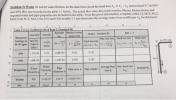 Prob em 1 pts in Lab 03 water friction, for the dark blue circuit the head loss h h1-h2 across bend "C" at 30% and 40% flow are recorded in the table 3 I below. The actual flow rates, Reynolds number, Blasius friction factor, and required water and pipe properties are included in the table. From the given information, complete cells L16, M10, M12, M16, NI0, N12,NI6,010, 012 and O16 in table 3.1 and determine the average minor loss coefficient...
Prob em 1 pts in Lab 03 water friction, for the dark blue circuit the head loss h h1-h2 across bend "C" at 30% and 40% flow are recorded in the table 3 I below. The actual flow rates, R...
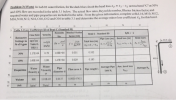 Prob em 1 pts in Lab 03 water friction, for the dark blue circuit the head loss h h1-h2 across bend "C" at 30% and 40% flow are recorded in the table 3 I below. The actual flow rates, Reynolds number, Blasius friction factor, and required water and pipe properties are included in the table. From the given information, complete cells L16, M10, M12, M16, NI0, N12,NI6,010, 012 and O16 in table 3.1 and determine the average minor loss coefficient...
Question #1 : a) Why liquids are usually transported in circular pipes? b) Which fluid at...
 Question #1 : a) Why liquids are usually transported in circular pipes? b) Which fluid at room temperature requires a larger pump to flow at a specified velocity in a given pipe; water or engine oil? Why? c) Consider the flow of air and water in pipes of the same diameter, at the same temperature, and at the same mean velocity. Which flow is more likely to be turbulent? Why? d) How is head loss or energy loss related to...
Q2 (12): Th and parallel pipes BC and BD. The head loss between the lower reservoir...
 Q2 (12): Th and parallel pipes BC and BD. The head loss between the lower reservoir and the pump can be ignored. The Darcy friction factor of each pipe is f 0.022. If the flow in pipe AB is 0.20 m'/s and AZ is 10.4 m, determine the total head of pump. What is daily power input (in the unit of Kw-hr) if the pump is running at 80% efficiency? e system shown in the following figure consists of two...
how to find the friction factor by using only experimental data, not the theoretical. Mann Tahoma...
 how
to find the friction factor by using only experimental data, not
the theoretical.
Mann Tahoma 11 Al Paste B I U abe X, X A- Aa-A Font 21 Paragraph Clipboard 2 RESULT 2.1 Experiment 1: Smooth Pipe Test section: Smooth pipe Test section diameter: 0.0254m Area="de = 5.067x10⁻⁴m Water temperature : 27°C Density at 27°C: 996.59 kg/m3 Dynamic viscosity at 27°C: 0.8509x10⁻³ Pas Clipboard Font Paragraph Styles 1.0 7.00 16.66 18.84 17.75 27.3 22.5 24.9 9.2 9.1 9.15 Experimental...
how
to find the friction factor by using only experimental data, not
the theoretical.
Mann Tahoma 11 Al Paste B I U abe X, X A- Aa-A Font 21 Paragraph Clipboard 2 RESULT 2.1 Experiment 1: Smooth Pipe Test section: Smooth pipe Test section diameter: 0.0254m Area="de = 5.067x10⁻⁴m Water temperature : 27°C Density at 27°C: 996.59 kg/m3 Dynamic viscosity at 27°C: 0.8509x10⁻³ Pas Clipboard Font Paragraph Styles 1.0 7.00 16.66 18.84 17.75 27.3 22.5 24.9 9.2 9.1 9.15 Experimental...
11. The head loss due to friction is found to be 12 m when water flows...
 11. The head loss due to friction is found to be 12 m when water flows 2.5 m/s in a 60-cm- diameter horizontal pipe. The pipe has a friction factor of 0.013. What is the length of the pipe over which these losses are measured? a) L= 120 m b) L=620 m c) L = 1200 m d) L = 1700 m
 EDIT: The fluid in the system is water. There is no data
regarding the inclination of the pipe. It's known that the
equipment used includes a fluid flow piping system (AFT), hydraulic
bench (FME00), barometer, and psychrometer. Also added an appendix
that has recommended equations.
Need help on a fluid mechanics friction problem
Given:
Pipe Diameter=23mm
Length=1000mm
Temperature = 70 Celsius
Flow rate = 1400 L/hr
Water column LP1= 330mm
Water column LP2=90mm
Find:
Flow rate m^3/s, Velocity m/s, Temp...
EDIT: The fluid in the system is water. There is no data
regarding the inclination of the pipe. It's known that the
equipment used includes a fluid flow piping system (AFT), hydraulic
bench (FME00), barometer, and psychrometer. Also added an appendix
that has recommended equations.
Need help on a fluid mechanics friction problem
Given:
Pipe Diameter=23mm
Length=1000mm
Temperature = 70 Celsius
Flow rate = 1400 L/hr
Water column LP1= 330mm
Water column LP2=90mm
Find:
Flow rate m^3/s, Velocity m/s, Temp...
 help me to answer question 9,11,13 please
Oilspecific gravity 0.85 and dynamic viscosity 1.52 x 10³ Pa.s to flow in a 550 mm diameter uPVC pipe. The allowable friction head loss is imited to 15 m and length of pipe is 100 m. al using Darcu-Weisbach formula, determine the flow velocity, the friction factor and the flow rate. using Hazen-Wiiams formula, determine the velocity and the flow rate. MoN 10 Water must flow in a straight 450 mm diameter galvanized...
help me to answer question 9,11,13 please
Oilspecific gravity 0.85 and dynamic viscosity 1.52 x 10³ Pa.s to flow in a 550 mm diameter uPVC pipe. The allowable friction head loss is imited to 15 m and length of pipe is 100 m. al using Darcu-Weisbach formula, determine the flow velocity, the friction factor and the flow rate. using Hazen-Wiiams formula, determine the velocity and the flow rate. MoN 10 Water must flow in a straight 450 mm diameter galvanized...
 Water flows from one large reservoir to another via a pipeline which is 0.9 m in diameter, 15km long, and for which f-0.04. The difference in height between the water surface levels in the two reservoirs is 50m. (a) Ignoring the minor losses in the pipeline, calculate the flow rate between the two reservoirs. (b) Assuming that the pipeline entrance and exit are sharp and that the minor losses are as in Table 1, calculate the discharge now. What is...
 Prob em 1 pts in Lab 03 water friction, for the dark blue circuit the head loss h h1-h2 across bend "C" at 30% and 40% flow are recorded in the table 3 I below. The actual flow rates, Reynolds number, Blasius friction factor, and required water and pipe properties are included in the table. From the given information, complete cells L16, M10, M12, M16, NI0, N12,NI6,010, 012 and O16 in table 3.1 and determine the average minor loss coefficient...
 Prob em 1 pts in Lab 03 water friction, for the dark blue circuit the head loss h h1-h2 across bend "C" at 30% and 40% flow are recorded in the table 3 I below. The actual flow rates, Reynolds number, Blasius friction factor, and required water and pipe properties are included in the table. From the given information, complete cells L16, M10, M12, M16, NI0, N12,NI6,010, 012 and O16 in table 3.1 and determine the average minor loss coefficient...
 Question #1 : a) Why liquids are usually transported in circular pipes? b) Which fluid at room temperature requires a larger pump to flow at a specified velocity in a given pipe; water or engine oil? Why? c) Consider the flow of air and water in pipes of the same diameter, at the same temperature, and at the same mean velocity. Which flow is more likely to be turbulent? Why? d) How is head loss or energy loss related to...
 Q2 (12): Th and parallel pipes BC and BD. The head loss between the lower reservoir and the pump can be ignored. The Darcy friction factor of each pipe is f 0.022. If the flow in pipe AB is 0.20 m'/s and AZ is 10.4 m, determine the total head of pump. What is daily power input (in the unit of Kw-hr) if the pump is running at 80% efficiency? e system shown in the following figure consists of two...
 how
to find the friction factor by using only experimental data, not
the theoretical.
Mann Tahoma 11 Al Paste B I U abe X, X A- Aa-A Font 21 Paragraph Clipboard 2 RESULT 2.1 Experiment 1: Smooth Pipe Test section: Smooth pipe Test section diameter: 0.0254m Area="de = 5.067x10⁻⁴m Water temperature : 27°C Density at 27°C: 996.59 kg/m3 Dynamic viscosity at 27°C: 0.8509x10⁻³ Pas Clipboard Font Paragraph Styles 1.0 7.00 16.66 18.84 17.75 27.3 22.5 24.9 9.2 9.1 9.15 Experimental...
how
to find the friction factor by using only experimental data, not
the theoretical.
Mann Tahoma 11 Al Paste B I U abe X, X A- Aa-A Font 21 Paragraph Clipboard 2 RESULT 2.1 Experiment 1: Smooth Pipe Test section: Smooth pipe Test section diameter: 0.0254m Area="de = 5.067x10⁻⁴m Water temperature : 27°C Density at 27°C: 996.59 kg/m3 Dynamic viscosity at 27°C: 0.8509x10⁻³ Pas Clipboard Font Paragraph Styles 1.0 7.00 16.66 18.84 17.75 27.3 22.5 24.9 9.2 9.1 9.15 Experimental...
 11. The head loss due to friction is found to be 12 m when water flows 2.5 m/s in a 60-cm- diameter horizontal pipe. The pipe has a friction factor of 0.013. What is the length of the pipe over which these losses are measured? a) L= 120 m b) L=620 m c) L = 1200 m d) L = 1700 m
Most questions answered within 3 hours.
-
Where is the error in this code sequence?
String s1 = "Hello";
String s2 = "ello";...
asked 10 months ago -
Financial data for Joel de Paris, Inc., for last year
follow:
Joel de Paris, Inc.
Balance...
asked 10 months ago -
Consider this reaction:
Al2(SO4)3 (aq)+ BaCl3
(aq) Al2Cl6 (aq)- +
3BaSO4(s) . What is the...
asked 10 months ago -
Suppose that Savneet is considering increasing her
recent random sample from 20 car rentals to 40...
asked 10 months ago -
Trucks arrive at an unloading terminal at an average rate of 120
per hour.
Trucks arrive...
asked 10 months ago -
Why are methanol and ethanol completely soluble in water while
octanol is not very little soluble....
asked 10 months ago -
A facilities manager at a university reads in a research report
that the mean amount of...
asked 10 months ago -
When the CuSO4 is rehydrated by adding water to the anhydrous
compound, is this an endothermic...
asked 10 months ago -
A ray of sunlight is passing from diamond into crown glass; the
angle of incidence is...
asked 10 months ago -
A block of mass 0.249 kg is placed on top of a light, vertical
spring of...
asked 10 months ago -
how do the kidneys compensate in the presences of acidosis
a) trigger hyperventilate
b) reserve acid...
asked 10 months ago -
Question 501 pts
The rental rate of capital to the firm increases. Which of the
following...
asked 10 months ago