Integral constraints within region R
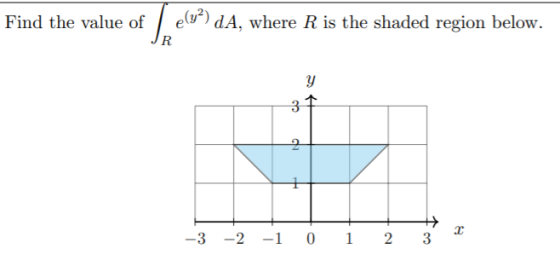
Find the value of \(\int_{R} e^{\left(y^{2}\right)} d A,\) where \(R\) is the shaded region below.
Homework Answers
Request Answer!
We need at least 9 more requests to produce the answer.
1 / 10 have requested this problem solution
The more requests, the faster the answer.
(8 points) Suppose R is the shaded region in the figure, and f(x, y) is a continuous function on R. Find the limits of integration for the following iterated integral. fx, y) dy dx JA Jc A-...
 Suppose \(R\) is the shaded region in the figure, and \(f(x, y)\) is a continuous function on \(R\). Find the limits of integrationfor the following iterated integral.(a) \(\iint_{R} f(x, y) d A=\int_{A}^{B} \int_{C}^{D} f(x, y) d y d x\)
Find for the given F and C
 Find \(\int_{C} \vec{F} \cdot d r\) for the given \(\vec{F}\) and \(C\).\(\cdot \vec{F}=-y \vec{i}+x \vec{j}+7 \vec{k}\) and \(C\) is the helix \(x=\cos t, y=\sin t r \quad z=t\), for \(0 \leq t \leq 2 \pi .\)$$ \int_{C} \vec{F} \cdot d \vec{r}= $$Find \(\int_{C} \overrightarrow{\mathrm{F}} \cdot d \overrightarrow{\mathrm{r}}\) for \(\overrightarrow{\mathrm{F}}=e^{y} \overrightarrow{\mathrm{i}}+\ln \left(x^{2}+1\right) \overrightarrow{\mathrm{j}}+\overrightarrow{\mathrm{k}}\) and \(C\), the circle of radius 4 centered at the origin in the \(y z\)-plane as shown below.$$ \int_{C} \vec{F} \cdot d \vec{r}= $$
value of z= 96 Task 3: Answer the following
 value of z= 96Task 3: Answer the following:a. Evaluate: \(\int_{\frac{\pi}{2}}^{\pi} \boldsymbol{Z} \cos ^{3}(x) \sin ^{2}(x) d x\)b. The moment of inertia, \(I\), of \(a\) rod of mass ' \(m^{\prime}\) and length \(4 r\) is given by \(I=\int_{0}^{4 r}\left(\frac{Z m x^{2}}{2 r}\right) d x\) where \(^{\prime} x^{\prime}\) is the distance from an axis of rotation. Find \(I \)Task 4: Answer the following:Using the Trapezoidal rule, find the approximate the area bounded by the curve\(y=\boldsymbol{Z} e^{\left(\frac{x}{2}\right)}\), the \(\mathrm{x}\) -axis and coordinates \(x=0,...
12. Consider the region bounded above by the function ?=1/(?+2)2(?+6)^2 and below by the xy-plane for...
 12. Consider the region bounded above by the function
?=1/(?+2)2(?+6)^2 and below by the xy-plane for x≥0 and ?≥0.
(1 point) Consider the region bounded above by the function z = - "2" (x + 2)2(y + 62 an and below by the xy-plane for x > 0 and y 2 0. On a piece of paper, sketch the shadow of the region in the xy-plane. Set up double integrals to compute the volume of the solid region in two...
12. Consider the region bounded above by the function
?=1/(?+2)2(?+6)^2 and below by the xy-plane for x≥0 and ?≥0.
(1 point) Consider the region bounded above by the function z = - "2" (x + 2)2(y + 62 an and below by the xy-plane for x > 0 and y 2 0. On a piece of paper, sketch the shadow of the region in the xy-plane. Set up double integrals to compute the volume of the solid region in two...
Let R be the region bounded by the following curves. Use the disk method to find...
Let R be the region bounded by the following curves. Use the disk method to find the volume of the solid generated by revolving the shaded region shown to the right about the x-axis. y=3-2x, y=0, x=0 Set up the integral that gives the volume of the solid using the disk method. Use increasing limits of integration
Find the area of the shaded region. The graph to the right depicts IQ scores of...
Find the area of the shaded region. The graph to the right depicts IQ scores of adults, and those scores are normally distributed with a mean of 100 and a standard deviation of 15. Click to view page 1 of the table. LOADING... Click to view page 2 of the table. LOADING... 85 120 A graph with a bell-shaped curve, divided into 3 regions by 2 lines from top to bottom, one on the left side and one on the...
(a): Evaluate
 5. (5 points) (a): Evaluate \(\int_{1}^{2} \int_{0}^{2}\left(y+2 x e^{y}\right) d x d y\).(b): Evaluate \(\int_{0}^{1} \int_{0}^{x^{2}} \int_{0}^{x+y}(2 x-y-z) d z d y d x\).
2. Geometric interpretation of integrals. Consider the integral where R is the region bounded by ...
 2. Geometric interpretation of integrals. Consider the integral where R is the region bounded by the a-axis, p-axis and r +y- 2 (a) Let =-z-v + 2, what object does this equation (NOT the integral) represent? (b) Interpret the integral as the volume of a shape. Sketch the shape. (e) Compute the integral by computing the volume of the shape. Page 3
2. Geometric interpretation of integrals. Consider the integral where R is the region bounded by the a-axis, p-axis...
2. Geometric interpretation of integrals. Consider the integral where R is the region bounded by the a-axis, p-axis and r +y- 2 (a) Let =-z-v + 2, what object does this equation (NOT the integral) represent? (b) Interpret the integral as the volume of a shape. Sketch the shape. (e) Compute the integral by computing the volume of the shape. Page 3
2. Geometric interpretation of integrals. Consider the integral where R is the region bounded by the a-axis, p-axis...
Use a change of variables to find the volume of the solid region lying below the surface -f(x, y) and above the plane region R x, y)xy)e- R: region bounded by the square with vertices (4, 0), (6, 2),...
 Use a change of variables to find the volume of the solid region lying below the surface -f(x, y) and above the plane region R x, y)xy)e- R: region bounded by the square with vertices (4, 0), (6, 2), (4, 4), (2, 2)
Use a change of variables to find the volume of the solid region lying below the surface -f(x, y) and above the plane region R x, y)xy)e- R: region bounded by the square with vertices (4, 0),...
Use a change of variables to find the volume of the solid region lying below the surface -f(x, y) and above the plane region R x, y)xy)e- R: region bounded by the square with vertices (4, 0), (6, 2), (4, 4), (2, 2)
Use a change of variables to find the volume of the solid region lying below the surface -f(x, y) and above the plane region R x, y)xy)e- R: region bounded by the square with vertices (4, 0),...
d) Find the area between the two curves (the shaded region). 2 + (2 r=2+cos 2θ ra sin 2θ d) Find the area between the two curves (the shaded region). 2 + (2 r=2+cos 2θ ra sin 2θ
 d) Find the area between the two curves (the shaded region). 2 + (2 r=2+cos 2θ ra sin 2θ
d) Find the area between the two curves (the shaded region). 2 + (2 r=2+cos 2θ ra sin 2θ
d) Find the area between the two curves (the shaded region). 2 + (2 r=2+cos 2θ ra sin 2θ
 Suppose \(R\) is the shaded region in the figure, and \(f(x, y)\) is a continuous function on \(R\). Find the limits of integrationfor the following iterated integral.(a) \(\iint_{R} f(x, y) d A=\int_{A}^{B} \int_{C}^{D} f(x, y) d y d x\)
 value of z= 96Task 3: Answer the following:a. Evaluate: \(\int_{\frac{\pi}{2}}^{\pi} \boldsymbol{Z} \cos ^{3}(x) \sin ^{2}(x) d x\)b. The moment of inertia, \(I\), of \(a\) rod of mass ' \(m^{\prime}\) and length \(4 r\) is given by \(I=\int_{0}^{4 r}\left(\frac{Z m x^{2}}{2 r}\right) d x\) where \(^{\prime} x^{\prime}\) is the distance from an axis of rotation. Find \(I \)Task 4: Answer the following:Using the Trapezoidal rule, find the approximate the area bounded by the curve\(y=\boldsymbol{Z} e^{\left(\frac{x}{2}\right)}\), the \(\mathrm{x}\) -axis and coordinates \(x=0,...
 12. Consider the region bounded above by the function
?=1/(?+2)2(?+6)^2 and below by the xy-plane for x≥0 and ?≥0.
(1 point) Consider the region bounded above by the function z = - "2" (x + 2)2(y + 62 an and below by the xy-plane for x > 0 and y 2 0. On a piece of paper, sketch the shadow of the region in the xy-plane. Set up double integrals to compute the volume of the solid region in two...
12. Consider the region bounded above by the function
?=1/(?+2)2(?+6)^2 and below by the xy-plane for x≥0 and ?≥0.
(1 point) Consider the region bounded above by the function z = - "2" (x + 2)2(y + 62 an and below by the xy-plane for x > 0 and y 2 0. On a piece of paper, sketch the shadow of the region in the xy-plane. Set up double integrals to compute the volume of the solid region in two...
 2. Geometric interpretation of integrals. Consider the integral where R is the region bounded by the a-axis, p-axis and r +y- 2 (a) Let =-z-v + 2, what object does this equation (NOT the integral) represent? (b) Interpret the integral as the volume of a shape. Sketch the shape. (e) Compute the integral by computing the volume of the shape. Page 3
2. Geometric interpretation of integrals. Consider the integral where R is the region bounded by the a-axis, p-axis...
2. Geometric interpretation of integrals. Consider the integral where R is the region bounded by the a-axis, p-axis and r +y- 2 (a) Let =-z-v + 2, what object does this equation (NOT the integral) represent? (b) Interpret the integral as the volume of a shape. Sketch the shape. (e) Compute the integral by computing the volume of the shape. Page 3
2. Geometric interpretation of integrals. Consider the integral where R is the region bounded by the a-axis, p-axis...
 Use a change of variables to find the volume of the solid region lying below the surface -f(x, y) and above the plane region R x, y)xy)e- R: region bounded by the square with vertices (4, 0), (6, 2), (4, 4), (2, 2)
Use a change of variables to find the volume of the solid region lying below the surface -f(x, y) and above the plane region R x, y)xy)e- R: region bounded by the square with vertices (4, 0),...
Use a change of variables to find the volume of the solid region lying below the surface -f(x, y) and above the plane region R x, y)xy)e- R: region bounded by the square with vertices (4, 0), (6, 2), (4, 4), (2, 2)
Use a change of variables to find the volume of the solid region lying below the surface -f(x, y) and above the plane region R x, y)xy)e- R: region bounded by the square with vertices (4, 0),...
 d) Find the area between the two curves (the shaded region). 2 + (2 r=2+cos 2θ ra sin 2θ
d) Find the area between the two curves (the shaded region). 2 + (2 r=2+cos 2θ ra sin 2θ
d) Find the area between the two curves (the shaded region). 2 + (2 r=2+cos 2θ ra sin 2θ
Most questions answered within 3 hours.
-
Where is the error in this code sequence?
String s1 = "Hello";
String s2 = "ello";...
asked 10 months ago -
Financial data for Joel de Paris, Inc., for last year
follow:
Joel de Paris, Inc.
Balance...
asked 10 months ago -
Consider this reaction:
Al2(SO4)3 (aq)+ BaCl3
(aq) Al2Cl6 (aq)- +
3BaSO4(s) . What is the...
asked 10 months ago -
Suppose that Savneet is considering increasing her
recent random sample from 20 car rentals to 40...
asked 10 months ago -
Trucks arrive at an unloading terminal at an average rate of 120
per hour.
Trucks arrive...
asked 10 months ago -
Why are methanol and ethanol completely soluble in water while
octanol is not very little soluble....
asked 10 months ago -
A facilities manager at a university reads in a research report
that the mean amount of...
asked 10 months ago -
When the CuSO4 is rehydrated by adding water to the anhydrous
compound, is this an endothermic...
asked 10 months ago -
A ray of sunlight is passing from diamond into crown glass; the
angle of incidence is...
asked 10 months ago -
A block of mass 0.249 kg is placed on top of a light, vertical
spring of...
asked 10 months ago -
how do the kidneys compensate in the presences of acidosis
a) trigger hyperventilate
b) reserve acid...
asked 10 months ago -
Question 501 pts
The rental rate of capital to the firm increases. Which of the
following...
asked 10 months ago