
Homework Answers
(1)- False: pressure is an intensive property as it does not depend on the mass of the system and also it is the ratio of two extensive properties I.e. force and area, thus it is an intensive property.
(2)- False: A Carnot cycle is one of the best-known reversible cycle. It comprises of four reversible processes.
(3)- True : At a particular temperature and the size of a body, the radiant energy emitted by a black body is maximum for a particular wavelength.
Add Answer to:
ressiire is an (2 pts) T / F Every irreversible cycle is called a Carnot cycle....
wrte the energy and entropy balances for the Heat Transfer Limited (HTL) Camot cycle. Assume the...
 wrte the energy and entropy balances for the Heat Transfer Limited (HTL) Camot cycle. Assume the HTL Carnot cycle is intemally reversible and extemally irreversible. The HTL Carnot cycle operates between a heat source temperature, TH600K, and heat sink temperature, T 300K. Assume the overall heat transfer coefficient multiply by the heat exchanger area (UA) of the high and low temperature heat exchanger are equal, i.e, UA UA, = 10 kW/K Using the LaGrange Multipliers method to find the maximum...
Solve the following problem in Thermodynamics: Carnot Cycle A heat engine receives heat from a source...
 Solve the following problem in Thermodynamics: Carnot Cycle A heat engine receives heat from a source at 2000 K at a rate of 500 kW, and rejects the waste heat to a medium at 300 K. The net output from the engine is 300 kW. Determine the maximum energy that can be driven out of the engine theoretically using Carnot Cycle. Compare the observed work-efficiency with the expected efficiency of the heat engine? How much energy is lost due to...
Which of the following statements concerning radiation heat transfer is false? The radiation emitted by a...
 Which of the following statements concerning radiation heat transfer is false? The radiation emitted by a body is proportional to the fourth power of its absolute temperature. For a body of particular size and temperature, the maximum energy is emitted b a black body For an opaque body, the sum of absorptivity and reflectivity is always equal to unity. Radiation is always negligible at room temperature. None of these statements is false.
4. The pressure-volume diagram below shows a special reversible cycle called the Carnot cycle A mole...
 4. The pressure-volume diagram below shows a special reversible cycle called the Carnot cycle A mole of an ideal gas starts off in state 1 in contact with a large thermal reservoir at temperature Th. The gas then undergoes an isothermal expansion from Vi to V2. Upon reaching state 2, the gas container is removed from contact with the thermal reservoir and covered with thermal insulation. Next the gas is allowed to expand adiabatically from V2to Vs. Because the expansion...
Problem #2 17.5 pts)Topic. Entropy A typical gasoline engine operates at 200°F while the maximum ...
 Problem #2 17.5 pts)Topic. Entropy A typical gasoline engine operates at 200°F while the maximum temperature inside the combustion chamber can be 1100F. On the other hand, the temperature of the combustion chamber of a typical diesel engine can reach up to 2500 F. So let's compare the performances of two Carnot cycles, one operating between ~1100°F and 200°F heat reservoirs and the other between ~2500°F and 200°F, to have a first-order crude estimate of engine performance Step a) Choose...
2. Discuss the Carnot Cycle & Efficiency, Kelvin Temperature Scale, Definition of Eutropy Change, Tds Equations,...
 2. Discuss the Carnot Cycle & Efficiency, Kelvin Temperature Scale, Definition of Eutropy Change, Tds Equations, Euthalpy-Entropy Diagrams (Mollier), Steady State Mass, Energy & Entropy Rate Balances for Coutrol Volumes, Rankine Cycle, Vapor Power, Refrigeration Cycle, and Vapor-Compression Heat Pump
Help me do it. Problem 4. A Carnot cycle using 2 mol mono-atomic gas works between...
 Help me do it.
Problem 4. A Carnot cycle using 2 mol mono-atomic gas works between a hot reservoir Ti 400K and a cold reservoir T2 300K The 1-2 and 3-4 processes are isothermal The 2-3 and 4-1 processes are adiabatic. Given Vi 12 L, V2 -8 L a) (3 pts) Find Pi, P2, Ps, Ps, Vs, V4 b) (4 pts) What is the heat received by the gas during the 1-2 process? o (4 ptsy) What is the heat...
Help me do it.
Problem 4. A Carnot cycle using 2 mol mono-atomic gas works between a hot reservoir Ti 400K and a cold reservoir T2 300K The 1-2 and 3-4 processes are isothermal The 2-3 and 4-1 processes are adiabatic. Given Vi 12 L, V2 -8 L a) (3 pts) Find Pi, P2, Ps, Ps, Vs, V4 b) (4 pts) What is the heat received by the gas during the 1-2 process? o (4 ptsy) What is the heat...
2) From the lecture (compare also text page 193-194) we learn that the maximum amount of...
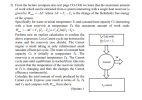 2) From the lecture (compare also text page 193-194) we learn that the maximum amount of work which can be extracted from a system interacting with a single heat reservoir is given by W =-AF where AF = F,-F, is the change of the Helmholtz free energy of the system. Specifically for water at initial temperature To and constant heat capacity Cp interacting with a heat reservoir at temperature Tr this maximum amount of work reads W =-AF =C (T-TR)+CT,...
Problem 2:2* (Carnot Cycle Application) Two kilograms of air within a piston-cylinder assembly execute a Carnot...
 Problem 2:2* (Carnot Cycle Application) Two kilograms of air within a piston-cylinder assembly execute a Carnot power cycle with maximum and minimum temperatures of 750 K and 300 K, respectively. The heat transfer to the air during the isothermal expansion is 60 kJ. At the end of the isothermal expansion, the pressure is 600 kPa. Assuming the ideal gas model for the air, determine (a) The thermal efficiency. (b) The Pressure and volume at the beginning of the isothermal expansion,...
A Carnot vapor refrigeration cycle is used to maintain a cold region at 0 ?F where...
A Carnot vapor refrigeration cycle is used to maintain a cold region at 0 ?F where the ambient temperature is 75 ?F. Refrigerant R-134a enters the condenser as saturated vapor at 100 lbf/in2 and leaves as saturated liquid at the same pressure. The evaporator pressure is 20 lbf/in2. The mass flow rate of refrigerant is 13 lbm/s . a-compressor power b-turbine power c- coefficient of performance
 wrte the energy and entropy balances for the Heat Transfer Limited (HTL) Camot cycle. Assume the HTL Carnot cycle is intemally reversible and extemally irreversible. The HTL Carnot cycle operates between a heat source temperature, TH600K, and heat sink temperature, T 300K. Assume the overall heat transfer coefficient multiply by the heat exchanger area (UA) of the high and low temperature heat exchanger are equal, i.e, UA UA, = 10 kW/K Using the LaGrange Multipliers method to find the maximum...
 Solve the following problem in Thermodynamics: Carnot Cycle A heat engine receives heat from a source at 2000 K at a rate of 500 kW, and rejects the waste heat to a medium at 300 K. The net output from the engine is 300 kW. Determine the maximum energy that can be driven out of the engine theoretically using Carnot Cycle. Compare the observed work-efficiency with the expected efficiency of the heat engine? How much energy is lost due to...
 Which of the following statements concerning radiation heat transfer is false? The radiation emitted by a body is proportional to the fourth power of its absolute temperature. For a body of particular size and temperature, the maximum energy is emitted b a black body For an opaque body, the sum of absorptivity and reflectivity is always equal to unity. Radiation is always negligible at room temperature. None of these statements is false.
 4. The pressure-volume diagram below shows a special reversible cycle called the Carnot cycle A mole of an ideal gas starts off in state 1 in contact with a large thermal reservoir at temperature Th. The gas then undergoes an isothermal expansion from Vi to V2. Upon reaching state 2, the gas container is removed from contact with the thermal reservoir and covered with thermal insulation. Next the gas is allowed to expand adiabatically from V2to Vs. Because the expansion...
 Problem #2 17.5 pts)Topic. Entropy A typical gasoline engine operates at 200°F while the maximum temperature inside the combustion chamber can be 1100F. On the other hand, the temperature of the combustion chamber of a typical diesel engine can reach up to 2500 F. So let's compare the performances of two Carnot cycles, one operating between ~1100°F and 200°F heat reservoirs and the other between ~2500°F and 200°F, to have a first-order crude estimate of engine performance Step a) Choose...
 2. Discuss the Carnot Cycle & Efficiency, Kelvin Temperature Scale, Definition of Eutropy Change, Tds Equations, Euthalpy-Entropy Diagrams (Mollier), Steady State Mass, Energy & Entropy Rate Balances for Coutrol Volumes, Rankine Cycle, Vapor Power, Refrigeration Cycle, and Vapor-Compression Heat Pump
 Help me do it.
Problem 4. A Carnot cycle using 2 mol mono-atomic gas works between a hot reservoir Ti 400K and a cold reservoir T2 300K The 1-2 and 3-4 processes are isothermal The 2-3 and 4-1 processes are adiabatic. Given Vi 12 L, V2 -8 L a) (3 pts) Find Pi, P2, Ps, Ps, Vs, V4 b) (4 pts) What is the heat received by the gas during the 1-2 process? o (4 ptsy) What is the heat...
Help me do it.
Problem 4. A Carnot cycle using 2 mol mono-atomic gas works between a hot reservoir Ti 400K and a cold reservoir T2 300K The 1-2 and 3-4 processes are isothermal The 2-3 and 4-1 processes are adiabatic. Given Vi 12 L, V2 -8 L a) (3 pts) Find Pi, P2, Ps, Ps, Vs, V4 b) (4 pts) What is the heat received by the gas during the 1-2 process? o (4 ptsy) What is the heat...
 2) From the lecture (compare also text page 193-194) we learn that the maximum amount of work which can be extracted from a system interacting with a single heat reservoir is given by W =-AF where AF = F,-F, is the change of the Helmholtz free energy of the system. Specifically for water at initial temperature To and constant heat capacity Cp interacting with a heat reservoir at temperature Tr this maximum amount of work reads W =-AF =C (T-TR)+CT,...
 Problem 2:2* (Carnot Cycle Application) Two kilograms of air within a piston-cylinder assembly execute a Carnot power cycle with maximum and minimum temperatures of 750 K and 300 K, respectively. The heat transfer to the air during the isothermal expansion is 60 kJ. At the end of the isothermal expansion, the pressure is 600 kPa. Assuming the ideal gas model for the air, determine (a) The thermal efficiency. (b) The Pressure and volume at the beginning of the isothermal expansion,...
Most questions answered within 3 hours.
-
Where is the error in this code sequence?
String s1 = "Hello";
String s2 = "ello";...
asked 11 months ago -
Financial data for Joel de Paris, Inc., for last year
follow:
Joel de Paris, Inc.
Balance...
asked 11 months ago -
Consider this reaction:
Al2(SO4)3 (aq)+ BaCl3
(aq) Al2Cl6 (aq)- +
3BaSO4(s) . What is the...
asked 11 months ago -
Suppose that Savneet is considering increasing her
recent random sample from 20 car rentals to 40...
asked 11 months ago -
Trucks arrive at an unloading terminal at an average rate of 120
per hour.
Trucks arrive...
asked 11 months ago -
Why are methanol and ethanol completely soluble in water while
octanol is not very little soluble....
asked 11 months ago -
A facilities manager at a university reads in a research report
that the mean amount of...
asked 11 months ago -
When the CuSO4 is rehydrated by adding water to the anhydrous
compound, is this an endothermic...
asked 11 months ago -
A ray of sunlight is passing from diamond into crown glass; the
angle of incidence is...
asked 11 months ago -
A block of mass 0.249 kg is placed on top of a light, vertical
spring of...
asked 11 months ago -
how do the kidneys compensate in the presences of acidosis
a) trigger hyperventilate
b) reserve acid...
asked 11 months ago -
Question 501 pts
The rental rate of capital to the firm increases. Which of the
following...
asked 11 months ago