

Homework Answers
Add Answer to:
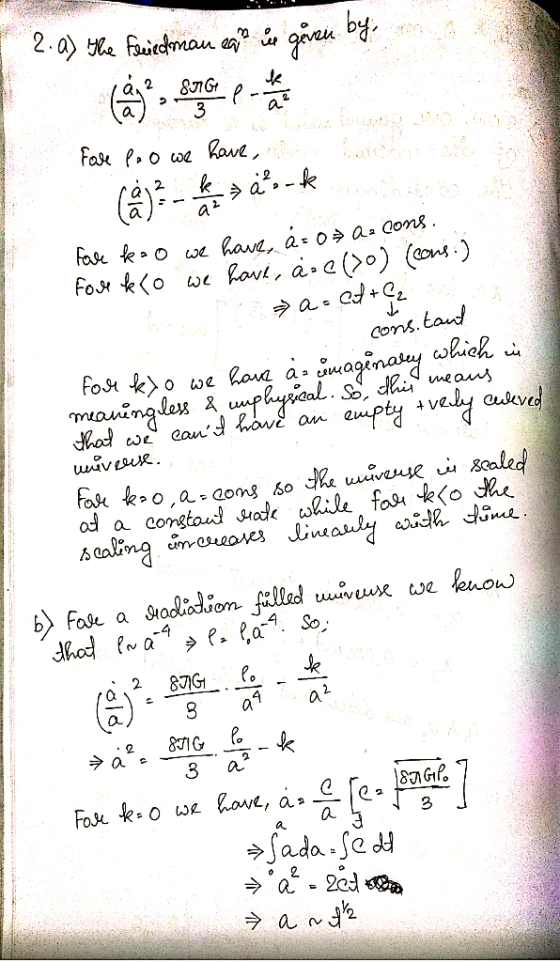
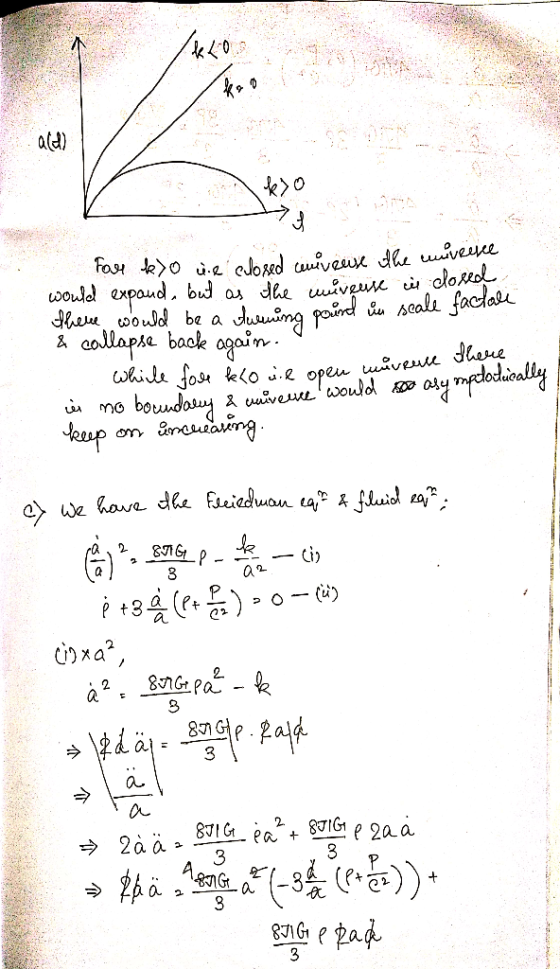
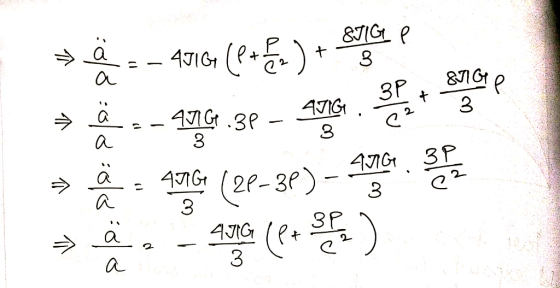
2. The acceleration equation We have derived in lectures the Friedmann and fluid equations, that describe...
3. The Cosmological constant When formulating general relativity, Einstein believed that the Universe was static. In or...
 3. The Cosmological constant When formulating general relativity, Einstein believed that the Universe was static. In order to arrange a static Universe, he proposed a change to the equations, something he would later famously call his "greatest blunder". That was the introduction of a cosmological constant, A, to the Friedmann equation (1) (a) (3 points) By referring to the Friedmann equation 1), derive an equation for a static Universe when k -0 (b) (8 points) Last week you derived an...
Newtonian Cosmology 1. In class, we solved the Friedmann equation for the critical case, where the...
 Newtonian Cosmology 1. In class, we solved the Friedmann equation for the critical case, where the constant of integration was set to k 0; this resulted in the Einstein-de Sitter model, where a ox t2/3 Now, let us consider the closed case (k 1), where the universe starts with a Big Bang, reaches a maximum expansion, turns around, and eventually ends in a Big Crunch. For the closed model, it is convenient to write the Friedmann equation as follows: 8T...
2. (i)Describe with neat sketches the meanings of streamlines, pathlines and streaklines. (6 marks) (Gi) Derive the equation of the streamlines for the following flow field and sketch them. (4 ma...
 2. (i)Describe with neat sketches the meanings of streamlines, pathlines and streaklines. (6 marks) (Gi) Derive the equation of the streamlines for the following flow field and sketch them. (4 marks) (iii) A flow field is given as (a) Determine the z-component of velocity assuming the flow field is for an incompressible fluid. (4 marks) (b) Determine the velocity and acceleration at the point (1,2,3) at time t-1. (6 marks) Assume that the z-component of velocity at z-0 is zero....
2.) As a raindrop falls through a cloud, it collides with smaller droplets of mist and...
 2.) As a raindrop falls through a cloud, it collides with smaller droplets of mist and grows in mass (a) Derive a differential equation that relates the mass and velocity of the drop as it falls and accretes mass. Hint: Do NOT just differentiate d(mv)/dt, but start with the impulse-momentum theorem in differential form, like we did in the derivation of the rocket equation. Your "system" should include the raindrop itself and a small mass Δm of droplets with which...
I need help with exercise #2. Your help will be really appreciated and rated. MAXWELL'S EQUATION...
 I need help with exercise #2. Your help will be really
appreciated and rated.
MAXWELL'S EQUATION I. Maxwell's Equation: Our first (of mony) distribution functions. Very important A. The "Maxwell-Boltzman speed distribution" gives the speed distribution, fiv), of particles confined to NN()d, which a volume, V, and in thermal equilibrium at a temperature, T. () is the number of particles moving within dv of a speed, v Distributions of this type can be considered as the product of three terms...
I need help with exercise #2. Your help will be really
appreciated and rated.
MAXWELL'S EQUATION I. Maxwell's Equation: Our first (of mony) distribution functions. Very important A. The "Maxwell-Boltzman speed distribution" gives the speed distribution, fiv), of particles confined to NN()d, which a volume, V, and in thermal equilibrium at a temperature, T. () is the number of particles moving within dv of a speed, v Distributions of this type can be considered as the product of three terms...
Elementary Differential Equation Unit Step Function Problem Project 2 A Spring-Mass Event Problenm A mass of...
 Elementary Differential Equation Unit Step Function Problem
Project 2 A Spring-Mass Event Problenm A mass of magnitude m is confined to one-dimensional motion between two springs on a frictionless horizontal surface, as shown in Figure 4.P.3. The mass, which is unattached to either spring, undergoes simple inertial motion whenever the distance from the origin of the center point of the mass, x, satisfies lxl < L. When x 2 L, the mass is in contact with the spring on the...
Elementary Differential Equation Unit Step Function Problem
Project 2 A Spring-Mass Event Problenm A mass of magnitude m is confined to one-dimensional motion between two springs on a frictionless horizontal surface, as shown in Figure 4.P.3. The mass, which is unattached to either spring, undergoes simple inertial motion whenever the distance from the origin of the center point of the mass, x, satisfies lxl < L. When x 2 L, the mass is in contact with the spring on the...
 3. The Cosmological constant When formulating general relativity, Einstein believed that the Universe was static. In order to arrange a static Universe, he proposed a change to the equations, something he would later famously call his "greatest blunder". That was the introduction of a cosmological constant, A, to the Friedmann equation (1) (a) (3 points) By referring to the Friedmann equation 1), derive an equation for a static Universe when k -0 (b) (8 points) Last week you derived an...
 Newtonian Cosmology 1. In class, we solved the Friedmann equation for the critical case, where the constant of integration was set to k 0; this resulted in the Einstein-de Sitter model, where a ox t2/3 Now, let us consider the closed case (k 1), where the universe starts with a Big Bang, reaches a maximum expansion, turns around, and eventually ends in a Big Crunch. For the closed model, it is convenient to write the Friedmann equation as follows: 8T...
 2. (i)Describe with neat sketches the meanings of streamlines, pathlines and streaklines. (6 marks) (Gi) Derive the equation of the streamlines for the following flow field and sketch them. (4 marks) (iii) A flow field is given as (a) Determine the z-component of velocity assuming the flow field is for an incompressible fluid. (4 marks) (b) Determine the velocity and acceleration at the point (1,2,3) at time t-1. (6 marks) Assume that the z-component of velocity at z-0 is zero....
 2.) As a raindrop falls through a cloud, it collides with smaller droplets of mist and grows in mass (a) Derive a differential equation that relates the mass and velocity of the drop as it falls and accretes mass. Hint: Do NOT just differentiate d(mv)/dt, but start with the impulse-momentum theorem in differential form, like we did in the derivation of the rocket equation. Your "system" should include the raindrop itself and a small mass Δm of droplets with which...
 I need help with exercise #2. Your help will be really
appreciated and rated.
MAXWELL'S EQUATION I. Maxwell's Equation: Our first (of mony) distribution functions. Very important A. The "Maxwell-Boltzman speed distribution" gives the speed distribution, fiv), of particles confined to NN()d, which a volume, V, and in thermal equilibrium at a temperature, T. () is the number of particles moving within dv of a speed, v Distributions of this type can be considered as the product of three terms...
I need help with exercise #2. Your help will be really
appreciated and rated.
MAXWELL'S EQUATION I. Maxwell's Equation: Our first (of mony) distribution functions. Very important A. The "Maxwell-Boltzman speed distribution" gives the speed distribution, fiv), of particles confined to NN()d, which a volume, V, and in thermal equilibrium at a temperature, T. () is the number of particles moving within dv of a speed, v Distributions of this type can be considered as the product of three terms...
 Elementary Differential Equation Unit Step Function Problem
Project 2 A Spring-Mass Event Problenm A mass of magnitude m is confined to one-dimensional motion between two springs on a frictionless horizontal surface, as shown in Figure 4.P.3. The mass, which is unattached to either spring, undergoes simple inertial motion whenever the distance from the origin of the center point of the mass, x, satisfies lxl < L. When x 2 L, the mass is in contact with the spring on the...
Elementary Differential Equation Unit Step Function Problem
Project 2 A Spring-Mass Event Problenm A mass of magnitude m is confined to one-dimensional motion between two springs on a frictionless horizontal surface, as shown in Figure 4.P.3. The mass, which is unattached to either spring, undergoes simple inertial motion whenever the distance from the origin of the center point of the mass, x, satisfies lxl < L. When x 2 L, the mass is in contact with the spring on the...
Most questions answered within 3 hours.
-
Where is the error in this code sequence?
String s1 = "Hello";
String s2 = "ello";...
asked 10 months ago -
Financial data for Joel de Paris, Inc., for last year
follow:
Joel de Paris, Inc.
Balance...
asked 10 months ago -
Consider this reaction:
Al2(SO4)3 (aq)+ BaCl3
(aq) Al2Cl6 (aq)- +
3BaSO4(s) . What is the...
asked 10 months ago -
Suppose that Savneet is considering increasing her
recent random sample from 20 car rentals to 40...
asked 10 months ago -
Trucks arrive at an unloading terminal at an average rate of 120
per hour.
Trucks arrive...
asked 10 months ago -
Why are methanol and ethanol completely soluble in water while
octanol is not very little soluble....
asked 10 months ago -
A facilities manager at a university reads in a research report
that the mean amount of...
asked 10 months ago -
When the CuSO4 is rehydrated by adding water to the anhydrous
compound, is this an endothermic...
asked 10 months ago -
A ray of sunlight is passing from diamond into crown glass; the
angle of incidence is...
asked 10 months ago -
A block of mass 0.249 kg is placed on top of a light, vertical
spring of...
asked 10 months ago -
how do the kidneys compensate in the presences of acidosis
a) trigger hyperventilate
b) reserve acid...
asked 10 months ago -
Question 501 pts
The rental rate of capital to the firm increases. Which of the
following...
asked 10 months ago