
Homework Answers

Add Answer to:
Question 15 (1 point) B The reaction of 5.5 grams of HCI with excess NaOH releases...
QUESTION 1 Heat is required to dissolve NaOH(s) in water. A-True B-False -------------------- QUESTiON 2 The...
QUESTION 1 Heat is required to dissolve NaOH(s) in water. A-True B-False -------------------- QUESTiON 2 The below equation represents an exothermic reaction: Reactants + delta H ----> product ATrue B-False -------------------- QUESTION 3 The Styrofoam cup was used as an insulated device that allows heat loss A-True B-False -------------------- QUESTION 4 The following is an endothermic reaction; NaOH+ HCI------> NaCl+H2O+42.12KJ A-True B-False -------------------- QUESTION 5 NaOH(s)---> Na^+(aq)+CH^-(aq)+44.02kJ Calculate the amount (in moles) of NaOH needed to make the reaction above...
When 3.0 grams of H2 is reacted with excess C at constant pressure, the reaction forms...
When 3.0 grams of H2 is reacted with excess C at constant pressure, the reaction forms CH4 and releases 54.2 kJ of heat. C(s) + 2 H2(g) --> CH4(g) What is the enthalpy of the reaction in kJ/mol of CH4? Enter your answer numerically and in terms of kJ/mol.
When 3.0 grams of H2 is reacted with excess C at constant pressure, the reaction forms...
When 3.0 grams of H2 is reacted with excess C at constant pressure, the reaction forms CH4 and releases 59.4 kJ of heat. C(s) + 2 H2(g) → CH4(g) What is the enthalpy of the reaction in kJ/mol of CH4? Enter your answer numerically and in terms of kJ/mol.
Question Completul Jualus. [CLO5] Consider again the dissolution reaction NaOH (s) + H20 (1) - Na+...
 Question Completul Jualus. [CLO5] Consider again the dissolution reaction NaOH (s) + H20 (1) - Na+ (aq) + HO- (aq) in a constant-pressure calorimeter containing mw = 98 grams of water. Dissolving mNaOH=2 grams of NaOH causes a ATsol = 5 °C of the solution inside the calorimeter. Data: the molar mass of NaOH is MNaOH=40 g/mol. The specific heat capacity of liquid water at room temper- ature is cw = 4.184 J/(g°C). Hint: note that mw >> mNaOH, so...
Question 16 (1 point) A laboratory worker is studying the combusion of hydrazine (N2H4) using a...
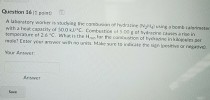 Question 16 (1 point) A laboratory worker is studying the combusion of hydrazine (N2H4) using a bomb calorimeter with a heat capacity of 50.0 kJ/ C. Combustion of 5.00 g of hydrazine causes a rise in temperature of 2.6 °C. What is the Hrxn for the combustion of hydrazine in kilojoules per mole? Enter your answer with no units. Make sure to indicate the sign (positive or negative). Your Answer: Answer Save
please answers all these questions : QUESTION 5 NaOH(s)---> Na^+(aq)+CH^-(aq)+44.02kJ Calculate the amount (in moles) of...
please answers all these questions : QUESTION 5 NaOH(s)---> Na^+(aq)+CH^-(aq)+44.02kJ Calculate the amount (in moles) of NaOH needed to make the reaction above releases 1000 kJ 22.71 mol 0.04402 mol 44020 mol 44.02 mol ______________ QUESTION 6 Use the equation below to find heat released if 2 moles of NaOH was dissolved in water. NaOH(s)---> Na^+(aq)+CH^-(aq)+44.02kJ A-44.02 kJ B-2.00 KJ C-88.02 KJ D-22.01 KJ --------- Question 7 In a neutralization reaction, NaOH(ag) reacted with HCl(ag) at 21.019C to produce 80g...
QUESTION 1 The weak acid, HX, is neutralized by sodium hydroxide as shown below: HX(aq) + NaOH(aq) → NaCN(aq) + H20(1)....
 QUESTION 1 The weak acid, HX, is neutralized by sodium hydroxide as shown below: HX(aq) + NaOH(aq) → NaCN(aq) + H20(1). Suppose you carried out this reaction in a coffee cup calorimeter using 50.0 mL of 0.500 M HX and 50.0 mL of 0.500 M NaOH. If the temperature of the calorimeter increases by 2.58 °C, what is the enthalpy of this neutralization reaction (in kJ/mol)? Assume the density of the solution is 1.00g/mL and that the specific heat is...
QUESTION 1 The weak acid, HX, is neutralized by sodium hydroxide as shown below HX(aq)+ NaOH(aq) NaCN(aq)+ H20(1) S...
 QUESTION 1 The weak acid, HX, is neutralized by sodium hydroxide as shown below HX(aq)+ NaOH(aq) NaCN(aq)+ H20(1) Suppose you carried out this reaction in a coffee cup calorimeter using 50.0 mL of 0.500 M HX and 50.0 mL of 0.500 M NaOH If the temperature of the calorimeter increases by 2.02 C, what is the enthalpy of this neutralization reaction (in kJ/mol)? Assume the density of the solution is 1.00g/mL and that the specific heat is 4.184 J/g "C...
Question 4 (1 point) Given the following reaction, what is the AG for the spontaneous reaction...
 Question 4 (1 point) Given the following reaction, what is the AG for the spontaneous reaction in KJ/mol? Faraday's constant 96500 Coulomb/mol (96.5 kJ/V mol) Round your answer to the nearest whole number (i.e. if you calculated 52.02, input your answer as 52). IF YOUR ANSWER IS A NEGATIVE VALUE MAKE SURE TO INCLUDE THE NEGATIVE SIGN. IF IT IS POSITIVE YOU CAN LEAVE IT AS IS. O2+ 2Ht+2e NO3+2H*+ 2e NO2+ E'o 0.295 V H2O2 H20 E'o 0.421 V
Question 8 1 pts A particular reaction has AH = -104 kJ and AS = -137...
 Question 8 1 pts A particular reaction has AH = -104 kJ and AS = -137 J/K. At 25°C, what is the minimum amount of heat that is lost to the surroundings when this reaction occurs? Enter your answer to 0 decimal places and in units of kJ. Do not include a positive or negative sign in your answer.
 Question Completul Jualus. [CLO5] Consider again the dissolution reaction NaOH (s) + H20 (1) - Na+ (aq) + HO- (aq) in a constant-pressure calorimeter containing mw = 98 grams of water. Dissolving mNaOH=2 grams of NaOH causes a ATsol = 5 °C of the solution inside the calorimeter. Data: the molar mass of NaOH is MNaOH=40 g/mol. The specific heat capacity of liquid water at room temper- ature is cw = 4.184 J/(g°C). Hint: note that mw >> mNaOH, so...
 Question 16 (1 point) A laboratory worker is studying the combusion of hydrazine (N2H4) using a bomb calorimeter with a heat capacity of 50.0 kJ/ C. Combustion of 5.00 g of hydrazine causes a rise in temperature of 2.6 °C. What is the Hrxn for the combustion of hydrazine in kilojoules per mole? Enter your answer with no units. Make sure to indicate the sign (positive or negative). Your Answer: Answer Save
 QUESTION 1 The weak acid, HX, is neutralized by sodium hydroxide as shown below: HX(aq) + NaOH(aq) → NaCN(aq) + H20(1). Suppose you carried out this reaction in a coffee cup calorimeter using 50.0 mL of 0.500 M HX and 50.0 mL of 0.500 M NaOH. If the temperature of the calorimeter increases by 2.58 °C, what is the enthalpy of this neutralization reaction (in kJ/mol)? Assume the density of the solution is 1.00g/mL and that the specific heat is...
 QUESTION 1 The weak acid, HX, is neutralized by sodium hydroxide as shown below HX(aq)+ NaOH(aq) NaCN(aq)+ H20(1) Suppose you carried out this reaction in a coffee cup calorimeter using 50.0 mL of 0.500 M HX and 50.0 mL of 0.500 M NaOH If the temperature of the calorimeter increases by 2.02 C, what is the enthalpy of this neutralization reaction (in kJ/mol)? Assume the density of the solution is 1.00g/mL and that the specific heat is 4.184 J/g "C...
 Question 4 (1 point) Given the following reaction, what is the AG for the spontaneous reaction in KJ/mol? Faraday's constant 96500 Coulomb/mol (96.5 kJ/V mol) Round your answer to the nearest whole number (i.e. if you calculated 52.02, input your answer as 52). IF YOUR ANSWER IS A NEGATIVE VALUE MAKE SURE TO INCLUDE THE NEGATIVE SIGN. IF IT IS POSITIVE YOU CAN LEAVE IT AS IS. O2+ 2Ht+2e NO3+2H*+ 2e NO2+ E'o 0.295 V H2O2 H20 E'o 0.421 V
 Question 8 1 pts A particular reaction has AH = -104 kJ and AS = -137 J/K. At 25°C, what is the minimum amount of heat that is lost to the surroundings when this reaction occurs? Enter your answer to 0 decimal places and in units of kJ. Do not include a positive or negative sign in your answer.
Most questions answered within 3 hours.
-
Where is the error in this code sequence?
String s1 = "Hello";
String s2 = "ello";...
asked 11 months ago -
Financial data for Joel de Paris, Inc., for last year
follow:
Joel de Paris, Inc.
Balance...
asked 11 months ago -
Consider this reaction:
Al2(SO4)3 (aq)+ BaCl3
(aq) Al2Cl6 (aq)- +
3BaSO4(s) . What is the...
asked 11 months ago -
Suppose that Savneet is considering increasing her
recent random sample from 20 car rentals to 40...
asked 11 months ago -
Trucks arrive at an unloading terminal at an average rate of 120
per hour.
Trucks arrive...
asked 11 months ago -
Why are methanol and ethanol completely soluble in water while
octanol is not very little soluble....
asked 11 months ago -
A facilities manager at a university reads in a research report
that the mean amount of...
asked 11 months ago -
When the CuSO4 is rehydrated by adding water to the anhydrous
compound, is this an endothermic...
asked 11 months ago -
A ray of sunlight is passing from diamond into crown glass; the
angle of incidence is...
asked 11 months ago -
A block of mass 0.249 kg is placed on top of a light, vertical
spring of...
asked 11 months ago -
how do the kidneys compensate in the presences of acidosis
a) trigger hyperventilate
b) reserve acid...
asked 11 months ago -
Question 501 pts
The rental rate of capital to the firm increases. Which of the
following...
asked 11 months ago