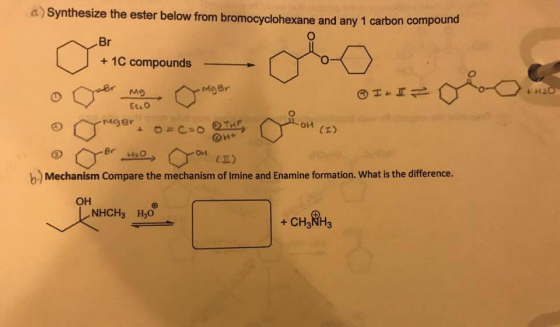
Organic Chemistry II Question: Please complete both parts a and b.
a.) Please show another way to synthesize this other than what I did. Synthesize the ester below from bromocyclohexane and any 1 carbon compound.
b.) Compare the mechanism of imine and enamine formation. What is the difference?
Homework Answers

Add Answer to:
Organic Chemistry II Question: Please complete
both parts a and b.
a.) Please show another way...
Organic Chemistry. Please answer all questions and show work 1. Provide a mechanism for the formation...
 Organic Chemistry. Please answer all
questions and show work
1. Provide a mechanism for the formation of the compound from
its biosynthetic precursors. (I believe it has to do with starting
units and extender units and built in a similar way that fatty
acids are made?)
2. How many signals would you expect to see in the
1HNMR and proton decoupled 13CNMR of the
polyketide (pictured above)?
11] A polyketide synthase leads to the formation of the following compound: OH
Organic Chemistry. Please answer all
questions and show work
1. Provide a mechanism for the formation of the compound from
its biosynthetic precursors. (I believe it has to do with starting
units and extender units and built in a similar way that fatty
acids are made?)
2. How many signals would you expect to see in the
1HNMR and proton decoupled 13CNMR of the
polyketide (pictured above)?
11] A polyketide synthase leads to the formation of the following compound: OH
Organic Chemistry question: 24. Please calculate the degrees of unsaturation for each compound below. Show or...
 Organic Chemistry question:
24. Please calculate the degrees of unsaturation for each compound below. Show or explain all work (4pts x 2 = 8 pts) a) C7H30 b) C7H11Br
Organic Chemistry question:
24. Please calculate the degrees of unsaturation for each compound below. Show or explain all work (4pts x 2 = 8 pts) a) C7H30 b) C7H11Br
organic chemistry- please help Show complete reaction conditions that are needed to prepare A, B, C,...
 organic chemistry- please help
Show complete reaction conditions that are needed to prepare A, B, C, D, E, and F from compound X and name each reaction. Generically designats cach product (24 pts): Reaction Name: Reaction Name: Product: Product: Х Reaction Name: Reaction Name: Product: Product: Reaction Name: Reaction Name: Product: Product:
organic chemistry- please help
Show complete reaction conditions that are needed to prepare A, B, C, D, E, and F from compound X and name each reaction. Generically designats cach product (24 pts): Reaction Name: Reaction Name: Product: Product: Х Reaction Name: Reaction Name: Product: Product: Reaction Name: Reaction Name: Product: Product:
Organic Chemistry 2 Please show detailed arrow-pushing mechanism. Best regards. B) Predict the products for the...
 Organic Chemistry 2
Please show detailed arrow-pushing
mechanism.
Best regards.
B) Predict the products for the reactions below (2 points per box, 4 points total section). MgBr SH Major product Major product
Organic Chemistry 2
Please show detailed arrow-pushing
mechanism.
Best regards.
B) Predict the products for the reactions below (2 points per box, 4 points total section). MgBr SH Major product Major product
Please Hurry up ?? CHOOSE THE CORRECT ANSWER Q1] Organic chemistry study (a) Properties of organic...
 Please Hurry up ??
CHOOSE THE CORRECT ANSWER Q1] Organic chemistry study (a) Properties of organic compounds (b) Reactions of organic compounds (c) syntheses of organic compounds (d) all above Q2] Tertiary Carbon is (a) carbon atom contact with four carbon atoms (b) carbon atom contact with two carbon atoms (c) carbon atom contact with three carbon atoms (d) carbon atom contact with one carbon atom Q3] One of these compounds contain quaternary carbon atom (a) 2,3-dimethylpentane (b) 3-methylhexane (c)...
Please Hurry up ??
CHOOSE THE CORRECT ANSWER Q1] Organic chemistry study (a) Properties of organic compounds (b) Reactions of organic compounds (c) syntheses of organic compounds (d) all above Q2] Tertiary Carbon is (a) carbon atom contact with four carbon atoms (b) carbon atom contact with two carbon atoms (c) carbon atom contact with three carbon atoms (d) carbon atom contact with one carbon atom Q3] One of these compounds contain quaternary carbon atom (a) 2,3-dimethylpentane (b) 3-methylhexane (c)...
Please note: This is 1 practice organic chemistry question with 6 parts to answer!!!! If you...
 Please note: This is 1 practice organic chemistry question with
6 parts to answer!!!! If you are unable to answer any of the parts
PLEASE leave question alone for the next expert!
Here are the 6 parts that require help:
1. Give full curved arrow pushing for the mechanism above.
2. Indicate if product is optically active or not..
3. Give a pictorial representation of the frontier molecular
orbital ON TOP of the provided structure for A and B.
4....
Please note: This is 1 practice organic chemistry question with
6 parts to answer!!!! If you are unable to answer any of the parts
PLEASE leave question alone for the next expert!
Here are the 6 parts that require help:
1. Give full curved arrow pushing for the mechanism above.
2. Indicate if product is optically active or not..
3. Give a pictorial representation of the frontier molecular
orbital ON TOP of the provided structure for A and B.
4....
Please note: This is 1 practice homework organic chemistry question with 4 parts in A-C to...
 Please note: This is 1 practice homework organic chemistry
question with 4 parts in A-C to answer!
1. Give full curved arrow pushing for the electrocyclic ring
closure reaction.
2. Indicate if product is achiral, meso compound or racemic.
3. Draw the HOMO of the reactant cation on top of the
structure.
4. To form your ALLOWED product, did the reaction proceed
conrotatary or disrotatory?
If you are unable to answer any of the parts PLEASE leave
question alone for...
Please note: This is 1 practice homework organic chemistry
question with 4 parts in A-C to answer!
1. Give full curved arrow pushing for the electrocyclic ring
closure reaction.
2. Indicate if product is achiral, meso compound or racemic.
3. Draw the HOMO of the reactant cation on top of the
structure.
4. To form your ALLOWED product, did the reaction proceed
conrotatary or disrotatory?
If you are unable to answer any of the parts PLEASE leave
question alone for...
organic chemistry lab help 2-4 please 2. What key IR and NMR absorptions would allow you...
 organic chemistry lab help 2-4 please
2. What key IR and NMR absorptions would allow you to determine that the products from the reactions above have been successfully synthesized? Ignore absorptions also found in the reactant 3. NaBH, usually reacts slowly or not at all with esters. Therefore, LiAlH, is often needed to reduce esters. Why do you think LiAlH, is more reactive than NaBH. (Hint: Compare the electronegativity of H versus Al or B). 93 4. Draw the mechanism...
organic chemistry lab help 2-4 please
2. What key IR and NMR absorptions would allow you to determine that the products from the reactions above have been successfully synthesized? Ignore absorptions also found in the reactant 3. NaBH, usually reacts slowly or not at all with esters. Therefore, LiAlH, is often needed to reduce esters. Why do you think LiAlH, is more reactive than NaBH. (Hint: Compare the electronegativity of H versus Al or B). 93 4. Draw the mechanism...
POST-LABORATORY EXERCISES mic Acid Oxidation of Cyclohexanol Chromic Acid Oxid 1. Suppose instead of ead of...
 POST-LABORATORY EXERCISES mic Acid Oxidation of Cyclohexanol Chromic Acid Oxid 1. Suppose instead of ead of using chromic acid as the oxidizing agent, you wed concentrated sulfuric acid. em to show the oxidation of cyclohexanol to cyclohexanone. W 1. Waite a mechanism to show the oxidatinast 개 wi 2. How would you carry out the following transformation? GENERAL EXPERIMENTAL ORGANIC CHEMIST action (If it has a name) and 3. Some of the reactions below are write the products of each...
please help me with Organic Chemistry/Alkenes problems. Thank you! Directions: Place your answers to the following...
 please help me with Organic Chemistry/Alkenes problems. Thank you!
Directions: Place your answers to the following questions in the spaces provided. 1. A common problem in the acid-catalyzed hydration of alkenes is the formation of an ether byproduct. Show the formation of the ether byproduct in relation to the reaction below by providing a curved-arrow mechanism for its formation. (2 pts) H30+ Н,0 OH Ans. 2. Which is the correct sequence of steps necessary to complete the following reaction? он...
please help me with Organic Chemistry/Alkenes problems. Thank you!
Directions: Place your answers to the following questions in the spaces provided. 1. A common problem in the acid-catalyzed hydration of alkenes is the formation of an ether byproduct. Show the formation of the ether byproduct in relation to the reaction below by providing a curved-arrow mechanism for its formation. (2 pts) H30+ Н,0 OH Ans. 2. Which is the correct sequence of steps necessary to complete the following reaction? он...
 Organic Chemistry. Please answer all
questions and show work
1. Provide a mechanism for the formation of the compound from
its biosynthetic precursors. (I believe it has to do with starting
units and extender units and built in a similar way that fatty
acids are made?)
2. How many signals would you expect to see in the
1HNMR and proton decoupled 13CNMR of the
polyketide (pictured above)?
11] A polyketide synthase leads to the formation of the following compound: OH
Organic Chemistry. Please answer all
questions and show work
1. Provide a mechanism for the formation of the compound from
its biosynthetic precursors. (I believe it has to do with starting
units and extender units and built in a similar way that fatty
acids are made?)
2. How many signals would you expect to see in the
1HNMR and proton decoupled 13CNMR of the
polyketide (pictured above)?
11] A polyketide synthase leads to the formation of the following compound: OH
 Organic Chemistry question:
24. Please calculate the degrees of unsaturation for each compound below. Show or explain all work (4pts x 2 = 8 pts) a) C7H30 b) C7H11Br
Organic Chemistry question:
24. Please calculate the degrees of unsaturation for each compound below. Show or explain all work (4pts x 2 = 8 pts) a) C7H30 b) C7H11Br
 organic chemistry- please help
Show complete reaction conditions that are needed to prepare A, B, C, D, E, and F from compound X and name each reaction. Generically designats cach product (24 pts): Reaction Name: Reaction Name: Product: Product: Х Reaction Name: Reaction Name: Product: Product: Reaction Name: Reaction Name: Product: Product:
organic chemistry- please help
Show complete reaction conditions that are needed to prepare A, B, C, D, E, and F from compound X and name each reaction. Generically designats cach product (24 pts): Reaction Name: Reaction Name: Product: Product: Х Reaction Name: Reaction Name: Product: Product: Reaction Name: Reaction Name: Product: Product:
 Organic Chemistry 2
Please show detailed arrow-pushing
mechanism.
Best regards.
B) Predict the products for the reactions below (2 points per box, 4 points total section). MgBr SH Major product Major product
Organic Chemistry 2
Please show detailed arrow-pushing
mechanism.
Best regards.
B) Predict the products for the reactions below (2 points per box, 4 points total section). MgBr SH Major product Major product
 Please Hurry up ??
CHOOSE THE CORRECT ANSWER Q1] Organic chemistry study (a) Properties of organic compounds (b) Reactions of organic compounds (c) syntheses of organic compounds (d) all above Q2] Tertiary Carbon is (a) carbon atom contact with four carbon atoms (b) carbon atom contact with two carbon atoms (c) carbon atom contact with three carbon atoms (d) carbon atom contact with one carbon atom Q3] One of these compounds contain quaternary carbon atom (a) 2,3-dimethylpentane (b) 3-methylhexane (c)...
Please Hurry up ??
CHOOSE THE CORRECT ANSWER Q1] Organic chemistry study (a) Properties of organic compounds (b) Reactions of organic compounds (c) syntheses of organic compounds (d) all above Q2] Tertiary Carbon is (a) carbon atom contact with four carbon atoms (b) carbon atom contact with two carbon atoms (c) carbon atom contact with three carbon atoms (d) carbon atom contact with one carbon atom Q3] One of these compounds contain quaternary carbon atom (a) 2,3-dimethylpentane (b) 3-methylhexane (c)...
 Please note: This is 1 practice organic chemistry question with
6 parts to answer!!!! If you are unable to answer any of the parts
PLEASE leave question alone for the next expert!
Here are the 6 parts that require help:
1. Give full curved arrow pushing for the mechanism above.
2. Indicate if product is optically active or not..
3. Give a pictorial representation of the frontier molecular
orbital ON TOP of the provided structure for A and B.
4....
Please note: This is 1 practice organic chemistry question with
6 parts to answer!!!! If you are unable to answer any of the parts
PLEASE leave question alone for the next expert!
Here are the 6 parts that require help:
1. Give full curved arrow pushing for the mechanism above.
2. Indicate if product is optically active or not..
3. Give a pictorial representation of the frontier molecular
orbital ON TOP of the provided structure for A and B.
4....
 Please note: This is 1 practice homework organic chemistry
question with 4 parts in A-C to answer!
1. Give full curved arrow pushing for the electrocyclic ring
closure reaction.
2. Indicate if product is achiral, meso compound or racemic.
3. Draw the HOMO of the reactant cation on top of the
structure.
4. To form your ALLOWED product, did the reaction proceed
conrotatary or disrotatory?
If you are unable to answer any of the parts PLEASE leave
question alone for...
Please note: This is 1 practice homework organic chemistry
question with 4 parts in A-C to answer!
1. Give full curved arrow pushing for the electrocyclic ring
closure reaction.
2. Indicate if product is achiral, meso compound or racemic.
3. Draw the HOMO of the reactant cation on top of the
structure.
4. To form your ALLOWED product, did the reaction proceed
conrotatary or disrotatory?
If you are unable to answer any of the parts PLEASE leave
question alone for...
 organic chemistry lab help 2-4 please
2. What key IR and NMR absorptions would allow you to determine that the products from the reactions above have been successfully synthesized? Ignore absorptions also found in the reactant 3. NaBH, usually reacts slowly or not at all with esters. Therefore, LiAlH, is often needed to reduce esters. Why do you think LiAlH, is more reactive than NaBH. (Hint: Compare the electronegativity of H versus Al or B). 93 4. Draw the mechanism...
organic chemistry lab help 2-4 please
2. What key IR and NMR absorptions would allow you to determine that the products from the reactions above have been successfully synthesized? Ignore absorptions also found in the reactant 3. NaBH, usually reacts slowly or not at all with esters. Therefore, LiAlH, is often needed to reduce esters. Why do you think LiAlH, is more reactive than NaBH. (Hint: Compare the electronegativity of H versus Al or B). 93 4. Draw the mechanism...
 POST-LABORATORY EXERCISES mic Acid Oxidation of Cyclohexanol Chromic Acid Oxid 1. Suppose instead of ead of using chromic acid as the oxidizing agent, you wed concentrated sulfuric acid. em to show the oxidation of cyclohexanol to cyclohexanone. W 1. Waite a mechanism to show the oxidatinast 개 wi 2. How would you carry out the following transformation? GENERAL EXPERIMENTAL ORGANIC CHEMIST action (If it has a name) and 3. Some of the reactions below are write the products of each...
 please help me with Organic Chemistry/Alkenes problems. Thank you!
Directions: Place your answers to the following questions in the spaces provided. 1. A common problem in the acid-catalyzed hydration of alkenes is the formation of an ether byproduct. Show the formation of the ether byproduct in relation to the reaction below by providing a curved-arrow mechanism for its formation. (2 pts) H30+ Н,0 OH Ans. 2. Which is the correct sequence of steps necessary to complete the following reaction? он...
please help me with Organic Chemistry/Alkenes problems. Thank you!
Directions: Place your answers to the following questions in the spaces provided. 1. A common problem in the acid-catalyzed hydration of alkenes is the formation of an ether byproduct. Show the formation of the ether byproduct in relation to the reaction below by providing a curved-arrow mechanism for its formation. (2 pts) H30+ Н,0 OH Ans. 2. Which is the correct sequence of steps necessary to complete the following reaction? он...
Most questions answered within 3 hours.
-
Where is the error in this code sequence?
String s1 = "Hello";
String s2 = "ello";...
asked 11 months ago -
Financial data for Joel de Paris, Inc., for last year
follow:
Joel de Paris, Inc.
Balance...
asked 11 months ago -
Consider this reaction:
Al2(SO4)3 (aq)+ BaCl3
(aq) Al2Cl6 (aq)- +
3BaSO4(s) . What is the...
asked 11 months ago -
Suppose that Savneet is considering increasing her
recent random sample from 20 car rentals to 40...
asked 11 months ago -
Trucks arrive at an unloading terminal at an average rate of 120
per hour.
Trucks arrive...
asked 11 months ago -
Why are methanol and ethanol completely soluble in water while
octanol is not very little soluble....
asked 11 months ago -
A facilities manager at a university reads in a research report
that the mean amount of...
asked 11 months ago -
When the CuSO4 is rehydrated by adding water to the anhydrous
compound, is this an endothermic...
asked 11 months ago -
A ray of sunlight is passing from diamond into crown glass; the
angle of incidence is...
asked 11 months ago -
A block of mass 0.249 kg is placed on top of a light, vertical
spring of...
asked 11 months ago -
how do the kidneys compensate in the presences of acidosis
a) trigger hyperventilate
b) reserve acid...
asked 11 months ago -
Question 501 pts
The rental rate of capital to the firm increases. Which of the
following...
asked 11 months ago